
Many seniors on Medicare struggle to afford their medications. Insulin, heart pills, diabetes drugs, and other essential prescriptions can cost hundreds of dollars a month. For those living on fixed incomes, these costs are unbearable. That’s where the Extra Help Program comes in. This federal program, officially called the Part D Low Income Subsidy (LIS), cuts prescription drug costs for low-income Medicare beneficiaries. In 2025, it saves the average enrollee about $6,200 a year. Yet, nearly 4.3 million eligible seniors still aren’t enrolled. If you or a loved one is struggling with medication costs, you need to know how to qualify-and how to apply.
Who Qualifies for Extra Help?
You don’t need to be broke to qualify. The program is designed for people with limited income and resources. In 2025, the income limits are $23,475 per year for a single person and $31,725 for a married couple living together. These numbers are based on your adjusted gross income (AGI) plus any tax-exempt interest you earned. That means if you get Social Security, a small pension, or interest from savings, it counts toward your total.
Resource limits are just as important. You can have up to $17,600 in resources as a single person or $35,130 if you’re married. Resources include money in bank accounts, stocks, bonds, mutual funds, and non-primary real estate. But here’s the key: your home, one car, personal belongings, and up to $1,500 set aside for burial expenses don’t count. Many people think they’re too rich because they own a house or have a car, but those assets are excluded.
Some income is also ignored. The first $20 of monthly income doesn’t count. The first $65 of earned income (like part-time work) is ignored, and half of anything over that is also excluded. If your child is in the military and sends you money, that doesn’t count either. These exclusions mean many seniors with slightly higher incomes still qualify.
How Do You Get Extra Help?
You might already have it without knowing. About 12.5 million Medicare beneficiaries were automatically enrolled in 2024 because they qualified through other programs. If you get Supplemental Security Income (SSI), have both Medicare and Medicaid, or are enrolled in a Medicare Savings Program (MSP), you’re automatically covered. No application needed. You’ll get a letter from Social Security confirming your enrollment.
If you don’t qualify automatically, you can apply in three ways:
- Online at ssa.gov/extrahelp (fastest method)
- By phone at 1-800-772-1213 (TTY: 1-800-325-0778), Monday through Friday, 8 a.m. to 5:30 p.m.
- In person at your local Social Security office
You’ll need to provide proof of income and resources. That means recent pay stubs, tax returns, bank statements, or retirement account balances. If you’re unsure what to submit, call Social Security first. They’ll tell you exactly what’s needed.
Processing takes about 3 to 6 weeks. But 87% of applications are handled within 21 days. If you’re approved, you’ll get a letter confirming your eligibility. Then, if you’re not already enrolled in a Part D plan, you’ll be automatically signed up for one with a $0 premium.
What Does Extra Help Actually Cover?
It’s not just a discount. It’s a full package of savings:
- No Part D premiums - You pay $0 for monthly premiums on any plan that offers them. In 2024, 2 to 7 such plans were available in each state.
- No deductible - The standard $595 Part D deductible is completely eliminated.
- Lower copays - If your income is at or below 100% of the Federal Poverty Level, you pay $1.60 for generics and $4.80 for brand-name drugs. If you’re between 100% and 150%, you pay up to $4.90 for generics and $12.15 for brand-name drugs.
- No late enrollment penalty - If you didn’t sign up for Part D when first eligible, you won’t be charged extra.
- Insulin cap at $35/month - Since 2025, all Extra Help beneficiaries get insulin for no more than $35 per prescription.
- $0 vaccines - Flu, pneumonia, and shingles shots are free.
These benefits combine to cut out-of-pocket drug spending by 83%, according to the Kaiser Family Foundation. For someone taking five or more prescriptions a month, that can mean saving over $500 a month.

Common Mistakes That Keep People From Qualifying
Many applications get denied for simple reasons:
- Overstating income - Including excluded income like child military payments or the first $20 of monthly income. This caused 18.3% of rejections in 2025.
- Miscounting resources - Listing your home, car, or personal items as assets. That’s wrong. Only cash, investments, and non-primary property count. This led to 14.7% of denials.
- Missing documents - Not submitting pay stubs, tax forms, or bank statements. About 22.1% of applications were incomplete.
If your application is denied, don’t give up. You can appeal. Call Social Security and ask for a reconsideration. Sometimes, a small correction-like removing an excluded asset-can turn a denial into approval.
What If You’re Just Above the Limit?
Even if your income or resources seem too high, you might still qualify. The limits are based on countable income and resources, not total. For example:
- If you earn $2,000 a month from Social Security and $300 from a part-time job, your countable income is $2,000 + ($300 - $65)/2 = $2,117.50 per month, or $2,541/year. That’s well under the $23,475 limit.
- If you have $18,000 in savings but $1,000 is in a burial fund, only $17,000 counts. You’re under the $17,600 limit.
Use the SSA’s new automated screening tool on ssa.gov/extrahelp. Launched in February 2025, it asks simple questions and tells you if you’re likely eligible. It’s designed to catch people who thought they didn’t qualify.
Why So Many People Miss Out
The Government Accountability Office found that 4.3 million eligible seniors aren’t enrolled. That’s $26.8 billion in unclaimed benefits every year. Why? Many think the program is too complicated. Others don’t know it exists. Some are ashamed to ask for help. But Extra Help isn’t welfare-it’s a benefit you paid for through Medicare taxes.
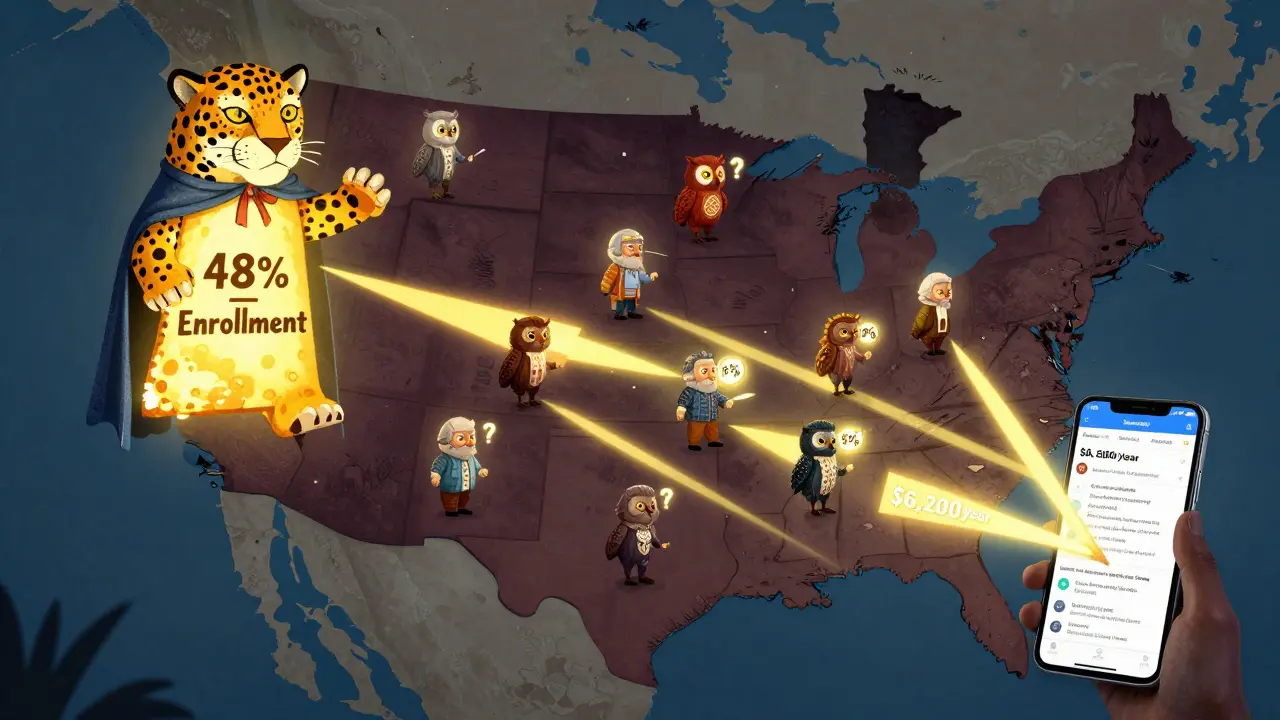
States vary widely in enrollment. Mississippi has the highest rate at 48% of Part D enrollees. Minnesota has the lowest at 23%. That gap isn’t about need-it’s about outreach. If you live in a state with low enrollment, you’re more likely to be missing out.
What Happens After You Apply?
If approved, you’ll get a letter from Social Security. Then:
- If you already have a Part D plan, your premiums and copays will be adjusted automatically.
- If you don’t have one, you’ll be enrolled in a plan with $0 premium. You can switch plans later if you want.
- Your pharmacy will see your Extra Help status when you fill prescriptions. You won’t pay full price.
- You’ll get a new Medicare card in the mail, showing your LIS status.
The whole process takes about 45 days from application to full benefits. There’s no gap in coverage. Even if you’re waiting for approval, you can still get drugs at reduced prices using the LINET program-offered by Humana-for up to two months while you wait.
Next Steps: What to Do Right Now
Don’t wait. If you’re a Medicare beneficiary and pay more than $50 a month for prescriptions:
- Go to ssa.gov/extrahelp and use the screening tool.
- Call 1-800-772-1213 and ask if you qualify.
- Gather your last tax return and bank statements.
- Apply online or in person. Don’t delay-every month you wait is another month paying full price.
Extra Help isn’t a handout. It’s a lifeline. And it’s there for you if you meet the simple rules. You’ve paid into Medicare your whole life. Now it’s time to claim what’s yours.
Do I need to reapply for Extra Help every year?
No. Once you’re approved, your eligibility is reviewed automatically each year. If your income or resources change significantly, Social Security will notify you. But most people don’t need to reapply unless they’re told to.
Can I get Extra Help if I have other insurance?
Yes. Extra Help works with other coverage like VA benefits, TRICARE, or employer plans. You can still get the full savings on your Medicare Part D drugs. But you must be enrolled in Medicare Part D to qualify.
What if I live in Alaska or Hawaii?
Income and resource limits are higher in Alaska and Hawaii due to the higher cost of living. In 2025, the income limit is $27,150 for individuals and $36,675 for couples. Resource limits are $20,100 and $40,170, respectively. Check with Social Security if you live in either state.
Can I apply if I’m not yet 65 but on Medicare because of disability?
Yes. Extra Help is available to anyone enrolled in Medicare Part D, regardless of age. That includes people under 65 who qualify due to disability or end-stage renal disease.
Will Extra Help affect my Medicaid or SSI benefits?
No. Extra Help does not reduce or eliminate your Medicaid or SSI benefits. In fact, if you get SSI, you’re automatically enrolled in Extra Help. The two programs are designed to work together.
Sanjana Rajan
March 19, 2026 AT 08:49Ugh, I can't believe people still don't know about this. My aunt in Delhi was paying $400/month for insulin until I helped her apply. Now she pays $35. Why is this not advertised on TV? It's not rocket science. Just fill out a form. Stop making it a big deal.
Kyle Young
March 19, 2026 AT 08:50It's fascinating how the structural design of this program reflects a deeper societal contract: that those who have contributed to the system through decades of payroll taxes are entitled to its benefits, not as charity, but as an obligation of reciprocity. The fact that 4.3 million are unenrolled speaks less to ignorance than to institutional fragmentation. The bureaucracy itself becomes a barrier to justice.
Aileen Nasywa Shabira
March 20, 2026 AT 12:45Oh wow, another government handout disguised as a 'lifeline.' Let me guess-next they'll be giving out free caviar to seniors who 'paid into Medicare.' Meanwhile, my tax dollars are funding people who have $18k in savings but claim they're 'poor' because their car is 'excluded.' This isn't help. It's entitlement on steroids.
lawanna major
March 20, 2026 AT 20:41There’s something deeply humane about a program that recognizes dignity in simplicity. The fact that your home, your car, your burial fund-things that represent stability, not wealth-are excluded shows this was designed by someone who actually understands what it means to be old and on a fixed income. This isn’t welfare. It’s justice. And if you’re hesitating because you think you don’t qualify? You probably do. The math is kinder than you think.
Use the tool. Call the number. Don’t wait until you’re skipping doses to act. You’ve earned this.
Melissa Starks
March 21, 2026 AT 14:10I’ve been helping elderly neighbors apply for this for years. One lady had $19k in savings because she was saving for a new furnace-she thought that disqualified her. I showed her the rules. Only $17,600 counts. She had $1,400 set aside for burial. That’s not wealth. That’s survival. And she cried when she found out she’d save $500 a month. We need more people like you, OP, explaining this. Not everyone has a grandkid who knows how to Google.
Also, the LINET program is a lifesaver. Don’t wait 6 weeks to get your meds. Use it. Pharmacies know about it. Ask for it. No shame.
And if you’re over the limit? Check again. The $20 monthly exclusion? The $65 earned income rule? Half of what’s left? Most people don’t even know that. It’s not about what you make. It’s about what counts.
Lauren Volpi
March 22, 2026 AT 01:37So let me get this straight-we’re giving free insulin to seniors who 'paid into Medicare' but the guy who worked 60 hours a week at Walmart since 1998 doesn’t get a damn thing? Classic. They don’t want to help the real working class. They want to help the ones who 'played by the rules.' Meanwhile, the rich are laughing all the way to the hospital with their private concierge care.
Melissa Stansbury
March 22, 2026 AT 02:45Wait-so if you have a car and a house you’re still eligible? I just applied for this and they asked for my bank statements and tax returns. I told them I live with my daughter and I don’t have a car because I sold it last year. They said I might qualify. I didn’t even know I could get insulin for $35. I’ve been cutting pills in half. This is insane. Why didn’t anyone tell me? I’m 72. I’ve been paying into this system since 1972. I feel like I’ve been punished for being frugal.
Amadi Kenneth
March 22, 2026 AT 09:03Wait... wait... wait. This program? It's a trap. Did you know the government uses your bank records to track your spending patterns? Once you apply, they flag your account for 'asset monitoring.' Next thing you know, they're auditing your Social Security, then your Medicare, then your children's tax returns. I know a man in Lagos who applied-his daughter lost her job because they 'reviewed her income' under 'household resources.' This isn't help. It's surveillance with a smiley face.
And why is the website so clean? Too clean. No typos? No broken links? That's a phishing site. I'm not applying. I'm not trusting. I'm not giving them my data.
Nilesh Khedekar
March 23, 2026 AT 20:01Bro, this is so simple. My uncle in Mumbai got this. He thought he made too much because he gets $1,200 from Social Security and $200 from rent. But they only count half of the rent after $65. So $135 left? Half is $67.50. Total countable income? $1,267.50/month. That's $15,210/year. Way under $23k. He got approved. No drama. Just paperwork. Stop overthinking. Just go to ssa.gov. Do it. Your meds are worth it.
Michelle Jackson
March 25, 2026 AT 05:31I applied last year. Got denied. Called them. They said I listed my car as an asset. I didn't. I swear I didn't. They said I had $18k in savings. I had $16k. I had $1k in a burial fund. I didn't mention it. They counted it anyway. I had to file an appeal. Took 3 months. They finally fixed it. Don't trust the online form. Call them. Say 'I need a reconsideration.' They'll help. Don't let them screw you over.