Why So Many People Still Don’t Trust Generic Drugs
You walk into the pharmacy, pick up your prescription, and notice something’s off. The pill looks different-smaller, white instead of blue, no logo on it. You ask the pharmacist, "Is this the same as the one I used to get?" They say yes. But you’re not sure. You’ve heard stories. Maybe a neighbor said their blood pressure spiked after switching. Or your aunt swore her arthritis got worse. You leave with the pills, but you’re uneasy.
This isn’t just about confusion. It’s a widespread belief that generic drugs are somehow less safe, less effective, or even fake. And it’s costing people their health-and money.
The truth? Generic drugs are not cheaper because they’re worse. They’re cheaper because they don’t need to spend millions on advertising or re-proving what’s already known. The U.S. Food and Drug Administration (FDA) requires every generic drug to have the exact same active ingredient, strength, dosage form, and route of administration as the brand-name version. And they must prove it works the same way in your body. That’s not a guess. It’s science.
How the FDA Proves Generics Work the Same
Before a generic drug hits the shelf, it goes through a strict review process. The FDA doesn’t just look at the ingredients. They test how your body absorbs it. This is called bioequivalence testing. The generic must deliver between 80% and 125% of the active ingredient compared to the brand-name drug. That’s not a wide range-it’s tight. It means your body gets nearly the same amount of medicine, every time.
These tests aren’t theoretical. They’re done on real people. Volunteers take both the brand and generic versions under controlled conditions. Scientists measure blood levels over time using two key numbers: Cmax (the highest concentration) and AUC (how much medicine is absorbed overall). If both fall within that 80-125% window, the FDA approves it. This isn’t a shortcut. It’s a proven method used for over 40 years.
And it works. In 2022, 90.8% of all prescriptions filled in the U.S. were for generic drugs. That’s over 6.8 billion prescriptions. If generics were unreliable, that number would be falling. Instead, it’s rising.
The Real Cost Difference-And Why It Matters
Generic drugs cost 80% to 85% less than brand-name drugs. On average, a 30-day supply of a brand-name medication might cost $150. The generic? Around $25. That’s not a small difference. For people on fixed incomes, on Medicare, or without good insurance, that gap means choosing between medicine and groceries.
The savings add up fast. In 2022 alone, generic drugs saved the U.S. healthcare system $377 billion. That’s money that stays in patients’ pockets, reduces insurance premiums, and helps clinics afford more services.
But here’s the catch: many patients don’t know this. A 2016 CVS Health study found that 87% of people had misconceptions about generics. Half believed they were less effective. A third thought they were made in lower-quality factories. Some even thought they were "second-rate." These aren’t facts-they’re myths. And they’re being passed along like gossip.
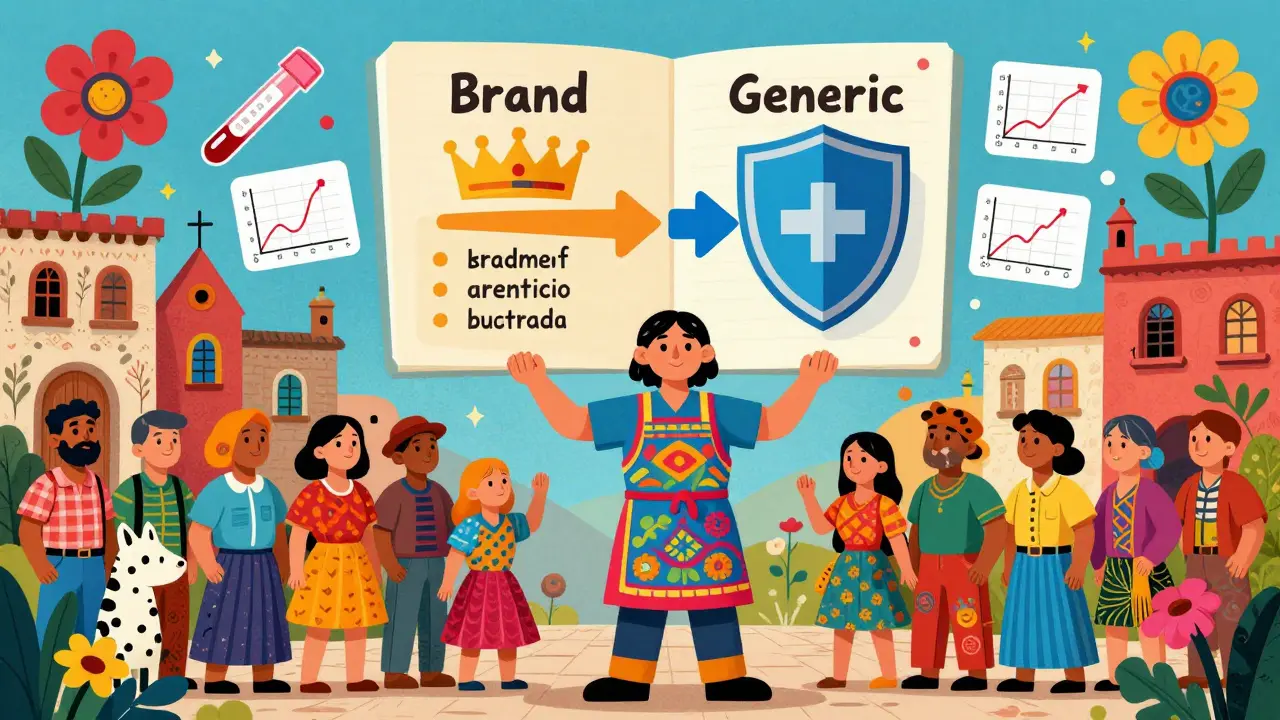
Why Patients Still Hesitate-Even When Doctors Recommend Generics
It’s not just about price. It’s about perception. The shape, color, and size of pills change when you switch from brand to generic. That’s because the inactive ingredients-like dyes and fillers-are different. But those don’t affect how the medicine works. They’re just there to make the pill look different so companies don’t copy the brand’s appearance exactly.
Still, 23% of patients surveyed by the University of Michigan said they questioned whether their medication was right just because it looked different. That’s a big problem.
Even worse, some patients experience side effects they didn’t have before-not because the drug changed, but because they believed it would. This is called the nocebo effect. A 2021 study in Annals of Internal Medicine found that patients told they were getting a generic drug were 18.7% more likely to stop taking it due to side effects, even when they were actually taking the brand-name version the whole time.
And then there’s the prescriber factor. When doctors say, "This generic is just as good," patient acceptance jumps from 52% to 89%. But not all doctors say it. Some still default to brand names out of habit, or because they’re unsure how to explain the difference. That silence speaks louder than words.
What Works: Real Tools for Community Health Workers
Community health centers are on the front lines. They’re where people go when they can’t afford specialists, when insurance is confusing, or when they don’t know where else to turn. That’s why the FDA created the Generic Drugs Stakeholder Toolkit-a free, ready-to-use set of resources for nurses, pharmacists, and community educators.
It includes:
- Fact sheets in English and Spanish
- Short videos showing how generics are tested
- Infographics comparing brand and generic pills side by side
- Provider scripts that use simple, clear language
One key strategy? The "Teach-Back" method. Instead of just saying, "This is safe," ask: "Can you tell me in your own words why this generic is the same as your old pill?" This simple trick has been shown to improve patient understanding by 28-42%.
At the Community Health Center of Burlington, staff started using these tools in 2021. Within six months, patient acceptance of generics rose by 37%. People stopped calling in to complain about pill color. They started asking, "Is there a cheaper version?"
Where Generics Still Face Resistance
Most of the time, generics work just fine. But there are exceptions-and they matter.
For drugs like those used to treat epilepsy, even tiny changes in blood levels can matter. A 2023 study in Epilepsy & Behavior found a slightly higher rate of seizures when patients switched from brand to generic antiepileptic drugs. That’s why neurologists often recommend sticking with one version-brand or generic-as long as it’s working. But this is rare. It affects less than 1% of all generic prescriptions.
The American Academy of Neurology says this doesn’t mean generics are unsafe. It means some drugs need more careful monitoring. That’s not a failure of the system-it’s a reason to be more thoughtful, not more afraid.
Another challenge? Complex generics. Inhalers, creams, eye drops, and injectables are harder to copy exactly. The FDA is working on new standards for these, but patient confusion is higher. A 2023 survey found 40% more people were unsure about these types of generics. That’s why education needs to be specific-not just "generics are good," but "this inhaler works the same as the brand because..."
The Bigger Picture: Health Equity and Access
Generics aren’t just about saving money. They’re about saving lives.
A 2021 study in Health Affairs tracked 3.2 million low-income patients. Those who switched to generics improved their medication adherence by 22%. Why? Because they could actually afford to take them. No more skipping doses. No more splitting pills. No more choosing between medicine and bus fare.
This is why the National Association of Community Health Centers now requires all patient counseling sessions to include generic drug education-starting January 2024. It’s not optional. It’s part of basic care.
And it’s working. In urban areas, 93% of prescriptions are generic. In rural areas? Only 78%. That gap isn’t about access to pharmacies. It’s about access to information. People in small towns don’t have the same exposure to public health campaigns. That’s why community presentations are so vital.
What’s Next? More Education, More Trust
The FDA launched "Generics 101" in 2023-a video series made for Medicare beneficiaries. Early results show a 31% improvement in knowledge among viewers over 65. That’s huge. Older adults are the biggest users of prescription drugs. They’re also the most likely to be confused by pill changes.
And starting January 1, 2025, Medicare Part D plans will be required to give standardized generic education materials to every beneficiary. That means every person on Medicare will get clear, consistent information-not just when they ask, but when they’re handed their prescription.
The message is simple: generics are not a compromise. They’re a smart choice. They’re safe. They’re effective. And they’re saving billions of dollars every year.
The next time you see someone hesitant about a generic, don’t assume they’re stubborn. They’ve been told the wrong thing for too long. Give them the facts. Show them the proof. Let them see the difference it makes in their wallet-and their health.
What You Can Do Today
- Ask your pharmacist: "Is there a generic version of this?" If they say no, ask why.
- If your doctor prescribes a brand-name drug, ask: "Is there a generic that works just as well?"
- Don’t judge a pill by its color. The active ingredient is what matters.
- Share FDA’s free resources with friends and family. Visit their website or ask your clinic for materials.
- If you’re a community health worker, use the FDA’s Stakeholder Toolkit. It’s free, evidence-based, and ready to use.
Generics aren’t the future of medicine. They’re the present. And they’re working.
Kacey Yates
January 29, 2026 AT 08:15My mom took generic lisinopril for 8 years her BP was perfect
Stop letting pharma scare you with fancy colors
ryan Sifontes
January 29, 2026 AT 11:05FDA is just a paid shill for big pharma
My cousin took generic metformin and his liver exploded
Laura Arnal
January 29, 2026 AT 17:04My doc showed me the bioequivalence charts and I was sold
Generics saved me $200 a month and my diabetes is under control
You’re not losing anything by trying them
Trust the data not the fear
Eli In
January 30, 2026 AT 23:27People here act like it’s a lottery
It’s not magic it’s chemistry
Same molecule same effect
Let’s stop stigmatizing affordability 🌍❤️
Sheryl Dhlamini
January 31, 2026 AT 04:41He thought he got the wrong medicine
It’s not about the drug it’s about control
We’ve been trained to equate appearance with authenticity
That’s a marketing problem not a medical one
Doug Gray
January 31, 2026 AT 10:06Pharmacokinetic variance across populations is not adequately accounted for in the FDA’s model
There’s a latent epistemological gap between regulatory compliance and individual physiological fidelity
Kristie Horst
February 1, 2026 AT 17:23How novel. How refreshing. How utterly… inconvenient for the narrative we’ve all been sold.
Let’s just all take a deep breath and thank the scientists who actually did the work instead of the marketers who sold us the fear.
Andy Steenberge
February 1, 2026 AT 21:04People aren’t just accepting generics-they’re relying on them
And the data backs it up: adherence improves, hospitalizations drop, costs fall
It’s not a hypothesis. It’s a public health win
Stop treating science like it’s optional
DHARMAN CHELLANI
February 3, 2026 AT 02:53India makes 40% of the world’s generics
And you’re still scared of a white pill?
Pathetic
Keith Oliver
February 4, 2026 AT 03:21Brand name pills are a ritual. A symbol of care.
Switching to generic feels like being replaced by a robot.
That’s not ignorance. That’s grief.
Robin Keith
February 4, 2026 AT 17:18Because what if the data is manipulated?
What if the volunteers are paid to say it’s fine?
What if the labs are compromised?
What if the FDA is just another corporate arm?
What if the 80-125% range is just a loophole for lazy chemistry?
What if… what if… what if…
I’m not anti-science. I’m anti-gullibility.
LOUIS YOUANES
February 5, 2026 AT 21:39Didn’t feel a thing
But I still feel weird taking them
Like I’m cheating my body somehow
Maybe I just need to get over it
Laia Freeman
February 6, 2026 AT 15:19SHE SAID SHE’S BEEN TAKING THE SAME BLUE PILLS FOR 15 YEARS AND SHE’S AFRAID TO CHANGE
WE NEED MORE OF THIS STUFF IN CLINICS AND CHURCHES AND BARBERSHOPS
NOT JUST ON WEBSITES
WE NEED TO TALK TO PEOPLE LIKE HUMANS