
When a generic drug hits the market, you expect it to work just like the brand-name version. But how do regulators know it actually does? For simple pills, checking peak concentration (Cmax) and total drug exposure (AUC) was enough. But for complex formulations-like extended-release pain meds, abuse-deterrent opioids, or slow-release heart drugs-those old metrics often miss the real story. That’s where partial AUC comes in.
Why Traditional Metrics Fail for Modern Drugs
The classic bioequivalence test looks at two things: how fast the drug reaches its highest level in your blood (Cmax), and how much total drug your body absorbs over time (AUC). These work fine for immediate-release tablets. But when a drug is designed to release slowly over hours, or has multiple release phases, Cmax and total AUC can look identical between two products-even if one releases too fast early on, or too slow later.Imagine two painkillers. Both have the same total amount of drug absorbed over 12 hours. But one releases 70% of its dose in the first two hours. The other releases only 20% in that same window. The first gives quick relief. The second doesn’t. Total AUC says they’re the same. But for someone in pain, they’re not. That’s the gap partial AUC was built to fill.
What Is Partial AUC (pAUC)?
Partial AUC, or pAUC, is a pharmacokinetic tool that zooms in on a specific part of the drug’s absorption curve-not the whole thing. Instead of measuring total exposure from time zero to infinity, you pick a clinically meaningful window. Maybe it’s the first 2 hours after dosing. Or the time when drug levels are above 50% of the peak. Or the interval right after absorption starts, before distribution kicks in.The goal? To catch differences in how fast or how early a drug enters the bloodstream. That’s critical for drugs where timing affects safety or effectiveness. For example:
- Abuse-deterrent opioids: If a generic releases too quickly when crushed, it can be snorted or injected. pAUC checks early exposure to make sure it matches the brand.
- Extended-release ADHD meds: If the drug doesn’t kick in within the first hour, a child may struggle in school before the full dose kicks in.
- Cardiovascular drugs: A delayed rise in concentration could mean a missed window for preventing a heart event.
Regulators like the FDA and EMA started pushing for pAUC around 2013. The European Medicines Agency was the first to formally recommend it for prolonged-release products. The FDA followed, especially after a 2017 workshop highlighted how traditional metrics failed to predict clinical outcomes for complex formulations.
How Is pAUC Calculated?
There’s no single way to define the time window for pAUC. The FDA says it should be tied to a clinically relevant pharmacodynamic effect-meaning the time when the drug starts working in the body. But in practice, three common methods are used:- Time-based cutoff: Measure exposure from time zero to, say, 2 hours or 4 hours.
- Cmax-based cutoff: Measure the area under the curve until drug concentration drops to 50% of the peak level.
- Tmax-based cutoff: Use the average time to peak concentration (Tmax) of the reference product as the endpoint.
Once the window is set, the area under the curve within that window is calculated. Then, like traditional bioequivalence, you compare the test product to the reference using a 90% confidence interval. The rule? The ratio of test to reference must stay between 80% and 125%.
But here’s the catch: pAUC is more variable than total AUC. Because you’re looking at a smaller slice of the curve, small differences in sampling times or individual metabolism can throw off the numbers. That’s why studies using pAUC often need bigger sample sizes-sometimes 25% to 40% larger than traditional studies.
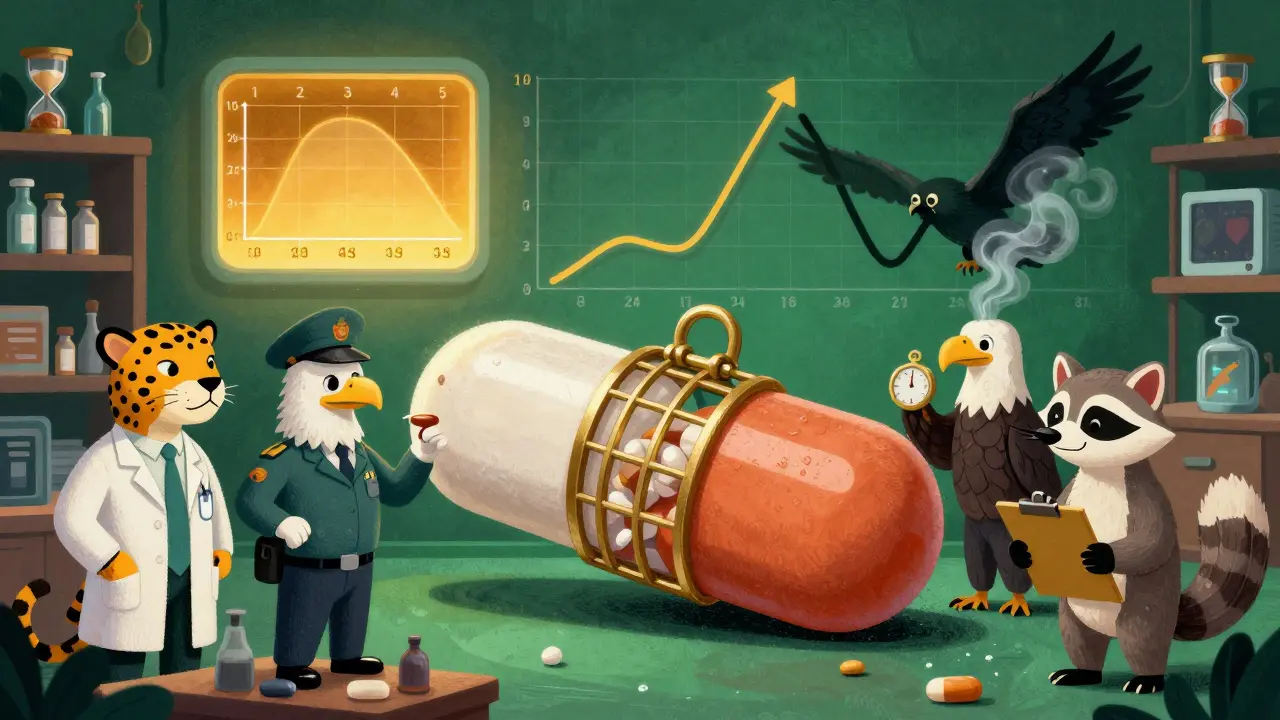
Real-World Impact: When pAUC Prevented a Dangerous Generic
In 2021, a case study presented at the American Association of Pharmaceutical Scientists showed how pAUC caught a dangerous mismatch. A generic version of an extended-release painkiller looked perfectly bioequivalent under standard Cmax and AUC tests. But when researchers ran a pAUC analysis for the first 3 hours, they found a 22% lower exposure compared to the brand. That meant patients might not get enough pain relief in the critical early hours after dosing. The generic was pulled before it reached the market.That’s not an isolated case. FDA inspection reports from 2022 show 17 ANDA submissions were rejected because companies used the wrong time window for pAUC. One company picked a cutoff based on their own product’s Tmax, not the reference. Another used a fixed time interval without clinical justification. These aren’t technical glitches-they’re failures in understanding the science behind the metric.
Who Uses pAUC? And Why Is It Growing?
pAUC isn’t used for every generic drug. It’s reserved for the most complex formulations. As of 2023, about 127 specific drug products require pAUC in their FDA product-specific guidance. That’s up from just a handful in 2015. The biggest growth areas:- Central nervous system drugs: 68% of new submissions now include pAUC.
- Pain management: 62% use it, especially for opioids.
- Cardiovascular agents: 45% require it due to timing-sensitive effects.
Big pharma and large generic manufacturers are the main users. Only 8% of pAUC studies are done by small companies. Why? Because it’s expensive. One biostatistician from Teva reported that adding pAUC to an extended-release opioid study increased their sample size from 36 to 50 subjects-and added $350,000 to development costs. But they say it saved them from a potential clinical failure.
Specialized contract research organizations (CROs) like Algorithme Pharma have built entire service lines around pAUC analysis. Their proprietary software helps define time windows and manage variability. The market for bioequivalence testing hit $2.8 billion in 2022-and pAUC is driving a big chunk of that growth.

The Challenges: Variability, Uncertainty, and Global Inconsistency
Despite its value, pAUC isn’t easy. Many generic developers complain about the lack of standardization. The FDA’s product-specific guidances vary wildly. Only 42% of them clearly explain how to pick the right time window. Some say use Tmax. Others say use 50% of Cmax. Some don’t specify at all.This uncertainty forces companies to run multiple pilot studies just to figure out the right approach. A 2022 survey found that 63% of biostatisticians needed extra statistical help for pAUC-compared to just 22% for traditional metrics. Training takes 3 to 6 months. Most bioequivalence specialists now list pAUC as a required skill in job postings.
And it’s not just a U.S. problem. The EMA, Health Canada, and other agencies have their own rules. The International Consortium for Innovation and Quality in Pharmaceutical Development found that inconsistent pAUC requirements across countries add 12 to 18 months to global drug development timelines. That’s billions in lost time and money.
What’s Next for pAUC?
The FDA is working on solutions. In early 2023, they launched a pilot program using machine learning to predict optimal pAUC time windows based on historical reference product data. The goal? To make it less subjective. If successful, this could lead to standardized cutoffs for entire drug classes-like all extended-release oxycodone products.By 2027, Evaluate Pharma predicts that 55% of new generic approvals will require pAUC. That’s more than double the 2022 rate. It’s becoming the new baseline for complex drugs.
Experts agree: pAUC isn’t a trend. It’s a necessary evolution. As drug delivery systems get more sophisticated, so must the tools we use to test them. The old metrics served us well. But for today’s medicines, they’re no longer enough.
Is partial AUC required for all generic drugs?
No, partial AUC is only required for specific complex formulations-like extended-release, abuse-deterrent, or multi-phase drugs. For simple immediate-release tablets, traditional Cmax and AUC are still sufficient. Regulators only ask for pAUC when the standard metrics can’t reliably predict therapeutic equivalence.
How is the time window for partial AUC chosen?
The time window should be tied to a clinically relevant effect. For example, if a drug needs to work within the first hour, the pAUC might cover 0 to 1 hour. The FDA recommends using data from the reference product-like its Tmax (time to peak) or the time when concentration drops to 50% of Cmax. There’s no universal rule, which is why many submissions get rejected for using arbitrary cutoffs.
Why does pAUC require larger study sizes?
Because pAUC looks at a smaller portion of the concentration-time curve, it’s more sensitive to variability in absorption between individuals. Small differences in when the drug peaks or how fast it’s absorbed can create bigger fluctuations in the calculated area. To maintain statistical power, studies often need 25-40% more participants than those using total AUC.
Can pAUC replace total AUC entirely?
No. pAUC is an additional tool, not a replacement. Regulators still require total AUC and Cmax for most products. pAUC is used alongside them to catch differences that those metrics miss-especially in the absorption phase. Think of it as adding a magnifying glass to an already detailed picture.
What software is used to calculate partial AUC?
Most companies use specialized pharmacokinetic software like Phoenix WinNonlin, NONMEM, or R packages with PK libraries. These tools allow users to define custom time intervals and apply the correct statistical methods-like the Bailer-Satterthwaite-Fieller approach-for calculating confidence intervals. Many CROs have built internal templates to streamline the process.
Gary Mitts
February 1, 2026 AT 15:49So now we need a PhD just to know if a pain pill works? Cool. I’ll just stick with Tylenol.
Bridget Molokomme
February 2, 2026 AT 06:31LOL the FDA spent $350k to find out that a generic shouldn’t dump all its drug in 2 hours? Bro, that’s not science, that’s common sense. And yet here we are.
jay patel
February 2, 2026 AT 07:43Man i read this whole thing and i am just blown away. Like seriously, how come we didnt think of this before? I mean, if your painkiller releases too fast you get high too quick and then crash, if too slow you still hurt. Its not just math its lifesaving. And the part about the 22% drop in first 3 hours? That could mean someone goes from pain relief to ER in minutes. And the fact that small companies cant afford this? Thats the real tragedy. Big pharma gets rich while the little guys get left behind. We need more funding for generics that actually work, not just ones that pass the old tests. This is why i love science when its done right. Not just to check boxes but to save real people. Also i think we need a meme about this. Like a cat on a skateboard with the caption 'when your generic hits like a brick instead of a whisper'.
Hannah Gliane
February 3, 2026 AT 00:08Ohhh so now we need 50 people instead of 36? 😭 I guess my $12 generic is gonna cost $40 now. Great. Just what we needed. Another reason to hate Big Pharma. Also can we please stop calling it 'partial AUC'? Sounds like a bad sci-fi movie. Call it 'early-bird exposure' or something. I'm tired of jargon pretending to be science.
Murarikar Satishwar
February 4, 2026 AT 13:14This is actually one of the most important developments in generic drug regulation in the last decade. The fact that regulators are finally recognizing that total AUC can mask clinically significant differences in release profiles is a huge win for patient safety. The variability issue is real, yes, but that’s why we need better sampling protocols and more robust statistical modeling-not less scrutiny. And while cost is a concern, the alternative-patients receiving ineffective or unsafe formulations-is far more expensive in human and economic terms. The growth in CNS and cardiovascular applications shows this isn’t just a niche tool anymore. It’s becoming essential. We should be investing in training and standardization, not complaining about sample sizes.
Dan Pearson
February 4, 2026 AT 22:49USA invented this shit and now Europe and India are crying about it? Classic. We’ve been doing this right since 2013 while the rest of the world was still using slide rules. If you can’t afford the study, maybe you shouldn’t be making pills. This isn’t a hobby, it’s medicine. And if your generic doesn’t match the brand’s early release? Then it’s not a generic-it’s a gamble. We don’t need cheaper drugs. We need safe ones. And guess what? America leads. Again. 🇺🇸
Bob Hynes
February 5, 2026 AT 04:28So… we’re basically saying that if your painkiller doesn’t kick in before your coffee cools, you’re screwed? I love how science is finally catching up to what patients have been screaming for years. Also, the fact that Canada’s rules are different from the US? That’s just chaos. I once got a generic that made me feel like a zombie for 4 hours. Turns out, it released too slow. No one told me. No one tested it right. This pAUC thing? It’s not just numbers-it’s dignity. And yeah, I’m Canadian. But even I’ll say: America got this one right. 🙌
Brett MacDonald
February 5, 2026 AT 18:53It’s funny how we think of drugs as magic pills but never question how they behave inside us. We want the result, not the process. But here we are, measuring time windows like astronomers tracking stars. Maybe the real breakthrough isn’t the math-it’s the humility. We used to think we understood absorption. Turns out, we were just lucky. Now we’re learning to see the invisible. And maybe… that’s what science really is.