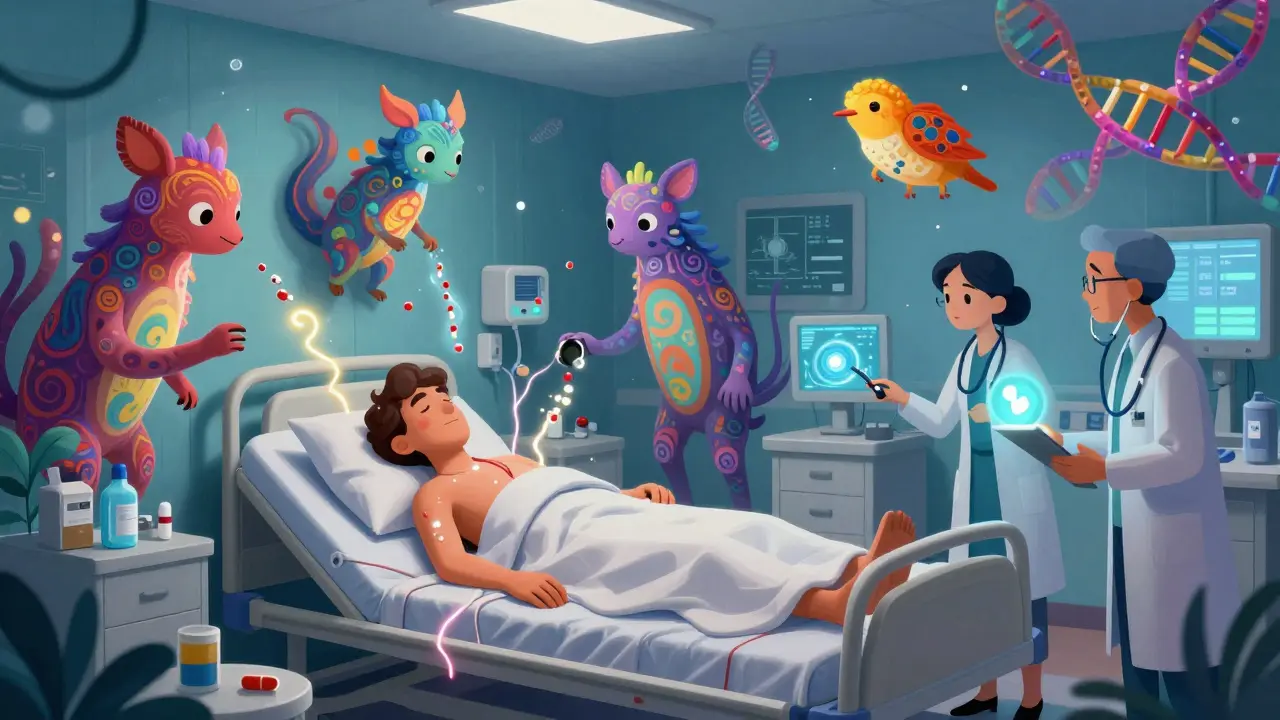
When you’ve had a serious reaction to a drug-like hives, trouble breathing, or anaphylaxis-it’s natural to assume you’ll never be able to take it again. But what if that drug is the only one that can save your life? What if it’s the only chemotherapy that works for your cancer, the only antibiotic that clears your cystic fibrosis infection, or the only biologic that controls your rheumatoid arthritis? That’s where drug desensitization comes in. It’s not a cure. It’s not a workaround. It’s a carefully controlled medical procedure that lets you temporarily tolerate a drug your body has learned to attack.
What Drug Desensitization Actually Does
Drug desensitization doesn’t change your immune system. It doesn’t erase your allergy. Instead, it temporarily tricks your body into ignoring the drug’s presence. By giving you tiny, increasing doses over several hours, your immune cells don’t have time to mount a full reaction. Think of it like slowly turning up the volume on a song that used to hurt your ears-eventually, your brain stops reacting to the noise. This technique works for IgE-mediated allergies (the kind that cause anaphylaxis) and even some non-IgE reactions like aspirin-exacerbated respiratory disease. It’s been used successfully for antibiotics like penicillin, chemotherapy drugs like carboplatin, monoclonal antibodies like rituximab, and even aspirin and NSAIDs. The key? You must be under direct medical supervision. No at-home attempts. No shortcuts. This is not something you can do on your own.Who Can and Can’t Be Desensitized
Not everyone with a drug allergy qualifies. The most important rule: if you’ve had a severe skin reaction like Stevens-Johnson syndrome, toxic epidermal necrolysis, or erythema multiforme with blistering and skin peeling, desensitization is not safe. These are life-threatening conditions tied to immune system overreaction, and repeating the drug-even in tiny amounts-could trigger it again. Other absolute no-gos include:- History of drug-induced hepatitis or nephritis
- Serum sickness reactions (fever, joint pain, rash that shows up days after taking the drug)
- Uncontrolled asthma or unstable cardiovascular disease
How the Procedure Works Step by Step
Desensitization isn’t one-size-fits-all. The protocol depends on the drug, the route of administration, and your reaction history. But most follow a similar pattern. For intravenous drugs (like antibiotics or chemo), the most common method is a 12-step protocol. You start with a dose that’s 1/10,000th of your full therapeutic dose. Each step doubles the amount, with 20 to 30 minutes between doses. By the end, you’ve received the full dose-usually in 5 to 6 hours. For oral drugs like aspirin or NSAIDs, the process is slower. Doses are given every hour, sometimes over multiple days. A full aspirin desensitization can take up to three days. Why? Because the gut absorbs drugs more slowly than veins, and the immune response needs more time to adjust. Here’s a simplified example of a typical IV protocol:- Step 1: 0.001 mL of 1:10,000 dilution
- Step 2: 0.002 mL of 1:10,000 dilution
- Step 3: 0.004 mL of 1:10,000 dilution
- Step 4: 0.008 mL of 1:10,000 dilution
- Step 5: 0.016 mL of 1:1,000 dilution
- Step 6: 0.032 mL of 1:1,000 dilution
- Step 7: 0.064 mL of 1:100 dilution
- Step 8: 0.128 mL of 1:100 dilution
- Step 9: 0.256 mL of undiluted drug
- Step 10: 0.512 mL of undiluted drug
- Step 11: 1.024 mL of undiluted drug
- Step 12: Full therapeutic dose
What Happens During and After
You’ll be in a hospital or specialized allergy clinic with a team ready to respond to emergencies. Epinephrine, IV steroids, antihistamines, and oxygen are all within arm’s reach. Nurses watch you constantly. A doctor is on-site. Once you reach the full dose, you’ll usually stay for another hour or two to make sure you don’t have a delayed reaction. Then you’re sent home with instructions: you must keep taking the drug daily. If you stop for more than 48 hours, your tolerance can vanish. That means if you miss a dose, you’ll need to restart the entire desensitization process. This is why it’s only done when the drug is essential and there are no alternatives. You can’t desensitize yourself to a drug you only take once a year. It’s meant for ongoing treatment-like daily antibiotics for cystic fibrosis, weekly chemo for cancer, or monthly biologics for autoimmune disease.
Success Rates and Real-World Impact
When done right, desensitization works in over 90% of cases. At Brigham and Women’s Hospital, patients with cancer who were allergic to their chemotherapy were able to complete their treatment plans-many of whom would have otherwise had to switch to less effective, more toxic drugs. For some, it meant the difference between life and death. In rheumatology, patients allergic to infliximab or rituximab were able to continue treatment for Crohn’s disease or lupus. In infectious disease, cystic fibrosis patients allergic to carbapenems avoided lung damage by staying on their lifesaving antibiotics. The American Academy of Allergy, Asthma & Immunology (AAAAI) updated its guidelines in 2022 to reflect how common these reactions have become. With newer targeted therapies-like immune checkpoint inhibitors and tyrosine kinase inhibitors-more patients are developing allergies to drugs that are otherwise irreplaceable. Desensitization isn’t a niche procedure anymore. It’s becoming standard care.Why You Can’t Do This at Home
Some people think, “I’ve had a mild reaction before. I can handle a little more.” That’s dangerous thinking. Even if your last reaction was just a rash, the next one could be anaphylaxis. And if you’re alone, you won’t have epinephrine, oxygen, or a doctor to stabilize you. The procedure requires:- Specialized training in allergy management
- Immediate access to emergency medications
- Continuous monitoring equipment
- A written, personalized protocol for your specific drug and history
What Happens If You React During the Process
Reactions during desensitization aren’t rare-but they’re manageable. If you develop mild symptoms like itching or a runny nose, the team will stop the infusion, give you antihistamines, and wait. Then they might slow down the dosing-increasing the time between steps or using smaller increments. If you have more serious symptoms-low blood pressure, wheezing, swelling-you’ll get epinephrine and steroids immediately. The procedure is paused until you’re stable. Then, depending on your response, they might restart at a lower dose or abandon the attempt altogether. It’s not failure. It’s safety. The goal isn’t to push through symptoms. It’s to find the safest path to the full dose.
Is This Permanent?
No. And that’s critical to understand. Desensitization is temporary. Your body doesn’t relearn the drug as safe-it just stops reacting while you’re being exposed to it. Once you stop taking the drug for more than 48 hours, your allergy can come back. That’s why patients on long-term therapy-like daily antibiotics or weekly biologics-can stay on desensitization indefinitely. But if you need the drug only once, like for a single surgery, you’ll need to repeat the entire process before each use.Where to Find a Desensitization Program
These programs aren’t available everywhere. They’re concentrated in major academic medical centers with allergy-immunology departments. In the UK, you’d typically be referred to a specialist center like the Royal Free Hospital in London or the Manchester Royal Infirmary. In the US, centers like Brigham and Women’s Hospital, the Asthma Center, and others have dedicated desensitization units. Your allergist or oncologist can refer you. But don’t wait. These programs often have waiting lists. Start the conversation early, especially if you’re about to begin a new treatment.Bottom Line
If you’ve been told you can never take a life-saving drug again because of an allergy, ask: “Is desensitization an option?” It’s not a last resort. It’s a proven, safe, and often essential tool. Thousands of people get through it every year. They go back to work. They finish chemo. They breathe easier. They live longer. It’s not easy. It’s not quick. But when done under expert supervision, it’s one of the most powerful interventions in modern allergy medicine.Can you desensitize to any drug?
No. Desensitization works for specific drugs where no alternatives exist, such as penicillin, chemotherapy agents, monoclonal antibodies, aspirin, and some antibiotics. It’s not used for drugs that cause skin blistering syndromes like Stevens-Johnson syndrome, or for reactions involving organ damage like hepatitis or nephritis.
How long does a drug desensitization take?
For intravenous drugs like antibiotics or chemo, it typically takes 5 to 6 hours. For oral drugs like aspirin, it can take several days, with doses given every hour. The timeline depends on the drug, the route, and your reaction history.
What if I miss a dose after desensitization?
If you stop taking the drug for more than 48 hours, your tolerance can disappear. You’ll need to repeat the full desensitization process before taking it again. That’s why it’s only used for medications you need to take regularly.
Is drug desensitization safe?
Yes, when performed by trained specialists in a controlled setting with emergency equipment. Success rates exceed 90% for appropriate candidates. The risk of a severe reaction during the procedure is low, and teams are prepared to respond immediately.
Can children undergo drug desensitization?
Yes. Children with life-threatening allergies to essential medications-like antibiotics for cystic fibrosis or chemotherapy for leukemia-can be desensitized under the same strict protocols as adults. Pediatric allergy centers have experience with this, though protocols may be adjusted for weight and size.
Do I need to be hospitalized for desensitization?
Usually, yes. Most desensitizations are done in a hospital or specialized allergy clinic where monitoring and emergency care are immediately available. Outpatient desensitization is rare and only considered for very low-risk cases with stable conditions.
Can I try desensitization if I had a reaction years ago?
Yes. Allergies don’t always fade over time. Even if your reaction happened years ago, you can still be desensitized if you need the drug now. Your allergist will review your history and may do a skin test or blood test first to confirm the allergy is still active.
Is there a cure for drug allergies?
No. There’s no known cure that permanently removes a drug allergy. Desensitization is the only way to temporarily tolerate the drug. Avoidance remains the standard for most people. Desensitization is reserved for when the drug is essential and no alternatives exist.
Sachin Bhorde
December 16, 2025 AT 11:42Man, this is wild. I work in oncology back in Mumbai and we do this all the time with carboplatin patients who get hives. The trick is the step-up dosing-go too fast and you’re asking for trouble. But when it works? Pure magic. One guy finished his 6th round of chemo after being told he’d never get another dose. He’s now coaching his kid’s cricket team. That’s the real win.
Joe Bartlett
December 17, 2025 AT 21:31UK does this better. We’ve got proper allergy units. Over here, they just say no and move on. Sad.
Marie Mee
December 19, 2025 AT 13:21They’re lying. This is a Big Pharma trick to keep you hooked. They don’t want you cured-they want you dependent. You think they’d let you stop? Nah. You’ll be on that drug forever. And they’ll charge you $20k a year for it. Wake up.
Kent Peterson
December 20, 2025 AT 10:34Wait-so you’re telling me that after 48 hours off the drug, your immune system just... resets? That’s not how immunology works. That’s not even close to how IgE memory works. This is oversimplified nonsense. Who wrote this? A med student? The protocol is more nuanced-dosing intervals vary by half-life, not just ‘every hour.’ And you don’t just ‘pause’ and restart-you re-evaluate baselines. This article is dangerously misleading.
Josh Potter
December 20, 2025 AT 16:30Bro. This is the most hype thing I’ve read all week. I had a penicillin reaction in 2019 and thought I was done for. Then I found a clinic in Philly that did this. 5 hours. Nailed it. Now I take amoxicillin like it’s candy. Life’s too short to be scared of meds. Do the thing. Get help. Don’t just quit.
Nishant Desae
December 21, 2025 AT 10:42I’ve seen this with my cousin who’s got CF and was allergic to meropenem. She was in and out of the hospital every few weeks, lungs collapsing. The doc suggested desensitization-she was scared, like, terrified. But after three days of slow doses, she got through it. Now she’s on it daily. No more ER trips. No more IVs every other week. She’s back at college. I just wanted to say-this isn’t just science, it’s hope. And hope matters. Even if it’s temporary. Even if it’s hard. It’s still worth it.
Meghan O'Shaughnessy
December 22, 2025 AT 04:13My mom’s from Nigeria and she’s been on rituximab for lupus. They did this in Chicago. She cried after the first step-said she felt like she was being poisoned. But by hour four? She was laughing with the nurses. Now she calls it her ‘medicine dance.’ It’s not just medical-it’s cultural. In some communities, you’re told to avoid drugs at all costs. This breaks that fear. That’s power.
Kaylee Esdale
December 23, 2025 AT 02:19Imagine your body screaming NO but you whisper YES every 20 minutes until it runs out of steam. That’s desensitization. No magic. Just patience. And a team that won’t let you quit. I wish more people knew this was real. Not a last resort. A lifeline.
CAROL MUTISO
December 23, 2025 AT 12:29So let me get this straight-you’re telling me we’ve got a procedure that lets you tolerate a poison by slowly feeding it to yourself... and we call this medicine? Not a psychological trick? Not a placebo with adrenaline? I mean, if your immune system is just ‘tired’ of reacting, why not just sleep longer? Or meditate? Or eat more kale? The whole thing feels like we’re bribing biology with a stopwatch. But hey-if it works, I guess we’re all just willing hostages to modern science. Still… I’d rather just die than sit in a hospital for six hours being slowly poisoned. No offense.