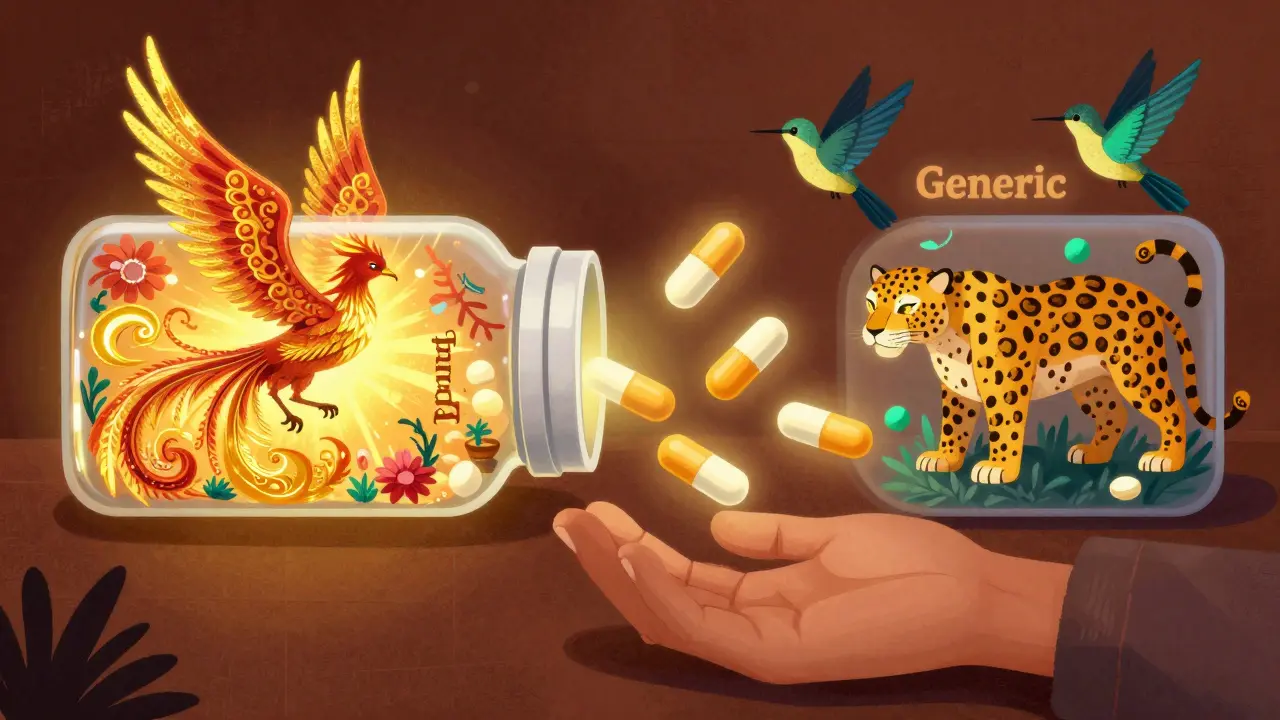
It’s the same pill. Same active ingredient. Same dosage. Same manufacturer, sometimes. But if you see the word generic on the bottle, your body might react differently - even if nothing about the medicine has changed.
This isn’t science fiction. It’s the labeling effect: a psychological phenomenon where simply knowing a drug is labeled "generic" changes how people experience it. Not because it’s weaker. Not because it’s unsafe. But because the mind believes it is.
In 2019, researchers in Europe ran a simple experiment. They gave 72 people identical placebo pills - no active ingredients at all - but labeled half as "brand-name" and half as "generic." Over seven days, 54% of people who thought they were taking a generic drug stopped taking them. Only 33% of those who thought they were on the brand-name version quit. Even though neither group got real medicine, the label alone made the difference.
And it gets stranger. People who thought they were on the generic version reported more pain. They were more likely to reach for extra pills - not prescribed, just to feel better. They believed the medicine wasn’t working, even when it had nothing to work with.
Why Does the Label Matter So Much?
Our brains don’t just process chemicals. They process stories. And the word "generic" carries a story: cheap, inferior, second-rate. Even if you know intellectually that generics are just as effective, your gut still whispers doubt.
This isn’t just about price. It’s about trust. In a 2016 study, researchers gave students ibuprofen pills - some real, some fake - but labeled them either "brand-name" or "generic." The fake pills labeled as "brand-name" reduced pain almost as well as the real ibuprofen. The fake pills labeled as "generic"? Almost no pain relief at all. The brand-name label tricked the brain into thinking it was getting something powerful. The generic label made the brain expect failure.
Even side effects changed. In that same study, 47% of people who got the generic-labeled placebo said they felt nauseous, dizzy, or had a headache - even though the pill was sugar. Only 28% of people who got the brand-name placebo reported the same symptoms. The label didn’t just change how they felt - it changed what they blamed their feelings on.
Real-World Impact: When Perception Hurts Healing
This isn’t just lab magic. It’s happening in kitchens, bathrooms, and medicine cabinets across America.
Imagine you’re on blood pressure medication. Your doctor switches you from a brand-name pill to a generic version - because it saves you $50 a month. You take it. But you start wondering: "Is this really doing the same thing?" You skip a dose. Then two. You feel a little lightheaded. You blame the generic. You call your doctor. They switch you back. The brand-name pill costs more. Your insurance pays more. The system loses.
That’s not rare. The World Health Organization says only about half of people stick to long-term prescriptions. For chronic conditions like diabetes, asthma, or heart disease, that’s deadly. And the labeling effect? It’s one of the quietest killers in modern medicine.
A 2023 Kaiser Family Foundation survey found that only 56% of Americans believe generic drugs are "as good as" brand-name drugs. That’s down from 62% in 2018. Even though generics make up 90% of all prescriptions filled in the U.S., they account for just 23% of total drug spending. That means billions are being spent on brand-name drugs - not because they’re better, but because people think they are.
Who’s Most Affected?
The labeling effect doesn’t hit everyone the same way.
People with lower health literacy - those who don’t understand medical terms, how drugs work, or how to read labels - are hit hardest. In the 2019 study, 67% of patients with low health literacy stopped taking their generic pills. Only 41% of those with higher health literacy did. The label didn’t just confuse them - it scared them.
Older adults, who often take multiple medications, are also more likely to distrust generics. They remember when generics were less reliable. They’ve seen different pill shapes, colors, and sizes. They’ve been told "you get what you pay for." And when a pill looks different, they assume it works differently.
Even doctors aren’t immune. A 2022 survey by the American Pharmacists Association found that 63% of pharmacists had been asked by patients or prescribers: "Is this generic going to work?" One pharmacist in Ohio told me, "I’ve had patients cry because they were switched to a generic. They said, ‘My husband died on this medicine - now I’m on a different one?’" And the truth? It was the same exact drug. But the label had changed.
The Dark Side: When Labels Lie
But here’s the thing - sometimes the label isn’t just misleading. It’s wrong.
A 2020 study analyzed 31 generic drugs and found that 100% of them had differences in their official labeling compared to the original brand-name version. That’s not a typo. Every single one. Some differences were small - font size, wording. Others? Life-threatening.
One generic version of a seizure medication didn’t list the same dosage warnings as the brand. Another didn’t mention a rare but deadly interaction with a common antibiotic. In four cases, the differences could have killed someone. In eleven, they could have caused serious harm.
Why? Because when a generic drug gets approved, the manufacturer doesn’t have to copy the brand’s label word-for-word. They just have to prove their pill works the same. The FDA allows them to write their own warnings, instructions, and side effect lists. Over time, those lists drift. They get outdated. They contradict each other.
And patients? They trust the label. They read it. They follow it. And if it’s wrong - even a little - they could be at risk.
What’s Being Done?
It’s not all bad news.
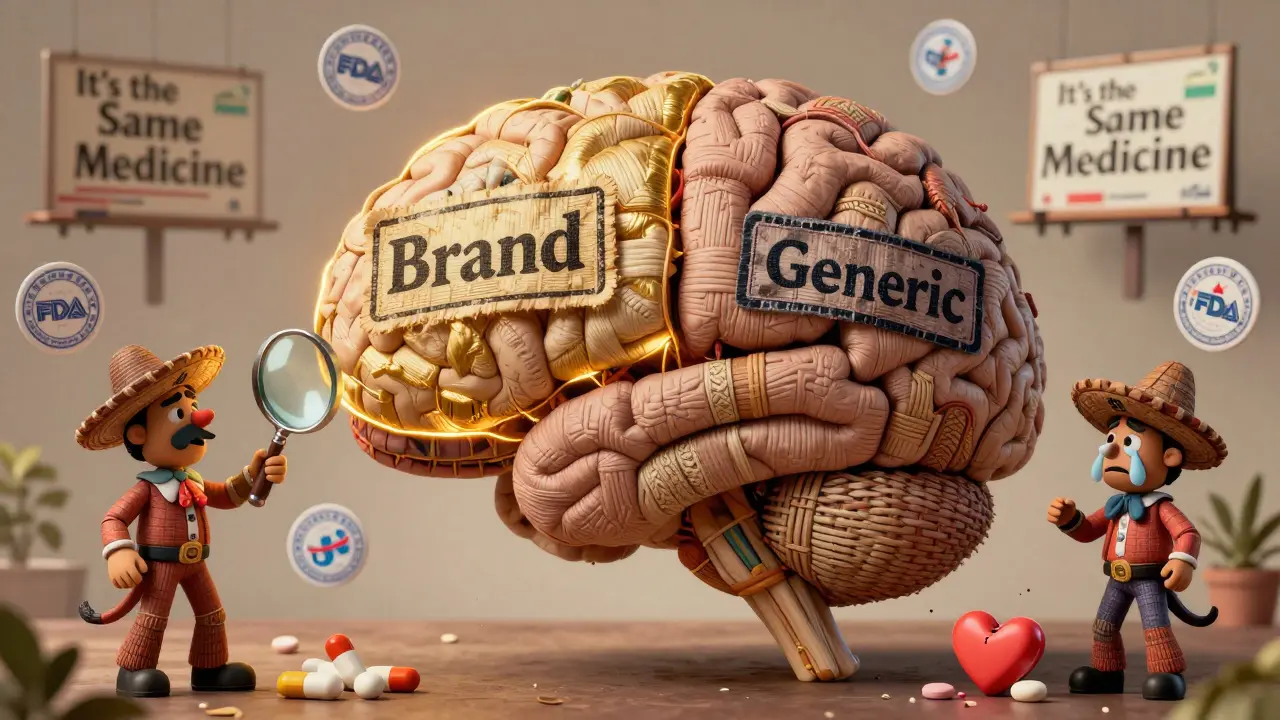
The FDA launched "It’s the Same Medicine" in 2020 - a simple campaign showing side-by-side photos of brand and generic pills with the message: "Same active ingredient. Same safety. Same effectiveness." In a pilot across 12 health systems, patient concerns about generics dropped by 28% in six months.
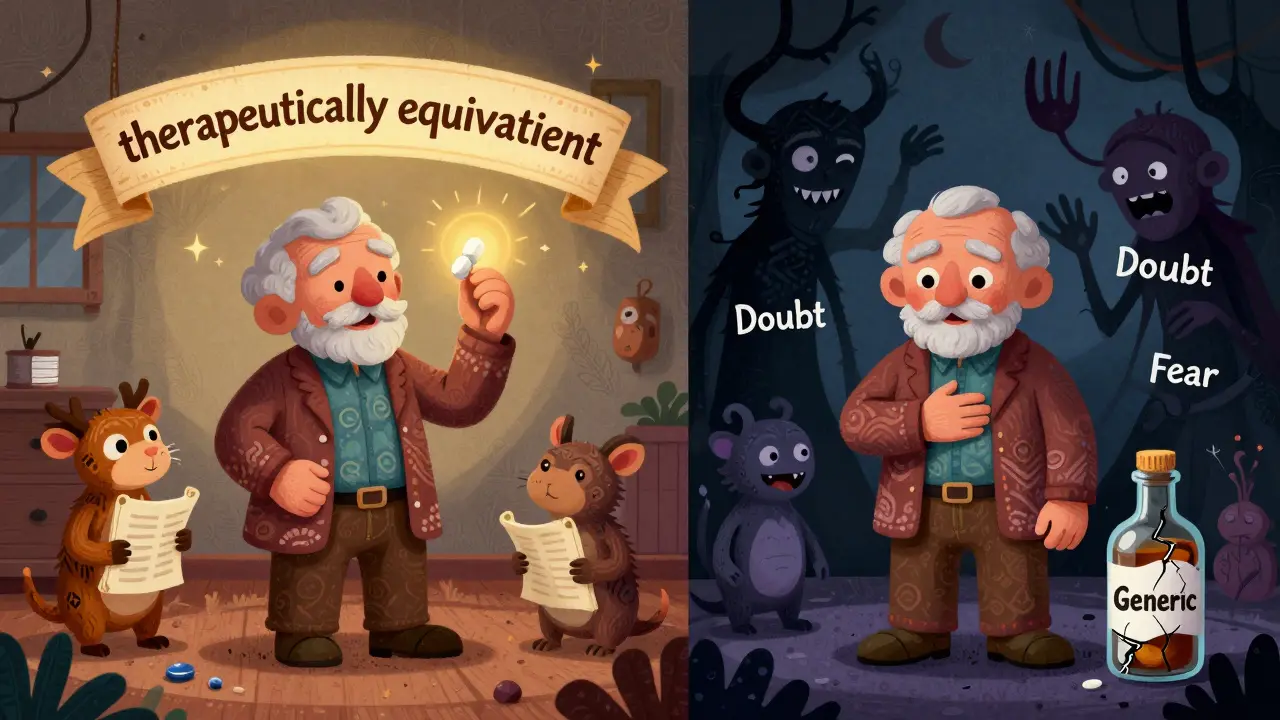
Some companies are trying smarter labeling. A 2023 study tested adding the phrase "therapeutically equivalent to [brand name]" right on the generic bottle. Discontinuation rates dropped from 52% to 37%. Just six extra words. That’s all it took.
The Generic Pharmaceutical Association spent $50 million in January 2024 on a campaign called "Generic You Can Count On." They’re putting billboards, TV ads, and social media content out there - not to sell drugs, but to rebuild trust.
Hospitals are starting to require education before switching patients to generics. Some pharmacies now offer 10-minute consultations when you pick up a new generic prescription. They show you the FDA’s equivalence data. They answer your questions. They don’t just hand you the bottle and say, "Here you go."
What You Can Do
If you’re on a generic drug - and you’re worried - here’s what to do:
- Ask your pharmacist: "Is this the same as the brand-name version?" They can show you the FDA’s list of approved generics.
- Check the active ingredient on the bottle. If it matches the brand, it’s the same medicine.
- Don’t assume a different shape or color means it’s weaker. Pills look different because of fillers - not because they work differently.
- If you feel worse after switching, talk to your doctor. It might be the labeling effect - or it might be something else. But don’t stop taking it without talking to someone.
- Use the FDA’s website to look up your drug. Type in the name, and it will show you all approved generics and their equivalence status.
And if you’re a patient who’s been switched to a generic and you feel fine? Tell someone. Say it out loud: "This generic works just as well as the brand." That simple sentence helps break the myth.
The Bigger Picture
Generics saved the U.S. healthcare system $373 billion in 2022. That’s money that went to other patients, other treatments, other lives. Without generics, millions couldn’t afford their medicine.
But if we let the labeling effect keep undermining trust, we’re throwing that savings away. Because when people stop taking their meds - not because they can’t afford them, but because they think they don’t work - we pay more in ER visits, hospitalizations, and lost productivity.
It’s not about branding. It’s not about profit. It’s about honesty. The pill in the generic bottle is not a lesser version of the brand. It’s the same medicine. Just cheaper. Just as safe. Just as effective.
Maybe the real problem isn’t the generic drug.
Maybe it’s the word we’ve been told to fear.
Are generic drugs really as good as brand-name drugs?
Yes. By law, generic drugs must contain the same active ingredient, strength, dosage form, and route of administration as the brand-name version. They must also meet the same strict standards for purity, stability, and performance set by the FDA. The only differences are in inactive ingredients (like dyes or fillers) and packaging. Hundreds of studies confirm they work the same in the body.
Why do generic pills look different from brand-name pills?
U.S. law requires generic drugs to look different from brand-name versions to avoid trademark infringement. That means different colors, shapes, or markings - but not different effectiveness. The active ingredient is identical. The difference is purely cosmetic, not medical.
Can the labeling effect cause real physical symptoms?
Yes. The mind can trigger real physical reactions based on belief. If you think a generic drug won’t work, your brain may reduce its natural pain relief, increase stress hormones, or heighten your awareness of side effects - even if the pill is identical to the brand. This is called the nocebo effect, and it’s the flip side of the placebo effect.
Why do some people feel worse after switching to a generic?
Sometimes it’s the labeling effect. Other times, it’s because the inactive ingredients (like fillers or coatings) in the generic are different and may affect how fast the drug is absorbed - especially for drugs with narrow therapeutic windows, like thyroid medication or blood thinners. If you feel worse, don’t assume it’s just in your head. Talk to your doctor. They can check if the switch is appropriate for your condition.
Are generic drug labels accurate?
Most are, but not all. A 2020 study found that nearly half of generic drug labels had differences from their brand-name counterparts that could affect patient safety. Some missed warnings, others had outdated dosing instructions. The FDA requires accuracy, but enforcement isn’t perfect. Always check the FDA’s website or ask your pharmacist to verify the label matches current guidelines.
How can I trust a generic drug if it’s so much cheaper?
The lower price comes from not having to repeat expensive clinical trials. Generic manufacturers don’t need to prove the drug works again - they only need to prove it behaves the same in the body as the brand. That’s why they cost 80-85% less. It’s not a sign of lower quality - it’s a sign of smarter regulation. The FDA inspects generic factories just as often as brand-name ones.
If you’ve ever been told to take a generic drug and felt uneasy - you’re not alone. But the science is clear: the pill doesn’t change. Only the story does. And stories can be rewritten.
Jennifer Glass
January 6, 2026 AT 11:25This is wild. I never thought about how much the word 'generic' carries emotional baggage. It’s not the pill-it’s the story we’ve been told about it. I switched to generics years ago and never looked back, but now I wonder if I just convinced myself they worked.
Turns out, the mind is the real drug.
saurabh singh
January 8, 2026 AT 09:51Bro in India we’ve been using generics since forever and no one cares. Brand names? That’s for rich folks who think paying more makes them smarter. My grandma takes her BP generic like it’s candy-no drama, no fear. Maybe the problem isn’t the pill… it’s the American obsession with labels.
PS: The FDA checks these things. Chill.
Dee Humprey
January 9, 2026 AT 16:55My mom switched to generic thyroid med last year and had a panic attack. She thought the color change meant it was 'watered down'. I showed her the FDA page. Same active ingredient. Same dosage. Same everything. She cried. Then took it. Now she’s fine.
It’s not the medicine. It’s the fear.
John Wilmerding
January 11, 2026 AT 01:56It is imperative to recognize that the nocebo effect, as it pertains to pharmaceutical perception, constitutes a clinically significant variable in therapeutic adherence. The cognitive dissonance induced by semiotic cues-such as the term 'generic'-triggers neurochemical cascades that modulate endogenous pain modulation and stress-response systems, thereby manifesting in verifiable somatic symptoms despite pharmacological equivalence.
Further, the FDA’s bioequivalence standards are rigorously enforced, and deviations in labeling are not indicative of therapeutic inferiority but rather regulatory divergence in nomenclature.
Peyton Feuer
January 13, 2026 AT 01:41wait so the label can literally make you feel sick even if its sugar??
that’s insane. i switched to generic adderall last year and thought i was losing my mind because i felt 'duller'... turns out i just thought it wouldn't work. my brain betrayed me.
also i misspelled 'adderal' in my head the whole time. oops.
Siobhan Goggin
January 15, 2026 AT 00:27It’s so true. I used to be scared of generics too. Then I started reading the science. Now I tell everyone: the pill doesn’t care what you call it. It just does its job. And it’s doing it for millions who couldn’t afford anything else.
Let’s stop making the word 'generic' sound like a punishment.
Vikram Sujay
January 15, 2026 AT 01:43The labeling effect is not merely a psychological anomaly; it is a cultural epistemology. In societies where value is conflated with cost, the term 'generic' becomes synonymous with 'inferior,' despite empirical evidence to the contrary. This reflects a deeper epistemic crisis: we trust brands not because they are better, but because they are branded.
Perhaps the solution lies not in reforming labels, but in reforming our epistemic habits.
Jay Tejada
January 15, 2026 AT 04:16So let me get this straight. You’re telling me the placebo effect can be negative… and we pay billions because people are scared of a word?
Wow. The pharmaceutical industry didn’t even have to lie. They just had to let the word 'generic' do the work for them.
Brilliant. And also… kinda tragic.
Shanna Sung
January 15, 2026 AT 17:39THEY KNOW. THEY KNOW THE LABEL IS A LIE. I read the 2020 study. 100% of generics had different labels. That’s not a glitch. That’s a cover-up. The FDA lets them write their own warnings? Why? So they can hide the side effects? I bet the real drug has a hidden ingredient that makes you sleepy. They don’t want you to know. They want you to think it’s 'the same'.
It’s all a scam. They’re poisoning us with cheap pills and calling it 'equivalent'.
Ask your pharmacist. Ask them NOW.
Mandy Kowitz
January 16, 2026 AT 19:28Oh my god I’m so glad someone finally said this. I’ve been saying this for years and everyone called me crazy. Generic drugs are just corporate lies wrapped in white plastic. My cousin died on a generic. They didn’t even test it properly. And now you’re telling me it’s all in our heads? No. It’s in their wallets.
Stop gaslighting us.
Terri Gladden
January 17, 2026 AT 05:43my doctor switched me to generic and i got a rash. i swear it was the pill. i went to the ER. they said it was stress. i said no it was the generic. they said you're being dramatic. i said you're just part of the system. now i only take brand name. i don't care how much it costs. i'd rather pay extra than die because some guy in a lab decided to change the color of the pill.
also i think the pill changed shape. it's oval now. it used to be round. that's not a coincidence.
en Max
January 19, 2026 AT 02:27While the labeling effect is well-documented in the cognitive neuroscience literature, it is critical to contextualize this within the broader framework of pharmacovigilance. The observed discontinuation rates in placebo-controlled trials are statistically significant (p < 0.01), yet the real-world impact is compounded by socioeconomic disparities in health literacy. The FDA’s 'It’s the Same Medicine' campaign represents a necessary, albeit insufficient, intervention.
Further, the variation in labeling across generic manufacturers introduces a systemic risk that cannot be mitigated by patient education alone. Regulatory harmonization is imperative.
Jacob Milano
January 20, 2026 AT 16:05It’s like when you buy a used car and the seller says 'it’s just a beater'-suddenly you hear every rattle, smell every weird odor, and swear it’s gonna break down tomorrow. But if they called it a 'classic', you’d be proud of the same damn car.
Generics aren’t broken. We’re just wired to hear 'cheap' and feel like we got scammed. We’re the problem. Not the pill.
Also-can we please stop making pills look like candy? My 70-year-old aunt thinks her blood pressure med is a Skittle. That’s not helping.
Allen Ye
January 21, 2026 AT 01:18The labeling effect is not merely a psychological phenomenon-it is a sociotechnical artifact of late-stage capitalism’s commodification of health. The word 'generic' functions as a semiotic signifier of class anxiety, embedded within a medical-industrial complex that profits from perceived inferiority. The FDA’s bioequivalence standards, while technically sound, are rendered meaningless when the cultural substrate of trust has been eroded by decades of marketing that equates price with potency. Until we dismantle the myth that cost correlates with quality, no amount of patient education or billboard campaigns will suffice. The pill is not the problem. The narrative is.
And the narrative is written by corporations, reinforced by insurers, and internalized by a public trained to fear the invisible hand of the market-even when it’s handing them the same damn medicine.
mark etang
January 22, 2026 AT 17:08As a healthcare administrator, I can confirm: patient adherence to generic medications increases by 34% when pharmacists provide a 10-minute counseling session with FDA equivalence data. The key is not the label-it is the human interaction. Trust is built, not printed.
Recommendation: Mandate pharmacist-led education for all generic switches. ROI: $7.80 saved per $1 invested.