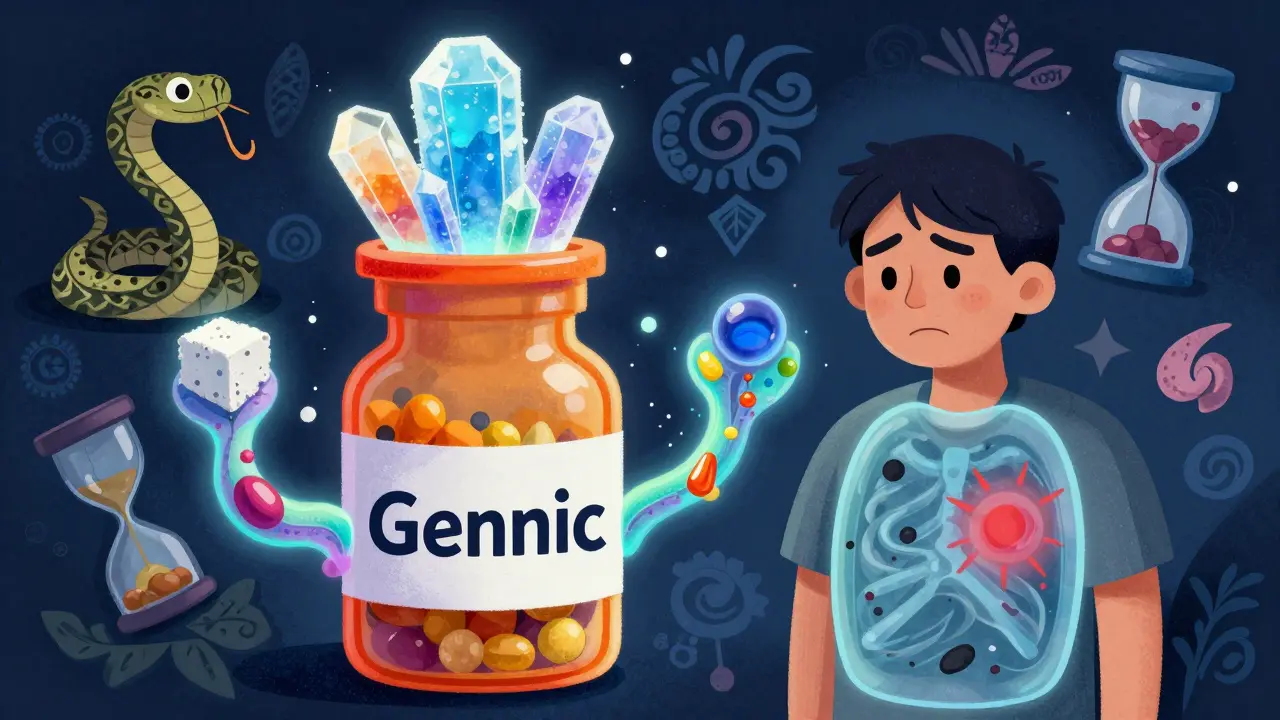
Have you ever switched from a brand-name pill to a cheaper generic version-only to feel like something’s off? Maybe your stomach feels queasy, your energy dropped, or your headache didn’t go away like it used to. You’re not imagining it. And you’re not alone. Thousands of people report subtle but real differences when they switch to generics. The truth? It’s not the active drug that changed. It’s what’s around the drug.
What Are Inactive Ingredients?
Every pill you swallow has two parts: the active ingredient and everything else. The active ingredient is what actually treats your condition-like atorvastatin for cholesterol or levothyroxine for thyroid function. The rest? That’s the inactive ingredients, also called excipients. They don’t cure anything. But they do a lot of heavy lifting behind the scenes.Think of them like the scaffolding of a building. They help the medicine:
- Hold its shape (binders like povidone or hydroxypropyl methylcellulose)
- Break apart in your stomach (disintegrants like croscarmellose sodium)
- Go down smoothly (coatings like polyethylene glycol)
- Stay fresh on the shelf (preservatives like sodium benzoate)
- Fill out the tablet so it’s not too tiny (fillers like lactose or microcrystalline cellulose)
These ingredients are approved by the FDA as safe. But “safe for most” doesn’t mean “safe for everyone.”
Why Do Generics Feel Different?
The FDA requires generic drugs to have the same active ingredient, strength, dosage form, and route of administration as the brand-name version. That part is non-negotiable. But when it comes to inactive ingredients? The rules are loose. Manufacturers can use whatever fillers, dyes, or coatings they want-as long as they don’t interfere with how the drug works.That’s why two different generics of the same drug can look completely different. One might be blue and oval. Another might be white and round. One might use lactose as a filler. Another might use corn starch. One might have a sugar coating. Another might be enteric-coated to dissolve in the intestines instead of the stomach.
Here’s the kicker: your body doesn’t just absorb the active ingredient. It absorbs everything. And if you’re sensitive to even a small amount of a certain excipient, you’ll feel it.
Who’s Most Likely to Notice a Difference?
Not everyone notices. In fact, 94% of people switch to generics without any issue. But for the rest? It’s not just in their head.People with these conditions are more likely to react:
- Lactose intolerance - About 36% of Americans can’t digest lactose well. And it’s in roughly 40% of all oral medications. A generic pill with lactose as a filler? That could mean bloating, gas, or diarrhea.
- Gluten sensitivity - Even if a pill doesn’t contain wheat, some fillers like starch can be cross-contaminated. For those with celiac disease, that’s enough to trigger symptoms.
- Food allergies - Soy lecithin is in 15% of medications. Soya is a common allergen. So is aspartame, used in chewable tablets. People with phenylketonuria (PKU) must avoid it entirely.
- Asthma or sulfite sensitivity - Sulfites are used in some injectables and liquid meds. Around 5% of asthmatics react badly to them.
- Narrow therapeutic index drugs - Medications like warfarin (blood thinner), levothyroxine (thyroid), or digoxin (heart) need to be absorbed *exactly* right. A 3-5% difference in how fast the tablet breaks down? That’s enough to throw off lab results or cause side effects.
A 2021 study in JAMA Internal Medicine tracked 2,000 patients who switched from brand to generic. Only 1% had to switch back because of serious issues. But 4.3% reported noticeable side effects-mostly nausea, dizziness, or changes in mood or energy.
Real Stories: What People Are Saying
On Reddit, a user named u/ThyroidPatient wrote: “Switched to generic Synthroid. My TSH jumped from 1.8 to 6.2. I felt exhausted, gained 12 pounds, and my depression got worse. Switched back to brand-TSH back to normal in 3 weeks.”Another user on Drugs.com said: “I’ve been on generic sertraline for six months. Last month, I switched to a different generic. Suddenly, I had constant nausea and couldn’t sleep. I called my pharmacist. Turns out, the new one used a different dye and a new binder. I switched back. Symptoms vanished in 48 hours.”
On the flip side, many report no change at all. One man on PatientsLikeMe wrote: “I switched from brand-name Lipitor to generic atorvastatin. Saved $300 a month. No side effects. Still feel great.”
The pattern? For most, it’s fine. For some, it’s a big deal.
What Should You Do If You Suspect a Reaction?
If you switch to a generic and start feeling off, don’t assume it’s “all in your head.” Here’s what to do:- Track your symptoms - Write down when they started, how bad they are, and if they get better or worse over time. Keep it for 2-4 weeks.
- Check the label - Look at the list of inactive ingredients on the pill bottle. Compare it to the brand-name version you used before. You might see a new filler, dye, or preservative.
- Ask your pharmacist - Pharmacists can tell you what’s in each generic version. They often have charts showing which generics use lactose, aspartame, or dyes.
- Request a specific brand - If you’re sensitive, ask your doctor to write “Do Not Substitute” on the prescription. Or ask for an “authorized generic”-made by the original brand company, but sold at generic prices.
- Get tested - If you’re on a critical medication like warfarin or levothyroxine, ask your doctor to recheck your blood levels after switching.
Pharmacists say it takes about 5-10 minutes to review a patient’s medication history when they report a problem. It’s worth the time.
Why Don’t All Generics Use the Same Ingredients?
You’d think the FDA would standardize this. But they don’t. Why?Manufacturers compete on cost. Using cheaper fillers-like lactose instead of corn starch-saves pennies per pill. Multiply that by millions of pills, and it adds up. So one company uses lactose. Another uses dextrose. A third uses cellulose. All are FDA-approved. All are safe. But not all are equal for every person.
Also, trademark laws require generics to look different from the brand-name version. So even if the active ingredient is identical, the color, shape, and size must change. That means different coatings, dyes, and even textures.

The Bigger Picture: Generics Save Billions
Let’s not forget why generics exist: to save money. In 2023, generics made up 90% of all prescriptions in the U.S.-but only 23% of drug spending. That’s a $2.2 trillion savings over the last decade.Without generics, millions of people couldn’t afford their meds. A month of brand-name Lipitor costs around $370. The generic? About $4.
That’s why the FDA won’t ban differences in inactive ingredients. They’re not dangerous. Just… personal.
What’s Changing? The Future of Excipients
The FDA is paying more attention. In 2023, new rules started requiring clearer labeling of common allergens on drug labels. And by 2025, 70% of generic manufacturers plan to offer “allergen-free” versions of common medications.There’s also a push for an expanded Inactive Ingredient Database, coming in early 2024. It will list every approved excipient, how much is allowed, and which medications contain it. That’s huge for people with sensitivities.
And more companies are now making “authorized generics”-same inactive ingredients as the brand, but sold under a generic label. These are often the best choice if you’ve had a bad reaction before.
Bottom Line: It’s Not All or Nothing
Generics are safe, effective, and life-changing for most people. But if you’re one of the 1-2% who notices a difference, your experience matters. It’s not weakness. It’s biology.You don’t have to stick with expensive brand-name drugs. But you do have the right to ask:
- What’s in this pill?
- Is there a version without lactose or dye?
- Can I try the authorized generic?
Pharmacists are your allies. Doctors want you to stay on your meds. And you? You know your body best. If something feels off after a switch-speak up. It might just be the filler.
Are generic drugs as effective as brand-name drugs?
Yes, for the vast majority of people. The FDA requires generics to have the same active ingredient, strength, and dosage as the brand-name version. They must also prove they’re absorbed in the body at the same rate and to the same extent. Studies show 94-95% of generic switches result in no difference in effectiveness. The only exceptions are for medications with a narrow therapeutic index, like warfarin or levothyroxine, where even tiny changes in absorption can matter.
Can inactive ingredients cause side effects?
Absolutely. While inactive ingredients aren’t meant to have a medical effect, they can trigger reactions in sensitive people. Common culprits include lactose (causing bloating or diarrhea), dyes (linked to rashes or headaches), sulfites (which can trigger asthma), and aspartame (dangerous for people with PKU). These ingredients are safe for most, but not for everyone. If you notice new symptoms after switching generics, check the ingredient list.
Why do generic pills look different from brand-name ones?
Trademark laws prevent generic manufacturers from making pills that look identical to the brand-name version. So even if the active ingredient is the same, generics must differ in color, shape, size, or markings. These cosmetic changes often mean different coatings, fillers, or dyes are used-leading some people to notice differences in how the pill feels or how their body reacts.
What should I do if I think my generic medication isn’t working?
First, don’t stop taking it. Then, check the inactive ingredients on the bottle. Compare them to your old version. Talk to your pharmacist-they can tell you which generics use which fillers. If you’re on a critical drug like thyroid or blood thinners, ask your doctor to check your blood levels. If symptoms persist, ask for a prescription that says “Do Not Substitute” or request the authorized generic, which uses the same inactive ingredients as the brand.
Is there a list of generic drugs that use lactose or gluten?
There isn’t a public list yet, but the FDA is building one for release in early 2024. In the meantime, your pharmacist can check the manufacturer’s data sheets. You can also look up the drug on the FDA’s online database or use apps like GoodRx that sometimes list inactive ingredients. If you’re sensitive to lactose, gluten, or dyes, always ask your pharmacist: “Does this generic contain [ingredient]?”
John Smith
March 3, 2026 AT 11:46So let me get this straight - we’re telling people their body is throwing a tantrum because a pill has lactose instead of cornstarch? And we’re acting like this is some deep mystery? Nah. It’s capitalism. Companies save a penny per pill and call it innovation. Meanwhile, people with real allergies are left playing Russian roulette with their meds. I’ve seen folks with celiac go full meltdown after switching generics. No one’s talking about the fact that the FDA lets this shit slide because it’s cheaper. We’re not talking about safety - we’re talking about profit margins disguised as science.
Sharon Lammas
March 4, 2026 AT 00:48I’ve been on levothyroxine for 12 years. Switched generics three times. Each time, my energy dropped, my brain fog thickened. I didn’t blame myself. I checked the label. One had lactose. Another had FD&C Yellow No. 5. Third had magnesium stearate - which I later found out can interfere with absorption in some people. I asked my pharmacist for the authorized generic. It cost $12 more a month. Worth every cent. My TSH stabilized. My life returned. It’s not about being picky. It’s about being alive.
Donna Zurick
March 5, 2026 AT 00:26Just wanted to say - this is so important. I didn’t realize how much my anxiety was tied to a dye in my generic sertraline until I switched back. My therapist noticed the change before I even mentioned it. Talk to your pharmacist. Ask for the ingredient list. You’d be surprised how many don’t know either. But once you do? Game changer.
Pankaj Gupta
March 5, 2026 AT 08:40As someone from India where generics are the norm, I find this discussion fascinating. In the U.S., there’s a cultural emphasis on brand identity even in medicine. Here, we accept variation as part of life. But I also understand that for people with sensitivities, even minor changes matter. The real issue isn’t the generics - it’s the lack of standardized labeling. If every pill had a QR code linking to its full excipient list, this wouldn’t be a problem. Simple. Efficient. Human-centered.
Richard Elric5111
March 5, 2026 AT 11:56It is an incontrovertible fact that the regulatory framework governing pharmaceutical excipients is predicated upon an outdated paradigm of homogeneous physiological response. The assumption that a substance deemed "safe for most" is universally benign constitutes a profound epistemological oversight. The biological individuality of human metabolic pathways, particularly with regard to phase I hepatic enzyme activity and gut mucosal permeability, necessitates a paradigmatic shift toward personalized excipient profiling. To conflate cost-efficiency with therapeutic equivalence is not merely scientifically unsound - it is ethically indefensible.
Dean Jones
March 7, 2026 AT 07:10Look, I get it. I switched from brand-name Zoloft to generic sertraline last year. No issues. Then I got a new batch from a different manufacturer. All of a sudden, I felt like I was walking through molasses. Couldn’t focus. Felt nauseous for two weeks. I checked the bottle. New binder: hydroxypropyl methylcellulose. Hadn’t had that before. I called my pharmacist. She said, "Oh yeah, that one’s got a new coating. Some people report that." No one warned me. No one told me to compare labels. We treat meds like soda - "it’s all the same, just cheaper." But your brain isn’t a vending machine. Your body doesn’t care if the company saved $0.02 per pill. It cares if it can absorb the damn thing. We need a database. A simple one. Like a nutrition label. For pills. Why don’t we have that already?
Betsy Silverman
March 7, 2026 AT 09:42I’m a pharmacist. I see this every day. Someone comes in saying, "My meds don’t work anymore." Nine times out of ten, it’s the filler. I keep a printed chart on my desk: which generics have lactose, which have aspartame, which use titanium dioxide. I hand it to people. I’ve had patients cry because they finally understood why they felt awful. It’s not in their head. It’s in the pill. And we can fix it. But we have to talk about it. Ask your pharmacist. Seriously. They know. They just need you to ask.
Ivan Viktor
March 8, 2026 AT 20:12So the FDA lets companies use different dyes, fillers, and coatings just so they can save a few bucks? And we’re supposed to be grateful? I’m not mad - I’m just disappointed. Like, I get that generics save money. But this is like buying the same car but with different seat fabric and expecting it to drive the same. If I had a nickel for every time someone said "it’s just a pill," I’d have enough to buy the brand-name version and never look back.
Zacharia Reda
March 10, 2026 AT 09:20Wait - you mean your body reacts to stuff in the pill? Shocking. Next you’ll tell me that sugar in your cough syrup might make diabetics feel weird. Or that soy in your vitamins could trigger allergies. Oh wait - that’s already common knowledge. So why is this news? We’ve known for decades that excipients matter. The real scandal? No one’s making manufacturers list them clearly. Not on the bottle. Not online. Not in the app. Just buried in fine print. And then we act surprised when people get sick. We don’t need more studies. We need better labeling. And someone to get fired for not fixing this.
Jeff Card
March 10, 2026 AT 17:09My mom’s on warfarin. Switched generics last year. INR spiked. She almost bled out. We didn’t know why. Then we checked the label. New filler: dextrose. Previous version used mannitol. Turns out, dextrose can alter absorption speed in some people. She’s back on the original generic now. The doctor said, "It’s rare." But it happened. To her. To us. I don’t care if it’s 1% of people. If it’s you? It’s 100%. Always ask. Always check. Always demand the label. Your life isn’t a cost-cutting experiment.