
OIH vs. Tolerance Symptom Checker
Select Your Symptoms
Click on the symptoms that apply to your current experience.
Analysis Result
Select symptoms to see potential indicators
Imagine taking a painkiller for your backache, only to find that the more you take, the worse the pain gets. It sounds like a nightmare, but it is a real medical phenomenon known as Opioid-Induced Hyperalgesia (OIH). This condition flips the script on how we expect pain medication to work. Instead of providing relief, long-term or high-dose exposure to opioids can actually make your nervous system hypersensitive to pain.
If you are dealing with chronic pain and feel like your current treatment plan is failing, understanding this paradoxical reaction could be the missing piece of the puzzle. It is not just about building a tolerance; it is a complex neurological shift that requires a different approach to management.
What Exactly Is Opioid-Induced Hyperalgesia?
Opioid-Induced Hyperalgesia is defined as a state where your body becomes increasingly sensitive to painful stimuli due to prolonged exposure to opioids. First documented in scientific literature in 1971 by researchers studying rats, this concept has evolved into a recognized clinical challenge in human medicine. Unlike typical pain progression, OIH involves a lowering of your pain threshold. You start feeling pain from things that didn't hurt before, and existing pain feels sharper and more intense.
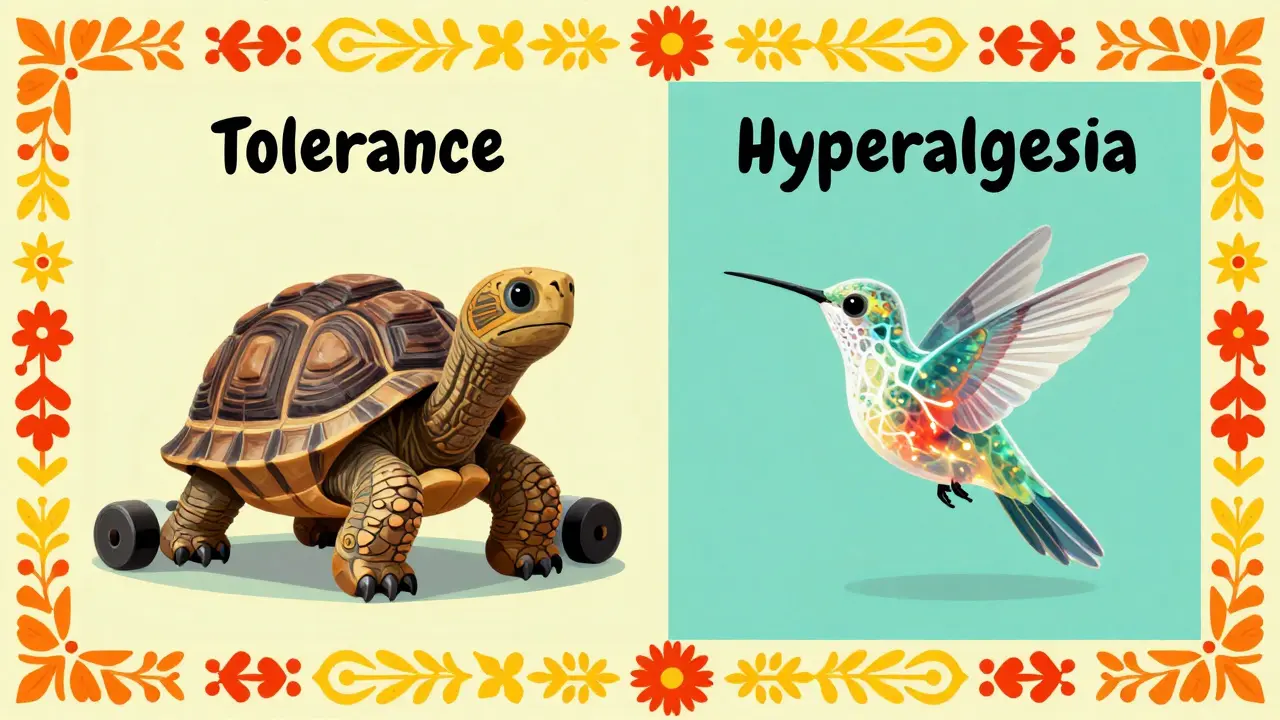
The key distinction here is between OIH and opioid tolerance. With tolerance, your body simply stops responding as strongly to the drug, so you need higher doses to get the same effect. With OIH, increasing the dose doesn't help-it makes the pain worse. The American Pain Society highlights this difference clearly: tolerance requires escalation for maintenance, while OIH involves an actual decrease in pain tolerance and an increase in pain perception despite higher doses.
How to Spot the Signs: Symptoms and Clinical Presentation
Recognizing OIH early can prevent dangerous cycles of escalating medication. The symptoms often creep in subtly, making them easy to mistake for worsening disease or simple ineffectiveness of the drug. Here are the primary indicators that clinicians look for:
- Diffuse Pain Spread: Your pain starts spreading beyond the original site. For example, if you had surgery on your knee, you might begin feeling widespread achiness in your legs or lower back.
- Allodynia: This is when non-painful stimuli become painful. Light touch, such as clothing brushing against your skin or a gentle breeze, might trigger sharp pain signals.
- Paradoxical Worsening: You notice that immediately after taking your prescribed dose, your pain intensifies rather than subsiding.
- Sensitivity to Temperature: Normal room temperatures might feel uncomfortably hot or cold.
Physical exams may also reveal other signs of opioid hyperexcitability, including muscle twitching (myoclonus) or confusion. These symptoms are particularly common in patients receiving high intravenous doses of morphine or hydromorphone, especially those with kidney issues where toxic metabolites build up.
The Biology Behind the Pain: Why Does This Happen?
To understand why opioids cause pain, we have to look at what happens inside your spinal cord and brain. When you take opioids, they bind to mu-opioid receptors. In normal circumstances, this blocks pain signals. However, with chronic use, the nervous system adapts in ways that amplify pain instead of blocking it.
The most significant mechanism involves the NMDA receptor. Opioids trigger a cascade that activates these receptors, leading to central sensitization. Essentially, your neurons become "wound up" and fire more easily. This process involves nitric oxide and protein kinase C, which further enhance the transmission of pain signals. Another factor is the release of dynorphin, an excitatory neuropeptide that increases nociceptive input. Additionally, genetic factors play a role; variations in the COMT enzyme, which breaks down neurotransmitters like dopamine, can make some individuals genetically predisposed to developing OIH.
OIH vs. Tolerance: Knowing the Difference
Distinguishing between OIH and tolerance is critical because the treatments are opposites. If you assume it is tolerance and raise the dose, you will worsen OIH. If you assume it is OIH and lower the dose, you might relieve tolerance-related issues but miss the mark if it was truly disease progression.
| Feature | Opioid Tolerance | Opioid-Induced Hyperalgesia (OIH) |
|---|---|---|
| Pain Response to Dose Increase | Temporary relief, then returns to baseline | Pain worsens or spreads |
| Pain Distribution | Remains localized to original site | Becomes diffuse and widespread |
| Sensitivity to Touch | No change | Increased sensitivity (allodynia) |
| Underlying Mechanism | Receptor desensitization | Central sensitization and NMDA activation |
Clinicians often use quantitative sensory testing to help differentiate the two. If your pain threshold drops in areas far away from your injury, it strongly points toward OIH. Conversely, if the pain stays exactly where the injury is and just needs more drug to manage, it is likely tolerance or disease progression.
Treatment Strategies: Breaking the Cycle
Managing OIH requires a careful, multi-step approach. The goal is to reset your nervous system's sensitivity without leaving you in unmanageable pain. Here are the evidence-based strategies used by pain specialists.
Opioid Rotation
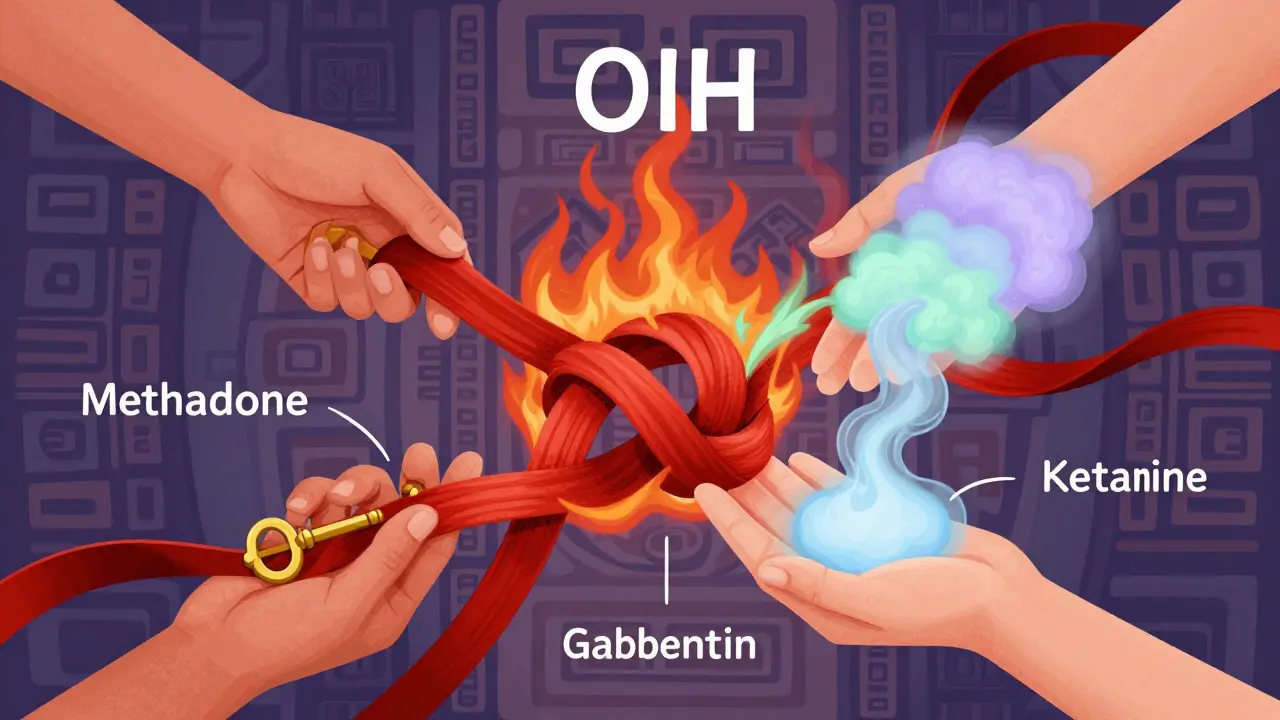
Switching from one opioid to another is a cornerstone of OIH treatment. Methadone is often the go-to choice because it has a unique dual action. It acts as a mu-opioid agonist (providing pain relief) but also blocks NMDA receptors (reducing the sensitization causing OIH). Studies have shown that rotating to methadone can reduce postoperative opioid requirements by up to 40% and significantly improve pain scores in OIH patients.
Dose Reduction
This sounds counterintuitive, but reducing the opioid dose can actually alleviate pain in OIH cases. By lowering the stimulus that is driving the hyperalgesia, the nervous system can begin to calm down. This must be done slowly and under strict medical supervision to avoid withdrawal symptoms, which can mimic OIH.
Adjunctive Medications
Adding non-opioid drugs helps target the specific mechanisms of OIH:
- Ketamine: An NMDA receptor antagonist, often used at low subanesthetic doses (0.1-0.5 mg/kg/hour) to block pain amplification.
- Magnesium Sulfate: Also acts as an NMDA antagonist and is sometimes used intravenously in acute settings.
- Gabapentin or Pregabalin: These alpha-2-delta ligands modulate calcium channels and help dampen central sensitization. Typical titration ranges are 900-3600 mg/day for gabapentin and 150-600 mg/day for pregabalin.
Non-Pharmacological Approaches
Cognitive behavioral therapy (CBT) and physical therapy can complement medication changes. CBT helps manage the psychological distress associated with chronic pain, while physical therapy ensures that deconditioning isn't contributing to the pain cycle.
Risk Factors and Who Is Most Vulnerable
Not everyone develops OIH, but certain groups are at higher risk. Understanding these factors can help you and your doctor monitor for early signs.
- High-Dose Users: Patients receiving large parenteral (IV) doses of morphine or hydromorphone are at greater risk.
- Renal Impairment: Kidney failure leads to the accumulation of toxic opioid metabolites like morphine-3-glucuronide, which are neuroexcitatory.
- Genetic Predisposition: Variations in the COMT gene affect how your body processes catecholamines, potentially increasing susceptibility to central sensitization.
- Long-Term Therapy: The longer you stay on high-dose opioids, the higher the likelihood of neuroadaptive changes occurring.
In surgical settings, even short-term high-dose intraoperative opioids have been linked to increased postoperative pain, suggesting that acute spikes in opioid levels can trigger transient OIH.
Navigating the Controversy: Is OIH Overdiagnosed?
The medical community still debates the prevalence and diagnostic certainty of OIH. Some experts argue that many cases labeled as OIH are actually untreated underlying pain, psychological factors, or simple tolerance. Dr. Stephan Schug, a prominent pain specialist, notes that while OIH is well-established in animal models, translating that to human clinical practice remains complex due to overlapping symptoms.
However, organizations like the Palliative Care Network of Wisconsin emphasize that ignoring OIH can lead to dangerous dose escalation. They provide specific criteria-such as diffuse pain patterns and allodynia-to help clinicians distinguish true OIH from other causes. Until validated biomarkers are available, diagnosis remains largely clinical, relying on careful observation of response to dose changes and adjunctive therapies.
Can Opioid-Induced Hyperalgesia be reversed?
Yes, OIH is generally reversible. The primary method is reducing the opioid dose or rotating to a different opioid like methadone. As the nervous system adjusts, pain sensitivity typically returns to baseline over days to weeks. Adjunctive medications like ketamine or gabapentin can speed up this process.
How do I know if it's OIH or just my pain getting worse?
Key differences include the spread of pain. In OIH, pain becomes diffuse and affects areas distant from the original injury. You may also experience allodynia, where light touch hurts. If your pain stays localized and simply requires more medication to manage, it is more likely tolerance or disease progression. Consult your pain specialist for a thorough evaluation.
Is methadone safe for treating OIH?
Methadone is considered effective for OIH due to its NMDA antagonist properties, but it carries risks. It has a long half-life and can accumulate in the body, leading to respiratory depression if not dosed carefully. It should only be managed by experienced pain specialists who can monitor blood levels and adjust doses safely.
Does stopping opioids completely cure OIH?
Discontinuing opioids can resolve OIH, but abrupt cessation can cause severe withdrawal and rebound pain, which mimics OIH symptoms. A gradual taper combined with non-opioid analgesics is the safest approach to allow the nervous system to reset without triggering additional pain pathways.
Are there genetic tests for OIH susceptibility?
Currently, there are no routine clinical genetic tests for OIH susceptibility. While research shows that COMT gene variants influence pain processing, these tests are not yet standard practice for diagnosing or predicting OIH in clinical settings. Diagnosis remains based on clinical presentation and response to treatment.