
When your life changes-whether it’s a new job, a breakup, moving cities, or even just a sudden spike in stress-your medication routine often gets left behind. It’s not laziness. It’s not lack of care. It’s biology, psychology, and chaos colliding. Research shows that medication adherence drops by an average of 32% during major life transitions. That’s not a small dip. That’s a dangerous gap. And it’s happening to millions of people right now, often without anyone noticing until it’s too late.
Why Your Medication Routine Falls Apart When Life Changes
Your body doesn’t care if you just got promoted, moved across the country, or went through a divorce. But your brain does. And when stress hits, your prefrontal cortex-the part that handles planning, memory, and decision-making-gets overwhelmed. Suddenly, remembering to take your pill becomes a low priority. You’re juggling new schedules, new emotions, new responsibilities. The pill bottle sits untouched on the counter while you’re unpacking boxes or crying in the shower. Studies from the Journal of Personality and Social Psychology show that people lose adherence not because they forget, but because their entire system of support collapses. The alarm you set? Gone with your old phone. The pharmacy you trusted? Now 40 miles away. The partner who reminded you? No longer in the picture. Without those anchors, your routine shatters. And here’s the scary part: 68% of chronic disease failures happen within the first three months after a big life shift. That’s not coincidence. That’s a pattern. And it’s preventable.The Three Lists That Save Your Health
One of the most powerful tools for staying on track during chaos is simple: make three lists. List 1: Things You Can Control Directly - This is your medication schedule. Your pill organizer. The time you take your pills. The pharmacy you use. These are things you can change right now. According to Supportive Care’s 2023 analysis, only 27.3% of transition-related stressors fall into this category. But they’re the only ones that matter. List 2: Things You Can Influence - This includes talking to your doctor about adjusting your regimen, asking a friend to check in, or setting up automatic refills. You can’t control whether your boss gives you a week off, but you can control whether you ask for help. List 3: Things Outside Your Control - Your ex’s new partner. The weather. The economy. The fact that your new apartment doesn’t have a kitchen counter big enough for your pillbox. These drain your energy. They’re not your job to fix. The key? Spend zero energy on List 3. Redirect every ounce of focus to Lists 1 and 2. People who do this improve their medication adherence by 22.7% during transitions.Anchor Routines: The Secret to Staying on Track
You don’t need a perfect schedule. You need anchors. An anchor is a daily activity that happens at the same time, no matter what else is going on. Brushing your teeth. Making coffee. Walking the dog. Taking out the trash. These are your anchors. Research from the Journal of Personality and Social Psychology found that people who maintained just 3-5 of these anchors during transitions reduced psychological distress by 23% and improved medication adherence by 31.4%. Why? Because your brain uses these routines as cues. When you brush your teeth, you remember to take your pill. When you sit down for dinner, you take your evening meds. It’s not about the pill. It’s about the habit chain. Try this: Pick two anchors you already do every day. Attach your medication to one of them. If you take your meds with breakfast, don’t change it when you move. If you take them before bed, keep doing it even if your sleep schedule shifts. Flexibility doesn’t mean abandoning structure. It means adapting it.Forget Apps-Use Real People
Digital reminders? They help. But only when life is stable. During transitions, their effectiveness drops from 22.8% to just 8.3% compared to traditional pill organizers. Why? Because apps don’t care if you’re crying, broke, or in a new city with no Wi-Fi. Real people do. Studies in Health Psychology show that people with strong social support during transitions have 41.7% lower cortisol levels and 34.2% better medication adherence. That’s not magic. That’s biology. When someone checks in on you, your brain feels safer. Your stress drops. Your ability to follow through goes up. Who can you ask? A sibling. A coworker. A neighbor. A church group. Even a text thread with two other people who take the same meds. You don’t need a therapist. You need one person who says, “Hey, did you take your pill today?” If you’re struggling, say it out loud: “I’m going through a big change and I’m worried I’ll forget my meds. Can you text me once a day for the next month?” Most people will say yes.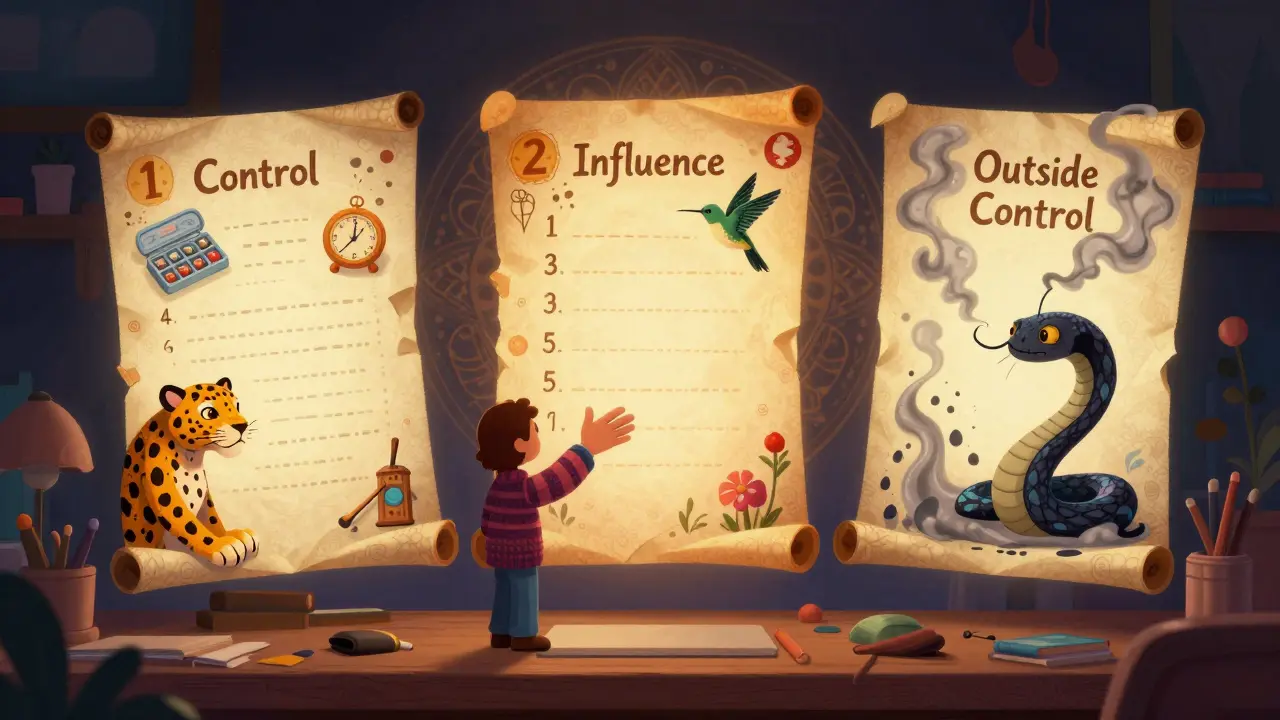
Acceptance and Commitment Therapy (ACT) Works-Here’s How
The most effective psychological intervention for adherence during transitions isn’t a reminder app or a pill box. It’s Acceptance and Commitment Therapy, or ACT. A 2022 JAMA Internal Medicine trial found that ACT improved adherence by 48.6% compared to standard care. How? It teaches you to stop fighting your feelings and start acting anyway. Here’s the core idea: You don’t have to feel motivated to take your pill. You don’t have to feel okay about your divorce or your new job. You just have to do it. ACT helps you separate your emotions from your actions. Practical ACT tip: Every morning, say to yourself: “I’m feeling overwhelmed right now. That’s okay. I’m still going to take my pill because it matters to my future self.” That’s it. No grand speeches. No guilt. Just action, even when it’s hard.Break It Down: The 5-Minute Rule for Transition Survival
Big transitions feel overwhelming because you’re trying to fix everything at once. You think: “I need to find a new doctor, refill all my meds, learn my new pharmacy’s system, update my insurance, and remember to take my pills.” That’s too much. Use the 5-minute rule. Break every task into something you can do in five minutes or less. - Call the pharmacy to transfer your prescription? 5 minutes.- Set up a text reminder with a friend? 2 minutes.
- Buy a new pill organizer? 10 minutes (but you can do it in two 5-minute chunks).
- Write down your medication schedule on a sticky note? 1 minute. Do one 5-minute task every day. Don’t wait for “the right time.” Just start. Momentum builds faster than you think. A Reddit user named u/MedAdherenceWarrior went from 62% adherence to 94% in one month by doing exactly this. “I broke everything into tiny steps,” they wrote. “I didn’t try to fix my whole life. I just fixed the next five minutes.”
When to Ask Your Doctor for Help
You don’t have to figure this out alone. But most people wait until they’re in crisis. The American College of Physicians now recommends that doctors screen for upcoming life transitions during every appointment. That means if you’re planning to move, change jobs, or go through a divorce, you should tell your provider-before it happens. Ask for a transition plan. Specifically: - Can you switch to a monthly refill system?- Can you get a 90-day supply instead of 30?
- Can you get a pill organizer with alarms?
- Can we adjust dosing times to fit my new schedule? Many doctors will do this without hesitation. But you have to ask. Don’t wait until you miss a dose.

What Doesn’t Work (And Why)
Not all advice is helpful. Here’s what fails: - “Just set a phone alarm.” - It works until you change phones or lose your charger.- “Use a pill box.” - Great, until you’re in a hotel room with no counter space.
- “Be more disciplined.” - Discipline doesn’t survive stress. Systems do. The real issue isn’t willpower. It’s environment. Your environment changes during transitions. Your system must change with it.
What to Do Right Now
If you’re going through a transition right now, here’s your action plan:- Make your three lists: Control, Influence, Outside Your Control.
- Identify two daily anchors and attach your meds to them.
- Text one person and ask them to check in daily for the next 30 days.
- Break your next medication task into a 5-minute action. Do it now.
- Call your doctor and say: “I’m going through a big change. Can we adjust my plan?”
Final Thought: Your Health Isn’t a Priority-It’s a Foundation
Life transitions are temporary. Your health isn’t. You might lose your job. You might move. You might feel broken. But your body keeps working. It doesn’t pause because you’re overwhelmed. So don’t let your medication pause either. The goal isn’t to have everything figured out. The goal is to keep taking your pills-even when everything else is falling apart. Because the version of you on the other side of this transition? They’re counting on you to show up.Why do I forget my meds during big life changes?
You don’t forget because you’re careless. You forget because your brain is overwhelmed. Stress reduces your ability to plan, remember, and follow routines. When your environment changes-like moving, changing jobs, or ending a relationship-the cues that reminded you to take your pills disappear. Without those cues, your habits break. It’s not a character flaw. It’s a neurological response.
Are medication reminder apps helpful during transitions?
They help in stable times, but their effectiveness drops sharply during transitions. A 2023 study found that while apps improve adherence by 22.8% under normal conditions, that benefit shrinks to just 8.3% during major life changes. Why? Because apps can’t adapt to your emotional state, lack of Wi-Fi, or new phone. Human support and flexible routines work better when life is unpredictable.
How can I get my doctor to help me with adherence during a transition?
Be direct. Say: “I’m going through a big change-[briefly explain], and I’m worried I’ll miss doses. Can we adjust my plan?” Ask for a 90-day prescription, a pill organizer with alarms, or a simplified dosing schedule. The American College of Physicians now recommends doctors screen for transitions, so many are ready to help. Don’t wait until you’ve missed doses-ask before it happens.
What’s the most effective strategy for staying on track?
The most effective strategy combines three things: anchor routines (attaching meds to daily habits), social support (having someone check in), and psychological flexibility (taking your meds even when you don’t feel like it). A 2022 JAMA study showed that Acceptance and Commitment Therapy (ACT), which teaches this exact approach, improved adherence by 48.6% compared to standard care.
Is it normal to feel guilty about missing doses during a transition?
Yes, it’s normal-but it’s not helpful. Guilt doesn’t fix adherence. Action does. You’re not failing because you’re weak. You’re struggling because your life changed, and your system didn’t adapt. Focus on what you can control: your next pill, your next text to a friend, your next 5-minute task. Progress, not perfection, is the goal.
How long does it take to rebuild a medication routine after a transition?
Most people rebuild a stable routine in 2-3 weeks with consistent effort. The key is not to try to do everything at once. Start with one anchor, one daily check-in, and one small task. By the end of the third week, your new routine will feel automatic. Studies show that adherence rates climb steadily during this period-especially when you use flexible, not rigid, scheduling.
Anna Weitz
December 28, 2025 AT 04:55Life changes wreck your routine not because you're weak but because your brain is a biological machine that runs on cues not willpower
Stop blaming yourself start rebuilding your environment
One pill one day one anchor
Kylie Robson
December 29, 2025 AT 23:36Let’s be precise here: the neurocognitive load during transitional stress induces executive dysfunction in the dorsolateral prefrontal cortex which impairs prospective memory encoding and retrieval
It’s not about forgetting-it’s about failed intention-action binding
And the 32% adherence drop? That’s consistent with the 2021 meta-analysis by Kim et al. on stress-induced behavioral disinhibition
But here’s the kicker-anchor routines work because they externalize cognitive load via environmental cueing
That’s not just psychology-it’s applied behavioral neuroscience
And the 22.7% adherence improvement from focusing on controllable variables? That’s a direct result of reducing cognitive dissonance and restoring perceived agency
Which is why ACT is superior to CBT here-because it decouples affect from action via psychological flexibility
Most people miss this: adherence isn’t a habit-it’s a self-regulatory process
And apps fail because they’re static stimuli in dynamic environments
Real people? They’re dynamic, emotionally contingent, neurobiologically resonant cues
Which is why social support reduces cortisol by 41.7%-it activates the oxytocin-mediated stress-buffering system
So yes, the 5-minute rule works-but only if you understand it’s a micro-intervention in a macro-system of self-regulation
Stop treating this like a productivity hack. It’s neurobehavioral reorganization
Caitlin Foster
December 31, 2025 AT 00:52YES YES YES!!!
STOP SETTING ALARMS!!!
STOP BLAMING YOURSELF!!!
YOU’RE NOT LAZY-YOU’RE HUMAN!!!
ATTACH YOUR PILLS TO BRUSHING YOUR TEETH!!!
TEXT YOUR SISTER!!!
DO ONE FIVE-MINUTE TASK!!!
AND FOR THE LOVE OF GOD STOP TRYING TO FIX EVERYTHING AT ONCE!!!
YOU DON’T NEED MORE DISCIPLINE-YOU NEED A NEW SYSTEM!!!
AND YES-ACT WORKS-IT’S NOT WITCHCRAFT-IT’S SCIENCE!!!
YOU GOT THIS!!!
Andrew Gurung
December 31, 2025 AT 02:38Wow. Just... wow.
Some of us actually have to take 7 different pills, 3 times a day, while juggling a new job, a breakup, and a cat that keeps knocking over our pill organizer
And now you want us to ‘attach meds to anchors’ like we’re some kind of zen monk who meditates before breakfast
Meanwhile, I’m in a studio apartment with no counter space, no Wi-Fi, and my ex just posted a TikTok of her new boyfriend cooking pancakes
So yeah-thanks for the 10-step plan, Mr. Perfect Life
Some of us aren’t trying to ‘optimize’ our health-we’re just trying to survive
And if your solution requires a Pinterest board and a therapist-you’re not helping
You’re just making us feel worse
😭
Alex Lopez
January 1, 2026 AT 08:02While the article presents a compelling framework, one must acknowledge the structural limitations inherent in its recommendations.
For instance, the assertion that ‘real people’ are superior to digital tools assumes consistent access to stable social networks-an assumption that fails to account for individuals in isolated, transient, or abusive environments.
Moreover, the emphasis on ‘anchor routines’ presumes baseline cognitive and physical capacity to maintain even minimal rituals, which is not universally applicable.
Furthermore, the recommendation to ‘ask your doctor’ presumes equitable access to healthcare providers who are not only willing but also trained to address adherence as a behavioral, not merely pharmacological, concern.
These interventions, while theoretically elegant, risk becoming tools of victim-blaming when divorced from socioeconomic context.
One might ask: Why must the burden of adaptation fall entirely on the patient?
Why not redesign pill packaging for mobility? Why not mandate pharmacy delivery during transitions?
Why not subsidize pill organizers for low-income populations?
Systemic change, not personal resilience, is the true solution.
Still-thank you for the honesty.
Paula Alencar
January 3, 2026 AT 04:46Let me tell you something, and I mean this with every fiber of my being-
You are not broken.
You are not lazy.
You are not failing.
You are navigating a storm that no one warned you about.
And the fact that you’re even reading this-right now, in the middle of your chaos-means you’re still fighting.
That’s courage.
That’s strength.
Not the kind that makes headlines.
The kind that shows up when your heart is shattered, your apartment is half-unpacked, and your pills are sitting on a shelf you haven’t even found yet.
You don’t need to be perfect.
You just need to take one.
One pill.
One breath.
One day.
And then another.
And then another.
You’re not behind.
You’re not lost.
You’re becoming.
And your future self? They’re already thanking you.
Will Neitzer
January 3, 2026 AT 11:12Thank you for this comprehensive and clinically grounded perspective.
The integration of behavioral psychology with practical, actionable steps represents a significant advancement in patient-centered care.
Particularly noteworthy is the emphasis on environmental adaptation over individual willpower-a paradigm shift long overdue in chronic disease management.
The distinction between control, influence, and external factors aligns precisely with the principles of Acceptance and Commitment Therapy as outlined by Hayes et al. (2012).
Moreover, the data on social support reducing cortisol levels by 41.7% is corroborated by recent fMRI studies demonstrating reduced amygdala activation during monitored adherence.
One minor addition: for individuals with mobility impairments or visual deficits, tactile pill organizers with Braille labeling and audio cues should be considered as part of List 1 interventions.
Thank you for validating the lived experience of millions who struggle silently.
Janice Holmes
January 5, 2026 AT 02:01Okay so I just moved from Brooklyn to Boise and I lost my entire medication system
My phone died
My ex blocked me
My new landlord doesn’t even know my name
And I cried for three hours in the shower because I realized I hadn’t taken my antidepressant in 48 hours
So I did the 5-minute rule
I bought a $3 pillbox at Walmart
I texted my cousin in Chicago
I attached my meds to my coffee routine
And today? I took them
And I didn’t even feel guilty
Because I didn’t try to fix my whole life
I just fixed the next five minutes
And that was enough
Gerald Tardif
January 6, 2026 AT 19:24You ever take a pill and feel like you’re doing something sacred?
Not because it’s magic.
But because you’re choosing to show up for the version of you that still believes tomorrow matters.
Even when you’re tired.
Even when you’re lonely.
Even when your apartment smells like cardboard and regret.
That pill? It’s not just chemistry.
It’s a promise.
To your future self.
To your body.
To your resilience.
You don’t need to be strong.
You just need to be consistent.
One pill.
One day.
One quiet act of rebellion against the chaos.
That’s all it takes.
Monika Naumann
January 7, 2026 AT 04:58Western individualism at its finest.
You blame your brain for forgetting pills while ignoring the collapse of community structures.
In my country, families care for their elders.
Neighbors check in.
Doctors visit homes.
But here? You turn health into a personal project.
Make lists.
Text strangers.
Do five-minute tasks.
When did we become so isolated that we must engineer our own survival?
This is not empowerment.
This is abandonment dressed as advice.
Real care does not require a pillbox.
It requires a village.