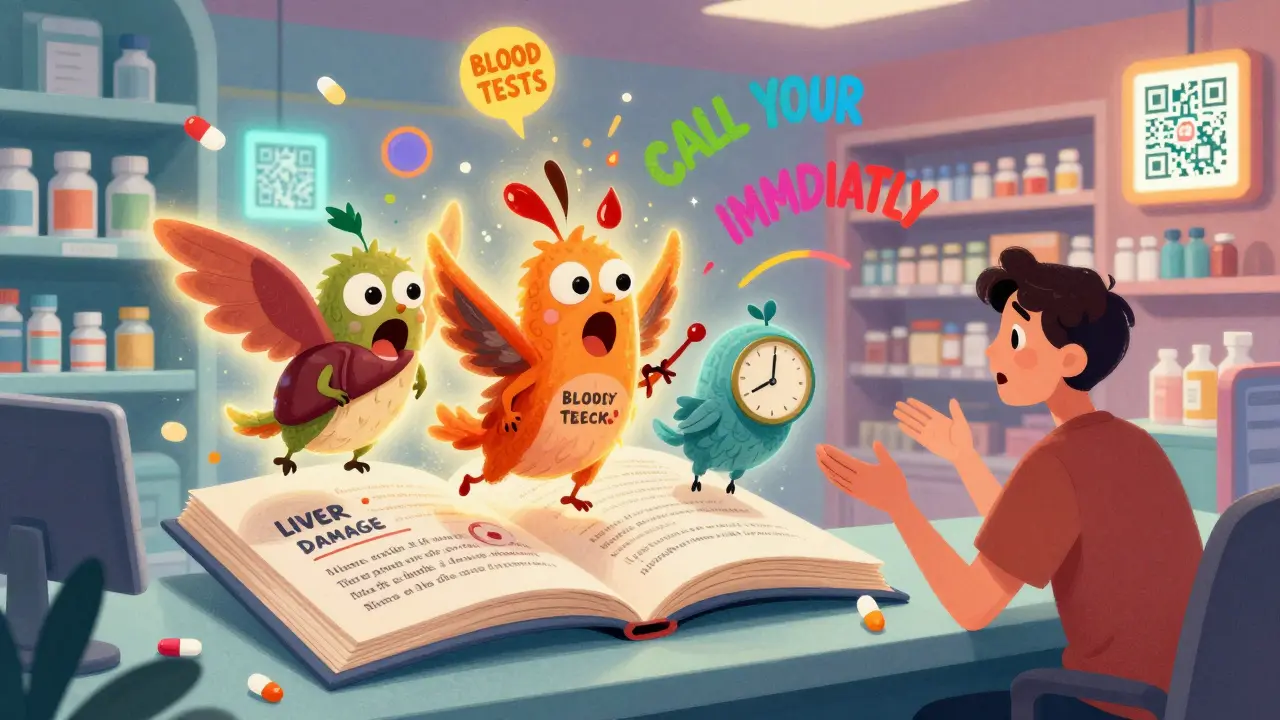
When you pick up a new prescription, the small paper insert that comes with it isn’t just filler. It’s a life-saving document called a Medication Guide. The FDA requires these guides for drugs with serious, preventable risks - things like liver damage, dangerous blood changes, or sudden mood shifts. But most people skim it or toss it. That’s a mistake. If you learn how to read it right, you can avoid hospital visits and even save your life.
What Makes a Medication Guide Different?
Not all drug information is the same. There’s the tiny leaflet inside the box - that’s the package insert, meant for doctors. Then there’s the Medication Guide, which is written for you. It’s required by law when a drug carries risks that can be reduced if you know what to watch for. Think blood thinners, antidepressants, immune suppressants, or cancer drugs. These aren’t just side effects you might ignore. These are events that can kill you if you don’t catch them early.The FDA says these guides must be written at a 6th to 8th grade reading level. That means no jargon. No confusing terms. Just plain language. But here’s the catch: even when it’s simple, people still miss the critical parts. Why? Because they don’t know where to look.
The 4 Sections You Must Read First
Every Medication Guide follows the same seven-section format. But only four of them matter for your safety. Skip the rest - at least at first.- What is the most important information I should know about [drug name]? This is where the FDA puts the biggest warnings. If the drug can cause liver failure, a rare blood disorder, or suicidal thoughts, this section says it clearly. Look for phrases like “can cause serious liver damage” or “may lead to life-threatening infections.” This isn’t a suggestion. This is a red flag.
- What are the possible or reasonably likely serious side effects of [drug name]? This isn’t a list of “maybe you’ll feel a little dizzy.” This is where they tell you what to monitor. For example, the guide for tofacitinib (Xeljanz) says: “Get your blood tested regularly to check for changes in blood cell counts.” That’s not vague. That’s a direct instruction. Write it down.
- How should I take [drug name]? This section tells you when and how often to get tested. For warfarin (Coumadin), it says: “Your INR should be checked at least once a month. If your dose changes, check it more often.” For clozapine (Clozaril), it says: “You need a blood test every week for the first 6 months.” These aren’t suggestions. These are deadlines.
- What should I tell my healthcare provider before taking [drug name]? This tells you what conditions make the drug dangerous for you. If you have liver disease, a history of blood disorders, or are pregnant, this section tells you whether you should even take it. Don’t assume your doctor knows your full history. Read this yourself.
How to Spot the Red Flags
There are seven phrases that should make you stop and pay attention. These are the FDA’s own “red flags” for high-risk monitoring:- “Get blood tests regularly”
- “Call your doctor immediately if”
- “Do not stop taking without talking to your doctor”
- “Avoid sunlight exposure”
- “Do not drink alcohol”
- “May impair driving ability”
- “Keep all scheduled appointments”
If you see any of these, highlight them. Circle the time frame - weekly, monthly, immediately. Underline the symptoms that require emergency care. For example, if your antidepressant guide says “Pay close attention to sudden changes in mood, behavior, or thoughts,” and you see “suicidal thoughts” listed as a possible side effect, you need to know exactly what that looks like. Is it feeling hopeless? Thinking about ending your life? Noticing new anger or panic attacks? Write down your own warning signs.
Real Examples That Save Lives
Take warfarin. It’s a blood thinner used after a stroke or for atrial fibrillation. The guide says: “If you notice unusual bruising, nosebleeds that won’t stop, or blood in your urine or stool, call your doctor right away.” These aren’t vague. They’re specific. And they’re backed by data: patients who followed their guide’s monitoring rules had 32% fewer serious bleeding events.Or look at clozapine, used for treatment-resistant schizophrenia. The guide says: “About 1 in 200 people taking clozapine may develop agranulocytosis - a dangerous drop in white blood cells.” Then it says: “You must have a blood test every week for the first 6 months.” That’s not optional. If you miss one test, you risk death. Yet, many patients skip them because they feel fine. Feeling fine doesn’t mean your blood count is safe.
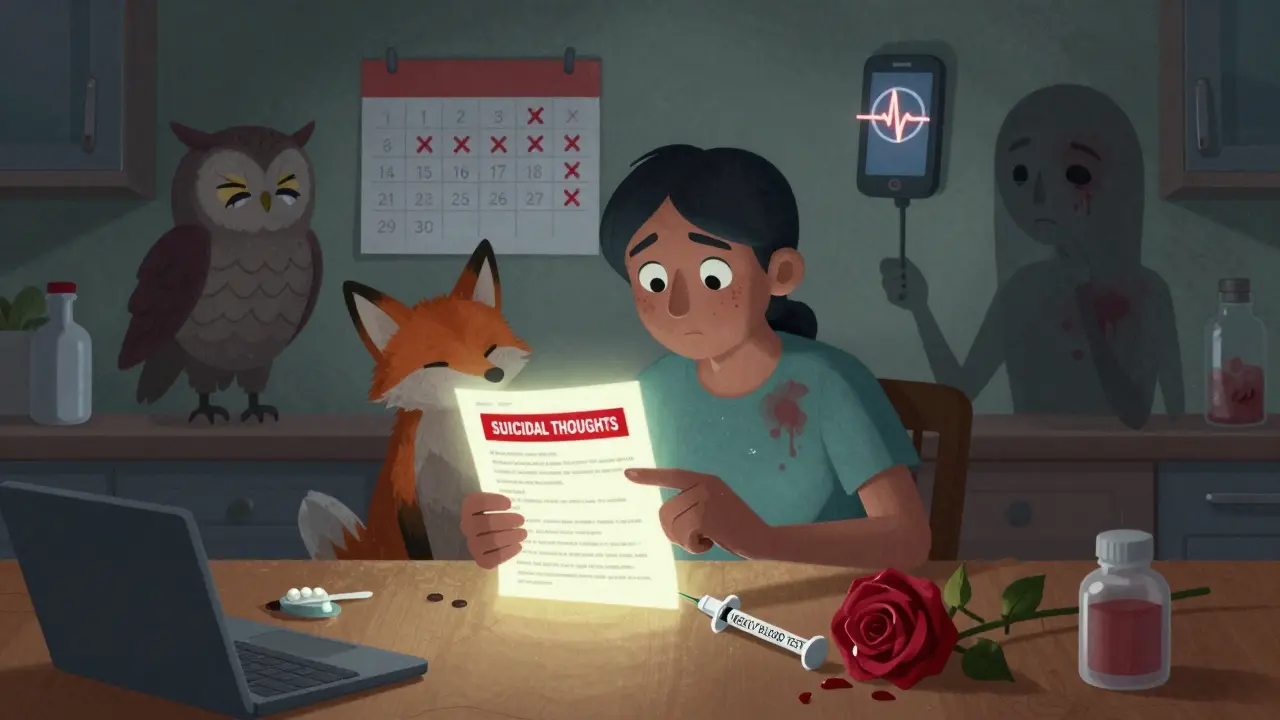
Antidepressants like sertraline or venlafaxine carry a black box warning for increased suicide risk in young adults. The guide says: “This risk is highest during the first 4 to 6 weeks after starting or changing the dose.” That’s a critical window. If you’re not watching for sudden mood swings, irritability, or withdrawal, you could miss the warning signs. One patient told her pharmacist she felt “a little more anxious” after a dose increase. She didn’t think it was a big deal. Two weeks later, she tried to end her life. Her guide had warned her. She just didn’t read it.
How to Actually Use This Guide
Reading it once isn’t enough. Medication Guides get updated. New risks appear. The FDA requires updates within 30 days of new safety data. So here’s how to use it for real protection:- Before your first dose: Spend 3 minutes reading the guide. Highlight the monitoring instructions. Write down the dates for your next blood test.
- Before every refill: Spend 2 minutes checking if anything changed. Did the monitoring frequency change? Did they add a new warning? You can find the latest version on DailyMed.gov - it’s free and updated daily.
- During treatment: Keep a simple journal. Note the date of your last blood test. Write down any new symptoms - even small ones. If you start feeling unusually tired, dizzy, or moody, write it down. Bring it to your next appointment.
One study from the University of Michigan found patients who kept a medication journal had 68% fewer adverse events. Why? Because they could show their doctor patterns - not just vague complaints.
What to Do If You Can’t Find the Guide
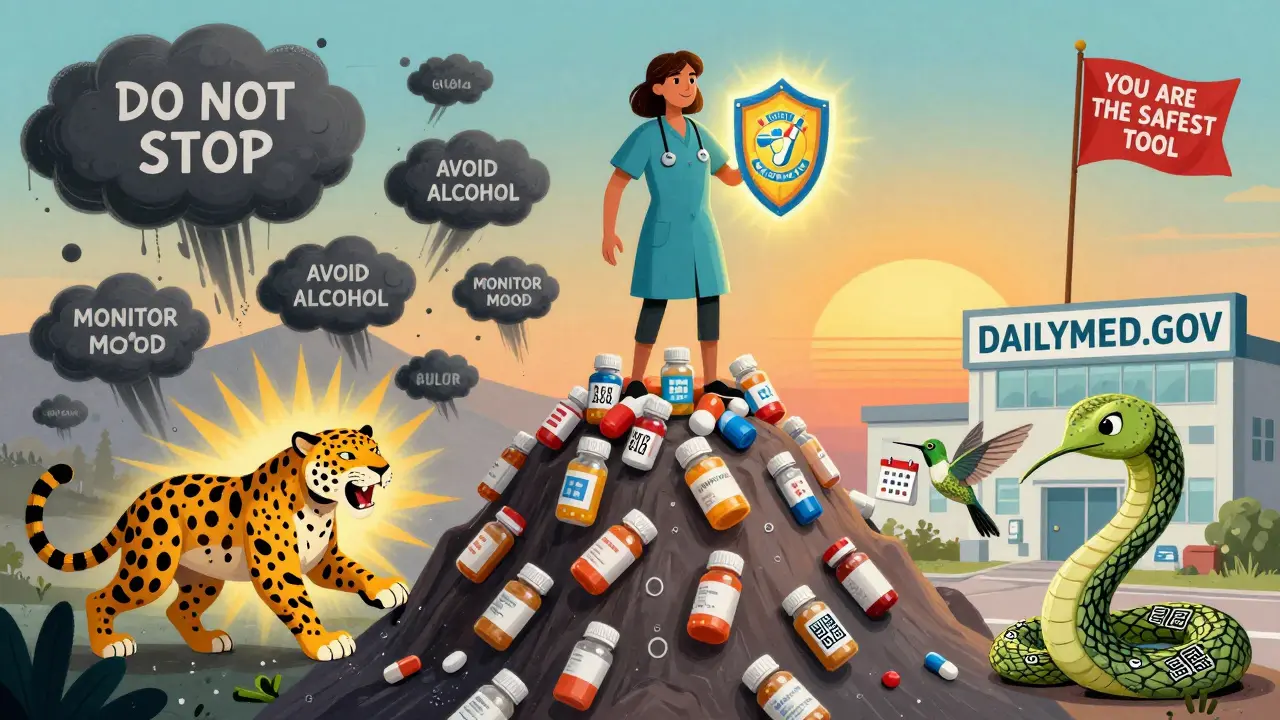
By law, the pharmacy must give you a Medication Guide every time you fill a prescription that requires one. If they don’t, ask for it. If they say “we don’t have it,” ask for the website or phone number to get it. You can also download it from DailyMed.gov - just search the drug name.Pharmacists report that when they physically hand you the guide and say, “This part here - the blood tests - you need to do this every month,” compliance jumps from 45% to 82%. Don’t be shy. Ask. It’s your right.
What’s Changing in 2026?
The FDA is pushing for better design. By 2026, all high-risk medication packages will have QR codes that link directly to the current Medication Guide. Some companies are already testing AI tools that pull your medical history and highlight only the risks that apply to you. But until then, you’re still the most important safety tool you have.Don’t wait for the system to fix itself. Take five minutes. Read the guide. Write down the dates. Know the symptoms. If your doctor doesn’t ask about your monitoring schedule, ask them. You’re not being difficult. You’re being smart.
Do I need to read the Medication Guide every time I refill my prescription?
Yes. Medication Guides are updated when new safety data comes out. Even if you’ve taken the drug for years, a new warning could have been added. Always check before each refill. The FDA requires updates within 30 days of new risks, and manufacturers must provide the latest version with every fill.
What if I don’t understand something in the guide?
Don’t guess. Call your pharmacist or doctor. Ask them to explain the monitoring instructions in plain terms. For example, if it says “check blood counts monthly,” ask: “What exactly are they checking? What happens if it’s low?” Most pharmacists are trained to help you understand these guides - and many will walk you through them in person if you ask.
Are Medication Guides only for serious drugs?
Yes. The FDA only requires Medication Guides for drugs with serious, preventable risks - like liver damage, blood disorders, or suicidal thoughts. Common medications like antibiotics or blood pressure pills don’t need them. If you get one, it’s because the drug carries a real danger you need to watch for.
Can I rely on my doctor to explain the risks?
Your doctor should, but they often don’t have time. A 2023 study found that 63% of patients misunderstood monitoring instructions because their doctor didn’t explain them clearly. Don’t wait for them to bring it up. Bring the guide with you. Point to the section. Ask: “What does this mean for me?” You’re the one taking the medicine - you deserve to understand it.
What if I miss a blood test or monitoring appointment?
Don’t panic, but don’t ignore it. Call your doctor immediately. For some drugs - like clozapine or warfarin - missing one test can be dangerous. For others, it might just mean you need to reschedule. Either way, don’t keep taking the drug without knowing your status. Your safety depends on those tests.
Where can I find the most current version of my Medication Guide?
Go to DailyMed.gov, run by the National Institutes of Health. Search for your drug name. You’ll see the latest FDA-approved guide with the exact date it was updated. This is the official version - not what the pharmacy printed last month. Always double-check here if you’re unsure.
Next Steps: Your Action Plan
Here’s what to do right now:- Find your most recent prescription. Look for the Medication Guide.
- Open it to the “Most Important Information” section. Read it out loud.
- Highlight every sentence with “test,” “monitor,” or “check.”
- Write down the next date you need to get blood work done.
- Call your pharmacy and ask if they have the latest version.
- Set a phone reminder for your next monitoring date.
You don’t need to be a medical expert to protect yourself. You just need to read the guide - and act on it. Your life might depend on it.
James Dwyer
January 27, 2026 AT 17:44This is the kind of post that should be mandatory reading for everyone on prescriptions. I used to toss these guides until my uncle ended up in the ER from a warfarin bleed. He didn’t know he was supposed to get his INR checked every 3 weeks. Now I print mine out and tape it to the fridge. Simple. Life-saving.
Phil Davis
January 29, 2026 AT 02:58So let me get this straight - the FDA makes companies write these in 6th-grade English… but people still skip them? Wow. I guess human nature hasn’t changed since the days of ‘read the manual’ stickers on VCRs.
Irebami Soyinka
January 30, 2026 AT 10:45Y’all in the US think this is revolutionary? In Lagos, we don’t even get these papers - we just swallow pills and pray. But if you’re lucky enough to have this? Read it like your life depends on it… because it does. My cousin died from clozapine because they skipped the blood tests. No drama. Just facts. 🔥
Katie Mccreary
January 31, 2026 AT 08:48Why do you think the system works this way? It’s not about education - it’s about liability. If you die because you didn’t read it, they’re covered. You’re the one who has to be the detective. Welcome to healthcare.
SRI GUNTORO
February 1, 2026 AT 14:36People don’t read because they’re lazy. And lazy people deserve what they get. If you can’t take five minutes to read a guide that could save your life, maybe you shouldn’t be taking the drug at all. Simple as that.
Kevin Kennett
February 3, 2026 AT 01:11I’ve been a nurse for 18 years. I hand out these guides like candy. I tell patients: ‘Don’t just read it - highlight it, write the dates on your calendar, tell your spouse what to watch for.’ One guy brought his wife to the pharmacy just so she could hear the warning about suicidal thoughts. That’s the kind of behavior that changes outcomes. You’re not being annoying - you’re being responsible.
Jess Bevis
February 4, 2026 AT 07:19QR codes by 2026? Finally. My grandma still uses paper. She lost her last guide and spent three days calling pharmacies. A QR code would’ve taken 5 seconds. Tech isn’t the enemy - apathy is.
Rose Palmer
February 5, 2026 AT 06:41It is imperative that individuals take personal responsibility for their pharmacological safety. The dissemination of accurate, FDA-mandated information is a cornerstone of patient autonomy. One must not rely on the fallibility of physician time constraints. Proactive engagement with Medication Guides is not merely advisable - it is an ethical imperative.
Howard Esakov
February 6, 2026 AT 17:52Oh wow, a 6th-grade reading level? How quaint. I suppose that’s why the FDA doesn’t trust us to understand terms like ‘agranulocytosis’ or ‘INR.’ Maybe if we all had PhDs in pharmacology, we wouldn’t need these dumb little pamphlets. /s
Rhiannon Bosse
February 7, 2026 AT 10:37EVERY SINGLE ONE OF THESE GUIDES IS A LIE. The FDA knows these drugs are dangerous - they just don’t want to pull them off the market. That’s why they make you check your blood every week. So they can say, ‘You were warned.’ Meanwhile, Big Pharma is laughing all the way to the bank. I saw a guy on TikTok who lost his spleen from a blood thinner. He had the guide. He followed it. Still died. Who’s really in control here? 🤔
Bryan Fracchia
February 9, 2026 AT 08:45Reading the guide isn’t just about safety - it’s about reclaiming your power. We’ve been taught to trust doctors blindly, but medicine isn’t magic. It’s chemistry. And chemistry has rules. If you take the time to learn those rules, you stop being a patient and start being a partner. That shift? That’s what changes everything. I used to be scared of my meds. Now I know exactly what they’re doing - and when to ask for help. That peace of mind? Priceless.