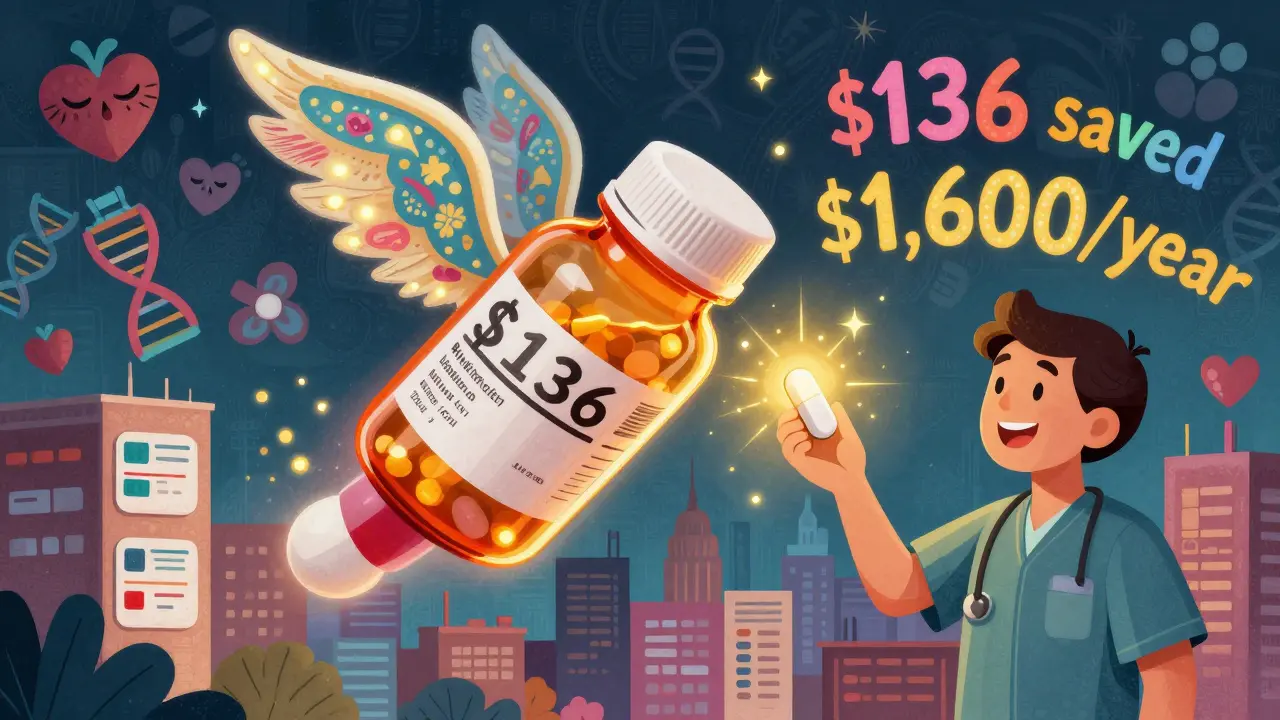
Switching to generic medications isn’t just a smart money move-it’s how millions of people in the U.S. and beyond keep taking their prescriptions without choosing between medicine and groceries. If you’ve ever stared at a $150 pill bottle and wondered if there’s a cheaper way, the answer is yes: generic medications deliver the exact same results at a fraction of the cost. And no, they’re not second-rate. They’re the same drug, made to the same standards, just without the marketing budget.
What Exactly Is a Generic Drug?
A generic drug contains the same active ingredient as the brand-name version. That means if you’re taking lisinopril for high blood pressure, the generic version has the exact same molecule working in your body as the brand-name Zestril. The FDA doesn’t allow anything less. To get approved, a generic must prove it delivers the same amount of medicine into your bloodstream at the same speed as the original. This is called bioequivalence. No guesswork. No shortcuts.The only differences? The color, shape, or filler ingredients-like the starch or dye that holds the pill together. These don’t affect how the drug works. You might notice the generic looks different, or tastes slightly different if it’s a liquid. But the medicine? Identical.
How Much Money Can You Actually Save?
The numbers don’t lie. On average, generic drugs cost 85% less than their brand-name counterparts. That’s not a small discount. That’s life-changing.Take a common medication like metformin for type 2 diabetes. The brand-name Glucophage might cost $140 for a 30-day supply. The generic? Around $4. That’s a $136 monthly saving. Multiply that by 12 months, and you’re looking at over $1,600 a year just on one pill.
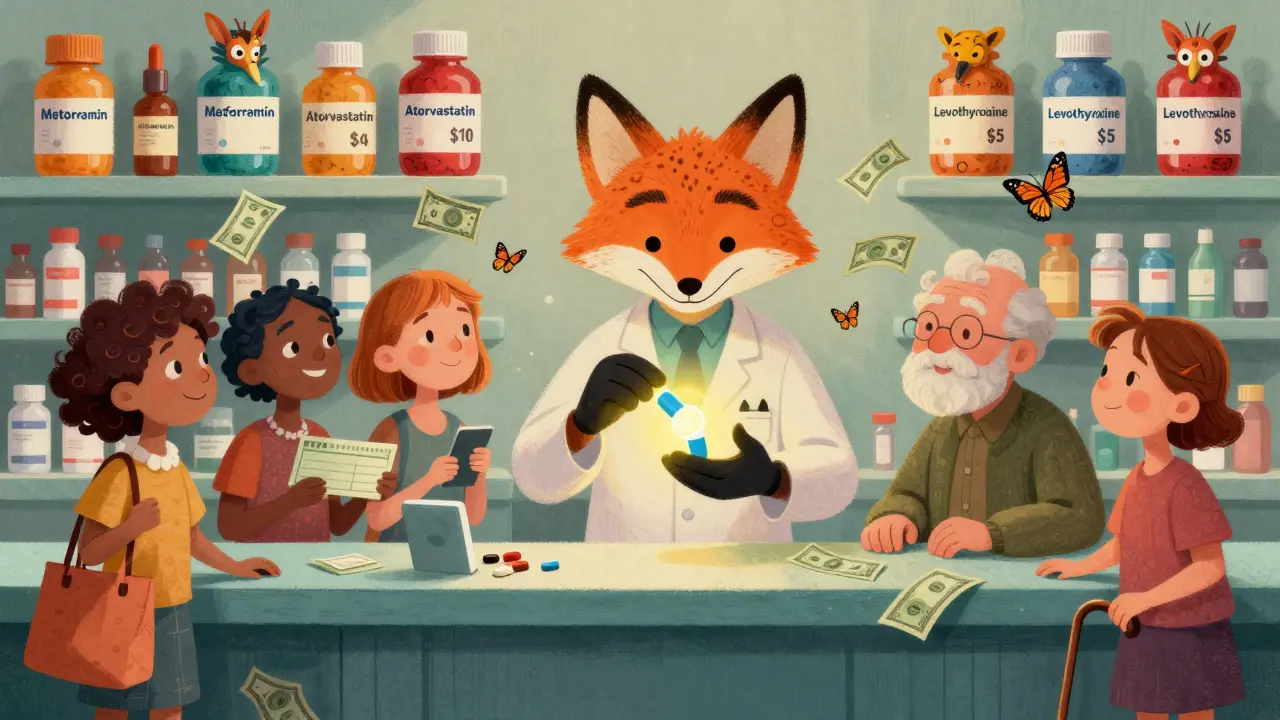
Another example: the cholesterol drug atorvastatin. Brand-name Lipitor used to cost $200+ per month. Now, the generic version runs under $10-even without insurance. The FDA tracked a single drug that dropped from $47 per dose to under $2 after generics entered the market. That one switch saved patients more than $4 billion in a single year.
And it’s not just cash-paying patients. Even people with insurance save big. Between 2010 and 2020, out-of-pocket costs for generic prescriptions fell by nearly half. Insurers pay less, so your copay drops too. Medicare Part D beneficiaries can often get 30-day supplies of common generics at Costco for under $20. Some, like levothyroxine or simvastatin, cost less than $5 at Walmart or Target’s discount pharmacy program.
Why Do Generics Cost So Much Less?
It’s simple: no reinventing the wheel. When a brand-name drug is first made, the company spends years and hundreds of millions on research, clinical trials, and FDA approval. Once the patent runs out-usually after 20 years-other companies can make the same drug. They don’t need to repeat those expensive trials. They just have to prove their version works the same way.That’s thanks to the Hatch-Waxman Act of 1984, which created the Abbreviated New Drug Application (ANDA) process. It’s the reason there are now over 100 generic manufacturers competing in the U.S. market. More competition = lower prices. The FDA approves hundreds of new generics every year to keep that pressure on.
And now, new players are shaking things up. Companies like the Mark Cuban Cost Plus Drug Company (MCCPDC), launched in 2022, sell generics directly to consumers with transparent pricing. No middlemen. No markups. Their data shows a median savings of $4.96 per prescription compared to traditional insurance channels. For uninsured patients, that number jumps to $6.08. That’s not a promotion. That’s the real price.
Are Generics Really as Safe and Effective?
Yes. And the science backs it up.The FDA inspects generic manufacturing plants the same way it inspects brand-name ones. Same standards. Same quality checks. Same rules for purity, strength, and stability. If a generic drug fails any of those tests, it doesn’t get approved.
Some patients worry they’ll feel different on a generic. Maybe they’ve heard stories about a friend who switched and felt “off.” But in most cases, that’s not the drug changing-it’s the mind. A 2023 JAMA Health Forum study found that perceived differences in effectiveness were almost always linked to placebo effects or changes in inactive ingredients, not the active drug itself.
There are rare exceptions. For drugs with a narrow therapeutic index-like warfarin, levothyroxine, or certain seizure meds-small changes in blood levels can matter. Even then, studies show switching between generics or from brand to generic doesn’t increase risk when monitored properly. Your doctor or pharmacist can help you decide if your medication falls into this category.
How to Start Using Generics
You don’t need a PhD to save money on prescriptions. Here’s how to make the switch:- Ask your doctor if your prescription has a generic version. Most do.
- When you get to the pharmacy, let the pharmacist know you’re open to the generic. They’re required by law to substitute unless your doctor says “dispense as written.”
- Compare prices. Sometimes the cash price at Costco, Walmart, or CVS is lower than your insurance copay. Use GoodRx or SingleCare to check.
- For maintenance meds (like blood pressure, diabetes, or cholesterol drugs), consider signing up for a discount pharmacy program. Many offer 30-day supplies for under $10.
- If you’re on Medicare, check your plan’s formulary. Generics are usually in Tier 1-lowest cost.
Don’t assume your insurance will automatically pick the cheapest option. Sometimes, they’ll default to the brand-name drug unless you ask. Be proactive.
When You Might Need the Brand Name
There are a few cases where sticking with the brand makes sense:- Your doctor specifically wrote “dispense as written” on the prescription.
- You’ve had a bad reaction to a specific generic filler in the past (rare, but possible).
- You’re taking a complex biologic drug-like Humira or Enbrel-where only biosimilars (similar, but not exact) are available. These are still cheaper than the brand, but not as cheap as traditional generics.
- Your insurance doesn’t cover the generic, or it’s not available in your area.
Even then, you can still save. Some biosimilars cost 15-35% less than the original biologic. And if you’re paying cash, you might find a better deal through MCCPDC or a nonprofit pharmacy.
Real People, Real Savings
Andrew Tighe from Phoenix switched his daughter’s medications to generics after her family’s insurance changed. She takes four daily prescriptions for a neurological condition. Before? $1,200 a month. After? $280. That’s $11,000 saved in a year.On Reddit, one user posted that switching from brand-name Adderall to generic amphetamine salts cut his monthly cost from $150 to $8. Another saved $300 a month on metformin and statins alone.
These aren’t outliers. They’re the norm. The FDA estimates that over the last decade, generic drugs saved U.S. patients more than $2.2 trillion. That’s more than the GDP of most countries.
What’s Next for Generic Medications?
The future is bright. More blockbuster drugs are coming off patent every year. By 2027, the generic market is expected to grow 7-8% annually. That means even more savings ahead.Biosimilars for cancer, autoimmune, and rare disease drugs are starting to hit the market. These won’t be as cheap as traditional generics, but they’re still a huge step down from the original biologics. Expect to see insulin, rheumatoid arthritis meds, and even some cancer drugs become more affordable in the next few years.
But there’s a risk: if too many generic manufacturers exit low-margin markets, supply can tighten. That’s why the FDA is pushing to clear its backlog of pending generic applications. More competition = more savings.
Final Thought: Your Health Doesn’t Have to Cost a Fortune
You deserve to take your medicine without fear of bankruptcy. Generic medications aren’t a compromise-they’re the standard. They’re what the system was designed to do: make life-saving drugs accessible to everyone.Don’t let confusion, stigma, or misinformation stop you. Ask your pharmacist. Check your prices. Switch when you can. The science is clear. The savings are real. And the people who’ve made the switch? They’re not sacrificing health. They’re protecting it.
Are generic medications as effective as brand-name drugs?
Yes. The FDA requires generic drugs to have the same active ingredient, strength, dosage form, and route of administration as the brand-name version. They must also prove they are bioequivalent-meaning they deliver the same amount of medicine into your bloodstream at the same rate. Thousands of studies and decades of real-world use confirm that generics work just as well.
Why do generic pills look different from brand-name ones?
By law, generic drugs can’t look identical to the brand-name version. That’s to avoid confusion and protect trademarks. So, the color, shape, size, or inactive ingredients (like dyes or fillers) may differ. But these changes don’t affect how the medicine works in your body. Only the active ingredient matters for effectiveness.
Can I switch from a brand-name drug to a generic without talking to my doctor?
In most cases, yes. Pharmacists are legally allowed to substitute generics unless your doctor wrote “dispense as written” on the prescription. But it’s always a good idea to let your doctor know you’ve switched, especially if you’re taking a medication with a narrow therapeutic index (like warfarin or levothyroxine). They can monitor your response if needed.
Why is my generic drug sometimes more expensive than the brand name?
This usually happens when your insurance plan has a high copay for the generic, or when the brand-name drug is on a discount program (like a manufacturer coupon). Sometimes, the brand-name version is cheaper than the generic if the generic hasn’t been approved yet or if it’s a newly released drug with limited competition. Always check cash prices using tools like GoodRx-even if you have insurance, paying cash can be cheaper.
Where can I find the cheapest generic medications?
Costco, Walmart, and Target often offer the lowest cash prices for common generics-sometimes under $10 for a 30-day supply. The Mark Cuban Cost Plus Drug Company (MCCPDC) offers transparent pricing with no markups and ships directly to your door. GoodRx and SingleCare coupons can also slash prices at most pharmacies. Always compare before you pay.
Do generic drugs have more side effects?
No. The active ingredient is identical, so the side effect profile is the same. Rarely, someone might react to an inactive ingredient (like a dye or preservative) in one version but not another. If you notice new side effects after switching, talk to your pharmacist or doctor. It’s usually not the drug itself-it’s a filler or coating.
Are all generic drugs made in the U.S.?
No. Many generic drugs are manufactured in India, China, and other countries. But every facility-whether in the U.S. or overseas-must pass the same FDA inspections. The FDA regularly inspects over 3,500 manufacturing sites worldwide. If a facility fails, the FDA blocks its products from entering the U.S. market.
Can I trust generic drugs from big pharmacies like CVS or Walgreens?
Absolutely. The FDA regulates all prescription drugs sold in the U.S., regardless of where they’re made or sold. Whether you buy a generic at CVS, Walmart, or a small local pharmacy, it’s held to the same strict standards. The pharmacy doesn’t change the drug’s quality-it just delivers it.
If you’re taking multiple medications, start with the ones you use every day-blood pressure, cholesterol, diabetes, thyroid, or antidepressants. These are the biggest money-savers. Switching just two or three prescriptions to generic can easily save you $500 or more a year. That’s a vacation. A car repair. A month’s worth of groceries. Your health shouldn’t cost you everything. With generics, it doesn’t have to.
Dusty Weeks
January 2, 2026 AT 04:24Paul Ong
January 3, 2026 AT 16:56sharad vyas
January 4, 2026 AT 15:49Austin Mac-Anabraba
January 6, 2026 AT 05:39Phoebe McKenzie
January 7, 2026 AT 09:37Layla Anna
January 9, 2026 AT 09:25Heather Josey
January 9, 2026 AT 18:38Donna Peplinskie
January 9, 2026 AT 22:04Olukayode Oguntulu
January 9, 2026 AT 22:27jaspreet sandhu
January 10, 2026 AT 13:34Ann Romine
January 12, 2026 AT 13:27