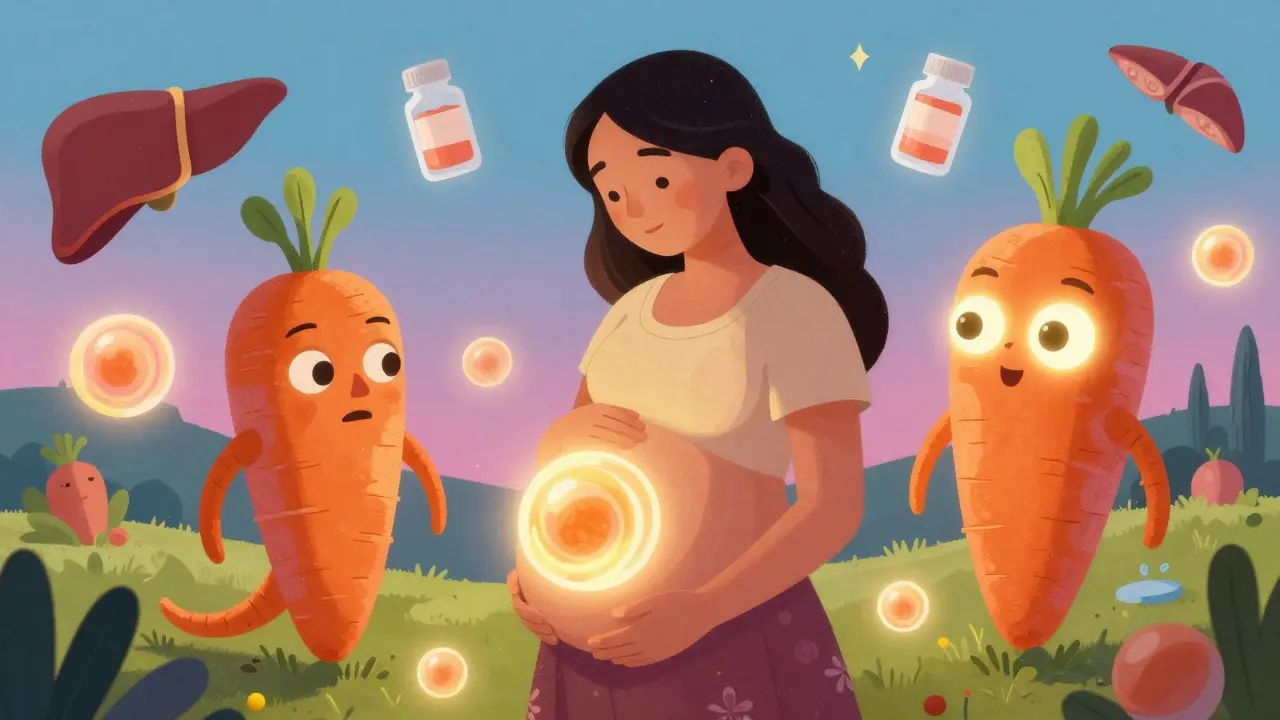
Vitamin A Intake Calculator for Pregnancy
Safe Vitamin A Intake During Pregnancy
The safe daily limit for preformed vitamin A during pregnancy is 10,000 IU. Preformed vitamin A (retinol, retinyl esters) is found in animal products, supplements, and some skincare products. Unlike beta-carotene (from plants), preformed vitamin A can cause birth defects in high doses. This calculator helps you track your intake from different sources.
Note: Beta-carotene sources (carrots, sweet potatoes, spinach) are safe and don't count toward your preformed vitamin A total.
Your Vitamin A Intake
Source Breakdown
When you think of vitamin A, you probably picture glowing skin, healthy eyes, or a strong immune system. But there’s a dark side most people never talk about-especially if you’re pregnant or planning to be. Retinoids and preformed vitamin A aren’t just supplements; they’re powerful drugs that can cause severe birth defects when taken during pregnancy. This isn’t theoretical. It’s documented, measured, and tragically real.
What Exactly Are Retinoids and Vitamin A?
Vitamin A isn’t one thing-it’s a family of compounds. There’s preformed vitamin A, found in animal products like liver, fish oils, and dairy. This includes retinol and retinyl esters, which your body uses directly. Then there’s provitamin A, like beta-carotene, found in carrots, sweet potatoes, and spinach. Your body converts this slowly into active vitamin A, and that’s key-it’s why beta-carotene is safe during pregnancy, while preformed vitamin A isn’t.
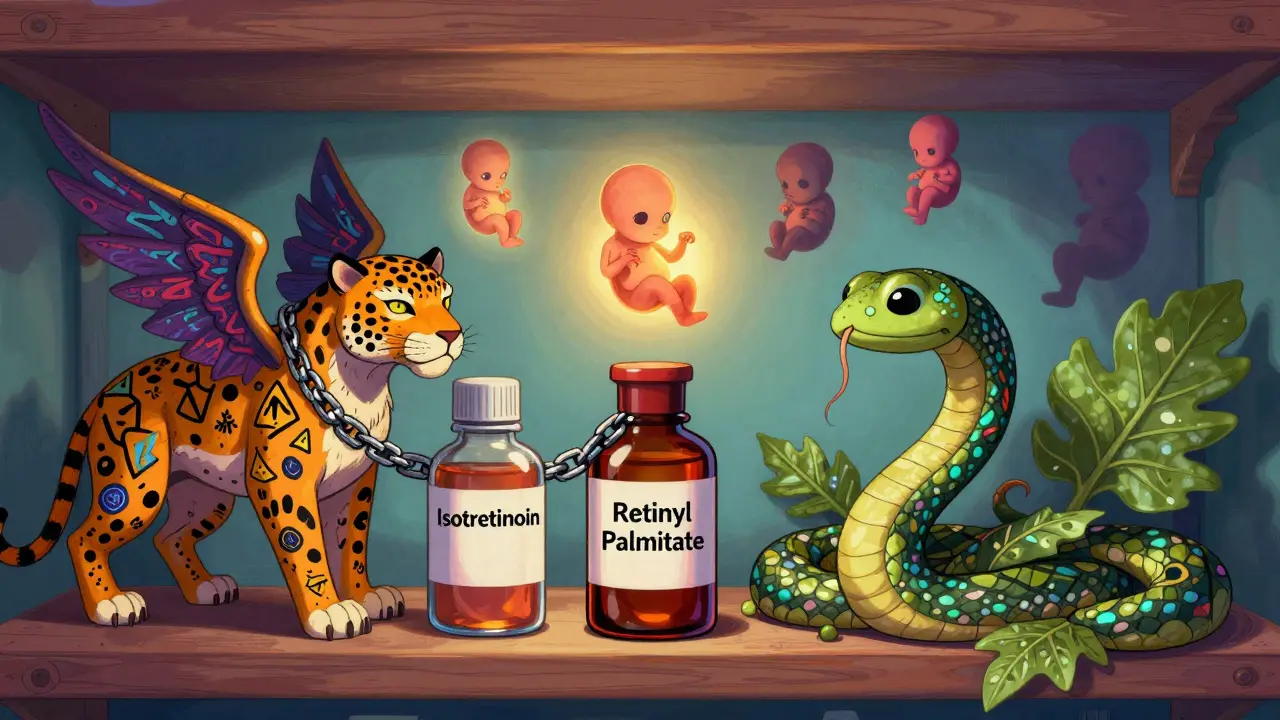
Then come the synthetic versions: retinoids. These are lab-made drugs designed to mimic vitamin A’s effects. The most well-known is isotretinoin (a powerful acne medication sold as Accutane®). Others include etretinate and acitretin. These are not supplements. They’re prescription drugs with strict controls because of how dangerous they are in early pregnancy.
When Does the Danger Start?
The most vulnerable time isn’t when you find out you’re pregnant. It’s before you know.
Organ development in the embryo happens between weeks 3 and 8 after conception. That’s when the heart, brain, eyes, ears, and jaw form. Retinoids interfere with the genes that control this process-especially the Hoxb-1 (a gene that guides body axis formation). Too much vitamin A during this window disrupts the blueprint. The result? Babies born with cleft lips, underdeveloped jaws, missing or malformed ears, heart defects, and brain abnormalities like exencephaly, where part of the brain sticks outside the skull.
This isn’t guesswork. In 1953, scientist Sidney Q. Cohlan gave pregnant rats massive doses of vitamin A and saw these exact defects. Since then, hundreds of human cases have been confirmed. The Teratology Society (the leading authority on birth defects from drugs) has spent decades mapping this risk.
How Bad Is the Risk Really?
Let’s break it down by source:
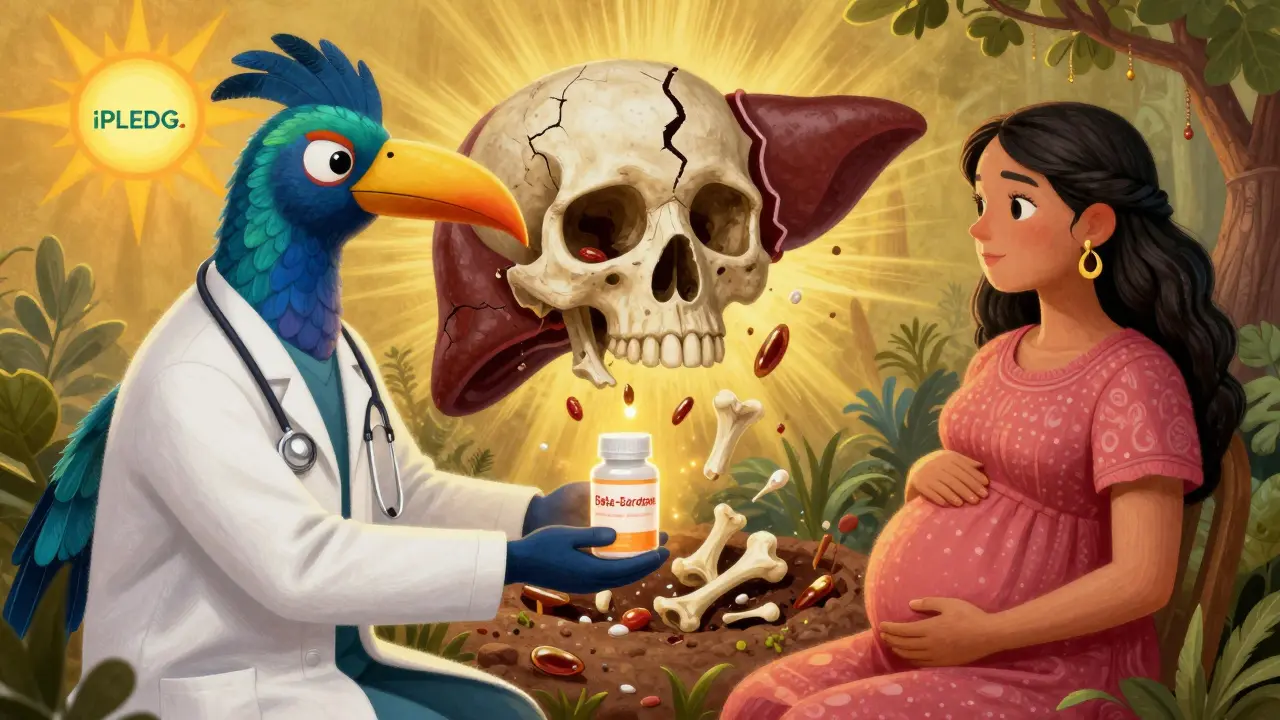
- Isotretinoin (Accutane®): If taken during the first trimester, it causes major birth defects in 20-35% of pregnancies. That’s 25 times higher than the baseline rate. The FDA’s iPLEDGE program, which tracks every prescription, reports 127 confirmed birth defects between 2010 and 2020. Most involved the heart or brain.
- Preformed Vitamin A (dietary supplements): Taking more than 10,000 IU daily during pregnancy increases the risk of major malformations by 2.4 times. That’s not a typo. It’s a real, measurable danger. Beef liver? One 3-ounce serving has 27,000 IU. A single serving could push you over the limit.
- Topical retinoids (creams, gels): These are much safer. Studies show less than 0.5 ng/mL of tretinoin enters the bloodstream after application-far below the level known to cause harm. Still, doctors advise avoiding them during pregnancy just in case.
- Beta-carotene: No risk. Even at doses of 180 mg per day (300,000 IU equivalent), no birth defects have been linked. Your body only turns it into vitamin A as needed.
Why Do People Get Exposed?
It’s not always about taking a drug.
A 2022 ConsumerLab.com review found that 45% of prenatal vitamins contain preformed vitamin A-usually as retinyl palmitate. The average prenatal vitamin has about 2,565 IU. That’s under the limit, but if you’re also eating liver once a week, taking a multivitamin with vitamin A, and using a skin cream with retinol? You could easily hit 15,000-20,000 IU without realizing it.
And then there’s the counseling gap. A 2021 JAMA Dermatology study found that 68% of women who got pregnant while on isotretinoin had not been properly counseled about contraception. One Reddit user, "AcneWarrior2021," wrote: "My dermatologist didn’t properly explain the pregnancy risks-I got pregnant 3 weeks after my last dose and had to terminate due to confirmed risk of craniofacial defects." The half-life of isotretinoin is only 18-24 hours, but the risk lingers. That’s why iPLEDGE requires two negative pregnancy tests and two forms of birth control before and during treatment.
For acitretin, the wait is even longer-2 years after stopping before trying to conceive. Many women don’t know this. Neither do many doctors outside dermatology.
What’s Being Done About It?
The iPLEDGE program in the U.S. and similar systems in Europe and Canada have cut pregnancy rates among isotretinoin users from 3.7% in 2002 to 0.7% in 2022. That’s progress. But it’s not perfect. Only 58% of general practitioners follow prescribing guidelines, compared to 92% of board-certified dermatologists. The system works, but only if everyone follows it.
Meanwhile, the supplement industry is still a wild west. The Council for Responsible Nutrition found that 73% of vitamin A supplements contain preformed vitamin A-not beta-carotene. And 42% of them exceed the 10,000 IU daily limit recommended for pregnant women.
New research is promising. A drug called LGD-1550 (a next-generation retinoid in Phase II trials) shows the same acne-fighting power as isotretinoin but without teratogenic effects in animal models. If it works in humans, it could replace isotretinoin entirely.
The Vitamin A Safety Consortium, funded by the NIH, is creating standardized educational materials. Early results show a 32% improvement in patient understanding after using them. That’s huge.
What Should You Do?
If you’re pregnant or thinking about it:
- Avoid all supplements containing retinol, retinyl palmitate, or retinyl acetate.
- Check your prenatal vitamin label. If it says "vitamin A" without specifying "beta-carotene," ask your provider to switch you.
- Never eat liver or cod liver oil during pregnancy. One serving can be toxic.
- If you’re on isotretinoin or another oral retinoid, use two forms of birth control and get monthly pregnancy tests. Don’t assume your doctor explained it fully-ask for written materials.
- Don’t panic if you took a supplement before knowing you were pregnant. The risk is dose-dependent. Talk to your OB-GYN. Get an ultrasound. Don’t assume the worst.
If you’re a healthcare provider:
- Always ask about supplement use during prenatal visits.
- Know the conversion: 1 IU retinol = 0.3 μg RAE. 1 IU beta-carotene = 0.05 μg RAE.
- Don’t assume patients understand the difference between beta-carotene and retinol. Use plain language: "This is safe. This is dangerous. This is not the same thing."
- For isotretinoin, follow iPLEDGE to the letter. Your patient’s future child depends on it.
What’s Next?
By 2026, we may see mandatory warning labels on high-vitamin A foods-like liver and fish oil supplements. The European Food Safety Authority and FDA are already reviewing limits. Global disparities are stark: in low-resource countries, where contraception access is limited and drug regulation is weak, teratogenic retinoid exposure rates are over eight times higher than in the U.S. That’s not just a medical issue-it’s a human rights issue.
The bottom line: Vitamin A isn’t the enemy. But preformed vitamin A and synthetic retinoids are powerful tools that demand respect. Treat them like you would chemotherapy-not because they’re always harmful, but because they can be, and because the cost of a mistake is too high.
Can I get too much vitamin A from food alone?
Yes. One 3-ounce serving of beef liver contains 27,000 IU of preformed vitamin A-more than double the daily upper limit for pregnant women (10,000 IU). Cod liver oil is even worse: a single teaspoon can deliver over 13,000 IU. Regular consumption of these foods during pregnancy significantly raises the risk of birth defects. The body stores excess vitamin A in the liver for months, so even occasional intake can build up.
Is beta-carotene safe during pregnancy?
Yes. Beta-carotene, found in carrots, sweet potatoes, spinach, and other orange or dark green vegetables, is converted to vitamin A only as your body needs it. Studies show no teratogenic effects even at doses as high as 180 mg per day (equivalent to 300,000 IU). This makes it the safest source of vitamin A for pregnant women. Always choose prenatal vitamins labeled with "beta-carotene" instead of "retinol" or "vitamin A (as retinyl palmitate)."
How long should I wait after stopping isotretinoin before trying to get pregnant?
At least one month after your last dose, according to the FDA. But because isotretinoin can linger in fat tissue, some experts recommend waiting three months. For other retinoids like acitretin, the wait is 2 years. Always follow your doctor’s guidance and confirm with the iPLEDGE program or equivalent system. Never assume the drug is "out of your system" just because your acne cleared up.
Are topical retinoids like tretinoin cream dangerous during pregnancy?
The risk is extremely low. Studies show plasma concentrations of tretinoin after topical use remain below 0.5 ng/mL-far below the level shown to cause harm in animal studies. However, because no drug is 100% risk-free during pregnancy, most dermatologists and obstetricians still recommend avoiding them. If you used them before knowing you were pregnant, there’s no need to panic, but discontinue use and discuss it with your provider.
Why are prenatal vitamins still containing vitamin A if it’s risky?
Many prenatal vitamins still include preformed vitamin A because it’s cheaper and more stable than beta-carotene. The average prenatal vitamin contains about 2,565 IU-well under the 10,000 IU safety threshold. But when combined with other supplements or foods like liver, the total intake can become dangerous. The problem isn’t the vitamin itself, but the lack of clear labeling and patient education. Always check the label and ask your provider if you’re unsure.
Jonathan Noe
February 12, 2026 AT 06:45Let me break this down real simple: if you're pregnant or thinking about it, stop eating liver like it's a snack. One serving = 27,000 IU. The limit is 10,000. That’s not a suggestion-it’s a warning label on your damn dinner plate. And don’t get me started on those ‘natural’ prenatal vitamins with retinyl palmitate. You think you’re being healthy? You’re just dosing your unborn kid like a chemistry experiment.
Also, topical retinoids? Yeah, the science says it’s negligible absorption. But if your dermatologist says ‘avoid,’ then avoid. Don’t be the person who says ‘I read a study’ and then ends up in a NICU.
Jim Johnson
February 13, 2026 AT 04:40Hey, I just wanna say-this post saved my ass. I was taking a prenatal with retinol and eating cod liver oil ‘for the omega-3s.’ Didn’t even know there was a difference between beta-carotene and retinol. Found out I was preggo 2 weeks in and freaked out. Called my OB, switched vitamins, and she said ‘thank you for asking.’ Seriously, this info needs to be on every prenatal box. You’re a legend for writing this.
Vamsi Krishna
February 14, 2026 AT 16:07Oh wow, so now we’re banning liver because some rich lady in California can’t handle her vitamins? How about we stop infantilizing women and let them make their own choices? You people act like pregnancy is a prison sentence with a list of forbidden foods. I ate liver twice a week during both my pregnancies. My kids are 8 and 11-perfectly healthy. This is fearmongering dressed up as science.
And don’t even get me started on iPLEDGE. You think the government cares about your unborn child? They care about liability. They want you scared so they don’t get sued. Meanwhile, real women in Nigeria and Bangladesh are feeding their babies vitamin A-rich foods because they’re ALIVE. Not because some FDA form says so.
Brad Ralph
February 16, 2026 AT 07:24Suzette Smith
February 17, 2026 AT 05:38Actually, I think the real issue is that doctors don’t tell women about this until it’s too late. I was on Accutane. My doctor said ‘just don’t get pregnant.’ Didn’t say ‘use two forms of birth control.’ Didn’t say ‘avoid liver.’ Didn’t even mention the 1-month waiting period. I got pregnant 3 weeks after stopping. They said ‘it’s probably fine.’ It wasn’t.
So yeah, this post is accurate. But the system is broken. We need mandatory counseling. Not just paperwork. Real talk. In person. With pictures. Not some PDF you ignore because you’re 22 and think you’re invincible.
Autumn Frankart
February 18, 2026 AT 01:22EVERYTHING in this post is a lie. Vitamin A is a NATURAL nutrient. The government and Big Pharma teamed up to scare women into taking synthetic beta-carotene so they can patent it and charge $50 a bottle. Liver has been eaten for centuries. Indigenous cultures thrived on it. This is just another way to control women’s bodies under the guise of ‘science.’
Also, isotretinoin was banned in Europe for years because of ‘birth defects’-until they realized the data was fabricated by pharmaceutical companies to eliminate competition. The real cause of birth defects? 5G radiation. The FDA knows this. They just won’t admit it.
Check the dates on those ‘confirmed cases.’ They all happened after 2008. Coincidence? I think not.
Stephon Devereux
February 18, 2026 AT 05:06Here’s the thing no one’s saying: this isn’t about vitamin A. It’s about control. We’ve turned pregnancy into a high-stakes compliance test. You can’t eat this, you can’t take that, you can’t even sneeze without a consent form. And guess who’s most affected? Low-income women who can’t afford ‘beta-carotene-only’ supplements or who don’t have access to dermatologists who actually read the iPLEDGE manual.
Yes, retinoids are dangerous. But the solution isn’t more warnings-it’s better healthcare access. If a woman in rural Alabama can’t get a $100 prenatal vitamin, she’s going to eat liver. And she should be able to. The real tragedy isn’t the birth defect-it’s the system that makes her choose between nutrition and fear.
steve sunio
February 19, 2026 AT 22:29u dumb? u read? 10k IU limit? lmao. my grandmum ate liver every day in 1960s n her kids was fine. u think science changed? no. u think corporate changed. they sell beta-carotene cause its more expensive. u pay for fear. i dont.
athmaja biju
February 21, 2026 AT 12:15As an Indian man, I find it ridiculous that Western medicine is treating a traditional food like liver as toxic. In our culture, liver is given to pregnant women to strengthen the baby’s bones and eyes. It’s part of Ayurveda. This fear-driven narrative ignores centuries of wisdom. Beta-carotene may be safe, but it’s not better-it’s just a processed alternative.
Also, why is the iPLEDGE program only enforced in the U.S.? In India, we don’t have such restrictions. We trust the body. We trust tradition. Maybe the real problem is over-medicalization.
Robert Petersen
February 22, 2026 AT 07:48Just want to say thank you for writing this. I’ve been a nurse for 12 years and I’ve seen too many cases where women didn’t know the difference between retinol and beta-carotene. I’ve held the hands of mothers who lost babies because they took a supplement labeled ‘vitamin A’ and assumed it was safe. This isn’t fear-it’s responsibility.
And yes, the supplement industry is a mess. But the solution isn’t to shut it down-it’s to educate. I hand out laminated cards to every pregnant patient: ‘If it says retinyl palmitate, put it back.’ Simple. Clear. Life-saving.
Reggie McIntyre
February 23, 2026 AT 22:58So… if beta-carotene is safe, why don’t we just make all prenatal vitamins that? Is it cost? Stability? Or are we just stuck in the 1980s because no one wants to update the formula? I’ve got a 2-year-old who’s never had a drop of retinol. I read labels like a detective. My kid’s eyes are sharp, his skin glows, and I didn’t need to eat liver once. Why is this still a debate?
Also, can we make a meme? ‘When your prenatal says ‘Vitamin A’ but you’re smart enough to know it’s not beta-carotene’? I’d wear that shirt.
Carla McKinney
February 25, 2026 AT 11:55People who say ‘I ate liver and my kids are fine’ are cherry-picking. You’re not a statistical sample-you’re an anecdote. The risk isn’t 100%. It’s 20-35% for isotretinoin. That’s still catastrophic. And yes, some women get lucky. But one lucky woman doesn’t cancel out 100 babies born with exencephaly.
Also, stop pretending this is about ‘control.’ It’s about biology. Retinoids bind to nuclear receptors and alter gene expression. That’s not opinion. That’s molecular biology. You can’t wish away Hox genes because you hate the FDA.
Stacie Willhite
February 27, 2026 AT 00:08I just wanted to say… if you’re reading this and you’re scared because you took a supplement before knowing you were pregnant, please don’t spiral. I did too. I took a multivitamin with retinyl palmitate for 4 weeks. I panicked. Called my OB. She did an ultrasound. Everything looked perfect. She said, ‘The risk is dose-dependent. You didn’t overdose. You’re fine.’
You’re not a bad mom. You’re a human. This post isn’t here to shame you. It’s here to help you move forward. Breathe. Talk to your doctor. Don’t Google. Don’t Reddit. Just breathe.