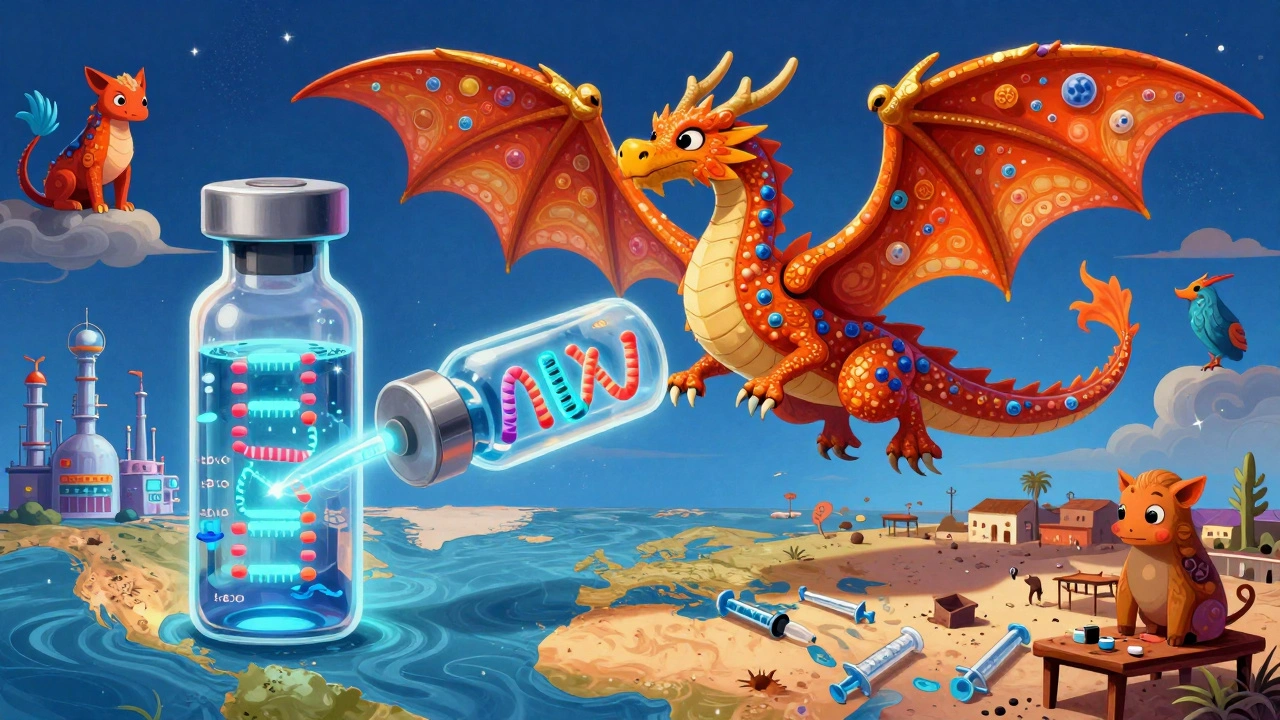
When people talk about generic vaccines, they’re thinking of something simple: cheaper versions of life-saving shots, like how generic pills for blood pressure or antibiotics cut costs dramatically. But vaccines don’t work like that. There’s no such thing as a true generic vaccine in the way we understand generics for pills. You can’t just copy the formula, swap out a few ingredients, and get the same result. Vaccines are vaccines-complex biological products made from living cells, viruses, or mRNA strands. They require factories built for precision, not mass production. And that’s why, even in 2025, billions of people in low-income countries still wait months-or years-for vaccines that wealthier nations received within weeks.
Why There Are No True Generic Vaccines
Unlike a pill made of a single chemical compound, a vaccine is a living system. It might use weakened viruses, protein fragments, or genetic code wrapped in lipid nanoparticles. Each step-growing cells, purifying proteins, stabilizing the final product-has to be perfect. One tiny mistake, and the batch is ruined. That’s why regulators like the FDA and EMA don’t accept the same shortcut used for generic drugs. For a pill, you prove it’s "bioequivalent"-it breaks down the same way in the body. For a vaccine? You have to prove it triggers the same immune response, which means running full clinical trials again. No shortcuts. No abbreviated approvals. No easy copycat. This isn’t just red tape. It’s science. The mRNA vaccines for COVID-19, for example, rely on synthetic lipids that only five or seven companies worldwide can make at scale. If you don’t have access to those lipids, you can’t make the vaccine-even if you have the recipe. That’s not a patent issue. That’s a supply chain issue. And it’s one that no amount of legal maneuvering can fix.The Manufacturing Reality: Billions of Doses, But Only a Few Factories
Only six companies control 70% of the global vaccine market. GSK, Merck, Sanofi, Pfizer, Johnson & Johnson, and the Serum Institute of India. The Serum Institute, based in Pune, India, is the biggest by volume. It produces 1.5 billion doses a year. That’s more than any other single manufacturer. But even that’s not enough. During the pandemic, the world needed over 11 billion doses of COVID-19 vaccines. The Serum Institute alone couldn’t meet demand. And it couldn’t just flip a switch to make more. Building a new vaccine factory isn’t like opening a new pharmacy. It takes 5 to 7 years. It costs between $200 million and $500 million. You need biosafety level 2 or 3 labs, ultra-cold storage for mRNA vaccines (-70°C), and a supply chain for raw materials that doesn’t exist in most countries. Even India, which makes 60% of the world’s vaccine volume, imports 70% of its key vaccine ingredients from China. That’s a vulnerability. When India shut down exports in April 2021 during its own COVID wave, global vaccine supply dropped by half.Who Gets Vaccines-and Who Doesn’t
The numbers are brutal. In early 2021, high-income countries, representing just 16% of the world’s population, had already bought up 86% of the first doses of COVID-19 vaccines. Meanwhile, in the Democratic Republic of Congo, health workers were getting doses that would expire in two weeks-because they had no way to keep them cold. In Africa, 83% of the 1.1 million doses delivered through COVAX in April 2021 went to just 10 countries. Twenty-three African nations had vaccinated less than 2% of their people. Africa produces almost none of its own vaccines. It imports 99% of them. That’s not because African countries lack talent or ambition. It’s because the infrastructure doesn’t exist. The African Union estimates it would take $4 billion and 10 years to get to 60% self-sufficiency. Right now, local manufacturing covers less than 2% of the continent’s needs. And here’s the irony: India, the world’s vaccine workshop, exports 70% of its generics and vaccines. But it’s not building capacity for the global poor-it’s building for markets that pay. The Serum Institute made the AstraZeneca vaccine for $3-$4 a dose. Western companies sold theirs for $15-$20. But even at $3, the margins were razor-thin. The factory costs alone were $500 million per line. There’s no profit in equity.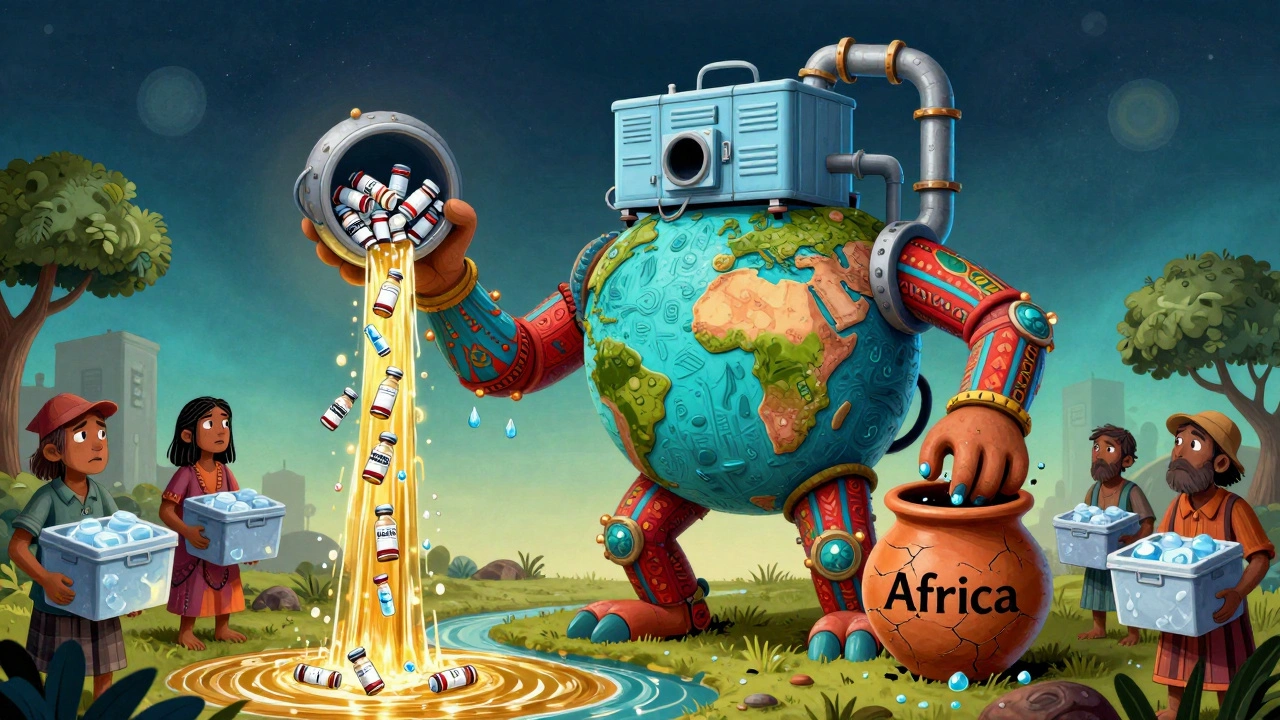
Technology Transfer: Promises vs. Reality
The WHO set up a mRNA vaccine technology transfer hub in South Africa in 2021, with help from BioNTech. The goal? Let African manufacturers learn how to make mRNA vaccines. Three years later, they produced their first batch. But the capacity? 100 million doses a year. That’s less than 1% of global demand. Why so slow? Because getting the recipe isn’t enough. You need the right machines. The right chemicals. The right trained staff. And none of those are easy to source in low-income countries. The same thing happened in Indonesia and Brazil. Even with technical help, delays piled up. Equipment was backordered for over a year. Lipid nanoparticles weren’t available. Local regulators didn’t have the staff to review applications. And without government subsidies, no private company would risk the investment.Why the Generic Drug Model Doesn’t Work for Vaccines
In the U.S., 90% of prescriptions are filled with generic drugs. They make up only 20% of spending. That’s because once a patent expires, dozens of companies can make the same pill. Prices crash. Competition kicks in. But vaccines? There’s no competition. Even when multiple companies make the same vaccine, they rarely undercut each other. Gavi, the global vaccine alliance, says the pneumococcal vaccine still costs over $10 per dose for low-income countries-even after years of negotiations. That’s because there are no true alternatives. No generic competitors. Just a handful of manufacturers with monopoly power. Compare that to India’s generic drug industry. It supplies 40-70% of the WHO’s DPT and BCG vaccines. But those are old, simple vaccines. The kind that have been around since the 1960s. The manufacturing is well understood. The supply chains are stable. The margins are low, but predictable. For new vaccines-like those for malaria, RSV, or future pandemics-there’s no playbook. And no one is willing to build the factories until they’re sure they’ll get paid.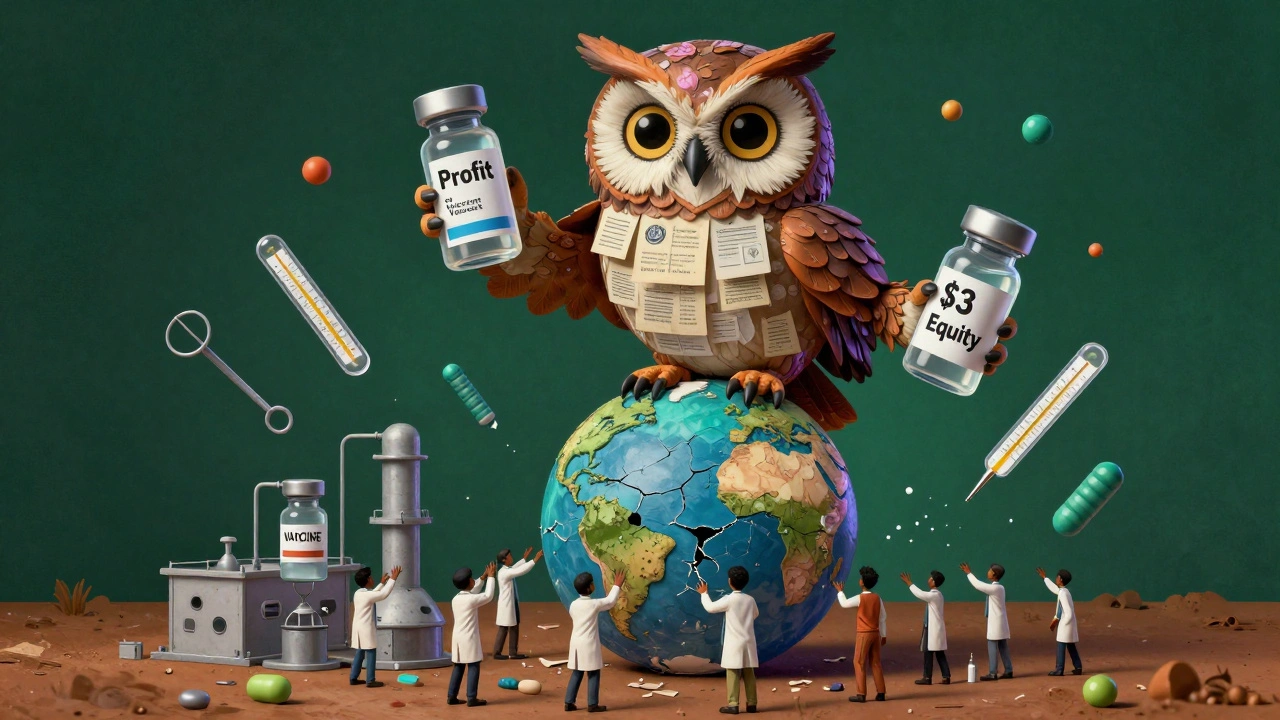
The Path Forward: What Needs to Change
There are no easy fixes. But here’s what’s needed:- Public funding for manufacturing: Governments need to invest in vaccine factories like they invest in roads or power grids. Not as charity-as infrastructure.
- Breaking supply chain monopolies: The companies that make lipid nanoparticles and cell culture media need to be forced to license their tech or face penalties. No one should control the lifeblood of a global vaccine supply.
- Streamlined regulation: WHO and regional regulators need to harmonize approval processes. If a vaccine is approved in India, it should be fast-tracked in Africa, not held up for redundant testing.
- Local ownership: Vaccines made in Africa should be owned and controlled by African institutions-not foreign companies with profit targets.
What’s Next?
By 2025, low- and middle-income countries will still be 70% dependent on imported vaccines. That’s the projection from Gavi. It’s not because we don’t know how to fix this. It’s because we haven’t chosen to. We’ve built a system where vaccine access is tied to wealth, not need. And until that changes, millions will keep dying-not because the science is too hard, but because the system is too broken.There are no generic vaccines. But there can be fair access. If we’re willing to pay for it.
Why can’t we just make generic versions of vaccines like we do with pills?
Vaccines are biological products, not chemical compounds. You can’t prove they work the same way just by testing blood levels like you can with pills. Each vaccine requires full clinical trials, specialized manufacturing, and rare raw materials. Even if you have the formula, you can’t copy it without the exact equipment, cell lines, and lipid nanoparticles-which only a handful of companies make.
Does India produce generic vaccines?
India produces the majority of the world’s vaccines by volume-60%-including 90% of the WHO’s measles vaccine and 70% of its DPT and BCG vaccines. But these aren’t "generics" in the drug sense. They’re original products made under license or developed independently. India’s strength is in manufacturing old, well-established vaccines at low cost-not copying new ones.
Why doesn’t Africa make more of its own vaccines?
Africa imports 99% of its vaccines because building manufacturing capacity requires billions in investment, decades of training, and access to rare materials. There are no existing factories with the right tech, and no private companies will invest without guaranteed buyers. The African Union estimates it will take $4 billion and 10 years to reach 60% self-sufficiency.
Can mRNA vaccine tech be transferred to low-income countries?
Yes, but it’s extremely difficult. The WHO’s hub in South Africa received tech from BioNTech but still took over two years to produce its first batch. The main barriers weren’t knowledge-they were equipment, supply chains, and regulatory capacity. You can’t just hand over a recipe. You need the entire ecosystem.
Are vaccine prices lower in low-income countries?
Sometimes, but not enough. Gavi negotiates lower prices, but even then, vaccines like the pneumococcal shot still cost over $10 per dose for the poorest countries. Meanwhile, the same vaccine costs under $3 in India-but only because the Serum Institute produces it at scale. For new vaccines, prices often stay high because there are no competitors.
What’s the biggest barrier to global vaccine equity?
It’s not patents. It’s infrastructure. The world has the science. What’s missing are the factories, the trained workers, the supply chains, and the political will to fund them. Until governments treat vaccine manufacturing like public infrastructure-not a private profit opportunity-equity won’t happen.
Kyle Flores
December 8, 2025 AT 02:42It’s wild how we treat vaccines like they’re just pills with extra steps. We’ve got the tech, the brains, the money-but we won’t share the tools. It’s not about science, it’s about who gets to profit. I’ve seen clinics in rural Georgia struggle to keep flu shots cold. Now imagine that in rural Congo. We’re not failing because we can’t-we’re failing because we don’t care enough to fix it.
Ryan Sullivan
December 9, 2025 AT 17:46The entire premise is fundamentally flawed. Vaccines are not pharmaceutical commodities-they are bioengineered artifacts requiring proprietary manufacturing ecosystems. To equate them with generic small-molecule drugs is to misunderstand the ontological distinction between synthetic chemistry and biological complexity. The notion that ‘copying the recipe’ is sufficient reveals a profound ignorance of immunological validation paradigms and GMP compliance thresholds.
Jennifer Anderson
December 10, 2025 AT 03:45someone said it above but like… why do we act like this is normal? we make phones, laptops, even electric cars in like 50 countries. but vaccines? nope, only 6 companies get to decide who lives and who doesn’t. it’s not rocket science, it’s just… greed dressed up as science.
Oliver Damon
December 10, 2025 AT 06:28The structural inequality here reflects a deeper epistemological failure: we’ve optimized for efficiency and profit in global health infrastructure, not resilience or equity. The assumption that market mechanisms will naturally distribute biological necessities is a neoliberal fallacy. The fact that lipid nanoparticles are a chokepoint isn’t accidental-it’s engineered. We’ve outsourced the moral calculus to supply chain logistics, and now we’re surprised when millions die because a factory in Shanghai shut down for a week.
Louis Llaine
December 10, 2025 AT 12:43So let me get this straight-we spent $10 trillion on wars but can’t afford to build 10 more vaccine factories? Yeah, that tracks. Next you’ll tell me the moon landing was fake because we didn’t fix the power grid.
Jane Quitain
December 11, 2025 AT 14:46we can do this!! imagine if every country had even ONE vaccine plant-like, just one! think of the jobs, the pride, the hope!! we just need to believe and push and fund and… come on people, we’re smarter than this!!
Sam Mathew Cheriyan
December 12, 2025 AT 03:10lol the real reason no one makes vaccines in africa? because the west doesn’t want them to. it’s all about control. the WHO? big pharma’s puppet. the tech transfer? a show for the cameras. they’ll let africa make chickenpox shots but not mRNA? please. they need africa to stay sick so they can keep selling. and don’t even get me started on the lipid nanoparticles-those are controlled by the same guys who own your internet.
Ernie Blevins
December 13, 2025 AT 02:44everyone’s overcomplicating this. it’s simple. rich people get vaccines. poor people die. that’s the system. no magic fix. no ‘fair access.’ just capitalism. move on.
Ted Rosenwasser
December 13, 2025 AT 19:41Let’s be real: the Serum Institute is a marvel of industrial scale, but it’s still operating under a colonial-era model-exporting low-margin commodities while the West hoards IP and high-margin biologics. This isn’t about ‘equity.’ It’s about redefining global value chains. We need a new Bretton Woods for biological goods. A WHO-recognized patent pool with binding tech licensing and sovereign manufacturing guarantees. Otherwise, we’re just rearranging deck chairs on the Titanic. 🚢💉