
Why accurate cancer staging matters more than you think
Getting cancer staged right isn’t just a box to check-it changes everything. A stage II tumor might be cured with surgery and chemo. A stage IV tumor needs a completely different plan: targeted therapy, immunotherapy, or palliative care. The difference between these paths often comes down to one thing: imaging. PET-CT, MRI, and PET-MRI don’t just show where the tumor is-they reveal how aggressive it is, whether it’s spread, and if treatment is working. Get it wrong, and patients face unnecessary surgery, missed opportunities, or delayed care. Get it right, and survival rates climb.
PET-CT: The workhorse of cancer staging
PET-CT became the standard in the early 2000s because it solved a big problem. Before it, doctors had to guess if a lymph node was cancerous based on size alone. A swollen node could be infection or cancer. PET-CT changed that by showing metabolic activity. Tumors burn sugar fast, so when patients get injected with a radioactive glucose tracer (18F-FDG), cancer lights up on the scan.
It’s fast. Most scans take 15 to 20 minutes. It’s widely available. Nearly every hospital in the U.S. and Europe has at least one PET-CT machine. It’s powerful for lung cancer, lymphoma, melanoma, and colorectal cancer. A 2023 meta-analysis found PET-CT correctly identified cancer spread in the lymph nodes of non-small cell lung cancer patients 84% of the time.
But it has limits. Soft tissues like the liver, prostate, or brain don’t always show clear differences in sugar use. Some tumors-like certain prostate or kidney cancers-don’t absorb the tracer well. And it uses radiation. A typical scan delivers 10 to 25 millisieverts-roughly the same as five years of natural background radiation. For younger patients or those needing repeated scans, that adds up.
MRI: Seeing the unseen with no radiation
MRI doesn’t use radiation or tracers. It uses magnets and radio waves to create ultra-detailed pictures of soft tissues. That makes it unbeatable for brain tumors, spinal cord cancers, liver lesions, and pelvic cancers like prostate or cervical cancer.
In prostate cancer, multiparametric MRI can detect tumors with 75% accuracy-better than PSA tests or standard CT scans. For breast cancer patients getting chemo before surgery, MRI tracks shrinkage better than mammograms. A 2017 study showed MRI spotted residual disease after treatment more reliably than PET-CT in early-stage cases.
But MRI is slow. A full-body scan can take over an hour. It’s noisy. Patients have to lie perfectly still. And it’s not for everyone. People with pacemakers, cochlear implants, or certain metal implants can’t have one. Even then, some tumors look like scar tissue on MRI, making it hard to tell if cancer is still alive after treatment.

PET-MRI: The hybrid that’s changing the game
PET-MRI, introduced in 2011, combines the metabolic power of PET with the soft-tissue detail of MRI in one scan. It’s like having two cameras at once-one showing what’s happening inside cells, the other showing exactly where it’s happening.
This matters most in tricky cases. In brain tumors, doctors struggle to tell if a growing area is new cancer or just radiation damage. PET-MRI gets it right 85-90% of the time. In liver cancer, it spots small metastases that PET-CT misses. For pediatric cancers, it cuts radiation exposure by half compared to PET-CT, which is huge for kids who may need scans every few months.
But it’s not perfect. The scan takes 45 to 60 minutes-longer than most patients can tolerate without sedation. Motion during the scan blurs the images. The machines cost $3 million to $4.2 million, and only 78% of PET-MRI units are in academic hospitals, not community clinics. Reimbursement is still a headache. Many insurers won’t pay for PET-MRI unless there’s a clear clinical reason.
When to choose which scan
There’s no one-size-fits-all. The best scan depends on the cancer type, location, and what the doctor needs to know.
- For lung cancer, lymphoma, or melanoma: Start with PET-CT. It’s fast, proven, and shows spread across the whole body.
- For prostate, cervical, or rectal cancer: MRI is the go-to. It shows local invasion into nearby organs better than anything else.
- For brain tumors or suspected recurrence after radiation: PET-MRI wins. It distinguishes tumor growth from scar tissue with far greater accuracy.
- For pediatric patients or young adults needing long-term monitoring: PET-MRI reduces lifetime radiation exposure. Worth the wait and cost.
- For pancreatic or liver cancer: PET-MRI can change treatment plans in nearly half of cases, according to a 2023 study. It’s not always available, but when it is, it’s worth pushing for.
Some cancers, like certain types of breast cancer, respond differently to chemo based on their molecular subtype. New ASCO guidelines now recommend tailoring imaging to tumor biology-not just location. That’s the future: smarter scans, matched to the cancer’s DNA.
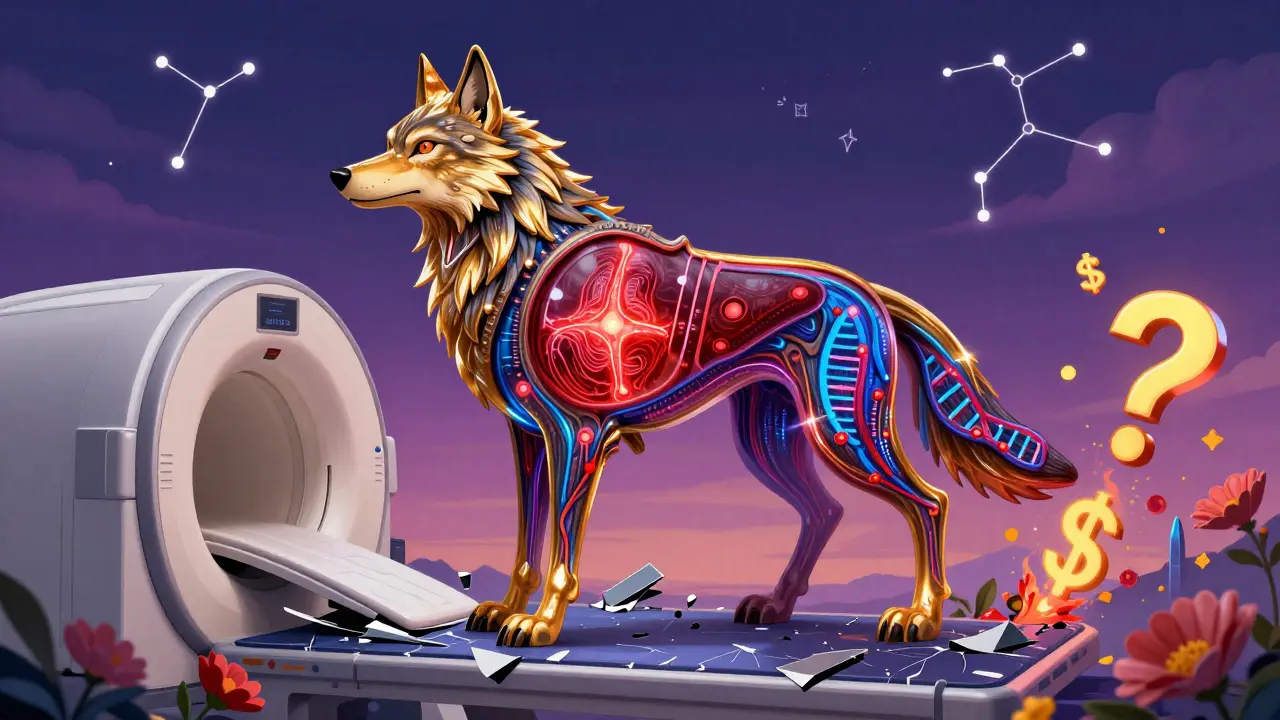
Cost, access, and the real-world challenges
Even if PET-MRI is better, it’s not always practical. A PET-CT scan costs $1,600 to $2,300. PET-MRI? $2,500 to $3,500. That’s a 50% jump. Many hospitals can’t afford the $4 million machine, the shielded room ($200,000+), or the specialized staff needed to run it.
Technologists need 40 extra hours of training just to operate PET-MRI. Radiologists need more time to interpret the complex data. A 2022 survey found 63% of sites struggled with PET-MRI’s attenuation correction errors-glitches that make tumors look bigger or smaller than they are. Fixing those requires physicists on staff, which most small hospitals don’t have.
Still, adoption is growing. The PET-MRI market is projected to hit $1.1 billion by 2030. Siemens launched a new system in early 2024 that cuts scan time to six minutes. That’s a game-changer. If they can make it faster, cheaper, and easier to use, it won’t stay a luxury for big hospitals.
What’s next? AI and personalized imaging
The next leap isn’t just better machines-it’s smarter analysis. At the 2023 RSNA meeting, researchers showed AI models that predict how a tumor will respond to treatment just from a single PET-MRI scan. These models look at thousands of tiny patterns in the images-things no human eye can catch.
Trials like the NCI’s PREDICT study are testing whether AI can replace biopsies in some cases. If an AI says a liver spot is cancer, and the scan pattern matches thousands of past cases, maybe you don’t need to stick a needle in.
Novel tracers are coming too. PSMA PET tracers for prostate cancer are already FDA-approved and outperform older methods. Future tracers may target specific cancer mutations, turning imaging into a molecular diagnostic tool.
Bottom line: The right scan, at the right time
PET-CT is still the backbone of cancer staging. It’s fast, affordable, and works for most cancers. MRI gives unmatched detail where soft tissue matters most. PET-MRI is the future-for brain, liver, pediatric, and recurrent cancers-but it’s not ready to replace the others.
The goal isn’t to pick the most advanced tool. It’s to pick the right tool. For most people, PET-CT is enough. For others-especially those with complex or recurrent disease-PET-MRI can be life-changing. The key is matching the technology to the patient, not the other way around.
Which imaging test is most accurate for cancer staging?
There’s no single most accurate test-it depends on the cancer type. PET-CT is best for lung cancer, lymphoma, and melanoma because it shows spread across the whole body. MRI is superior for brain, prostate, and pelvic cancers due to its soft-tissue detail. PET-MRI is the most accurate for distinguishing tumor recurrence from treatment changes, especially in the brain and liver, but it’s not always necessary.
Is PET-MRI better than PET-CT for all cancers?
No. PET-MRI offers advantages in specific cases-like brain tumors, pediatric cancers, or liver metastases-but it’s not better for everything. For lung cancer or lymphoma, PET-CT is just as accurate, faster, cheaper, and more widely available. Experts agree PET-MRI should be reserved for cases where its added detail changes treatment decisions.
Does MRI detect cancer better than PET-CT?
It depends on the cancer. For prostate cancer, MRI detects tumors with 75% accuracy, while standard PET-CT using FDG only hits 62%. But for lymphoma, PET-CT is far better because it shows metabolic activity. MRI shows structure; PET-CT shows function. They answer different questions.
How much radiation do these scans expose you to?
PET-CT exposes patients to 10-25 millisieverts of radiation, similar to several years of natural background exposure. MRI uses no radiation at all. PET-MRI cuts radiation in half compared to PET-CT because it removes the CT component’s dose. For children and patients needing repeated scans, this difference matters.
Why isn’t PET-MRI used more often if it’s better?
Cost and access. A PET-MRI machine costs $3-4.2 million, compared to $1.8-2.5 million for PET-CT. It requires special shielding, longer scan times, and highly trained staff. Many hospitals can’t justify the expense unless they treat complex cases regularly. Insurance also often won’t cover it without proof of medical necessity.
Can AI replace the need for these scans?
Not yet. AI is being used to enhance these scans-predicting treatment response or spotting subtle patterns humans miss-but it doesn’t replace imaging. AI needs data from PET-CT or MRI to work. The future is AI + imaging, not AI instead of imaging.
Donna Fleetwood
January 31, 2026 AT 03:34April Allen
February 1, 2026 AT 10:18Melissa Cogswell
February 2, 2026 AT 17:25Shubham Dixit
February 3, 2026 AT 23:51KATHRYN JOHNSON
February 5, 2026 AT 07:54Sazzy De
February 6, 2026 AT 09:19Rohit Kumar
February 8, 2026 AT 01:03Gaurav Meena
February 8, 2026 AT 20:49Jodi Olson
February 9, 2026 AT 21:46Marc Bains
February 11, 2026 AT 12:07kate jones
February 11, 2026 AT 22:22Natasha Plebani
February 12, 2026 AT 12:42Eliana Botelho
February 12, 2026 AT 17:38Rob Webber
February 14, 2026 AT 14:08