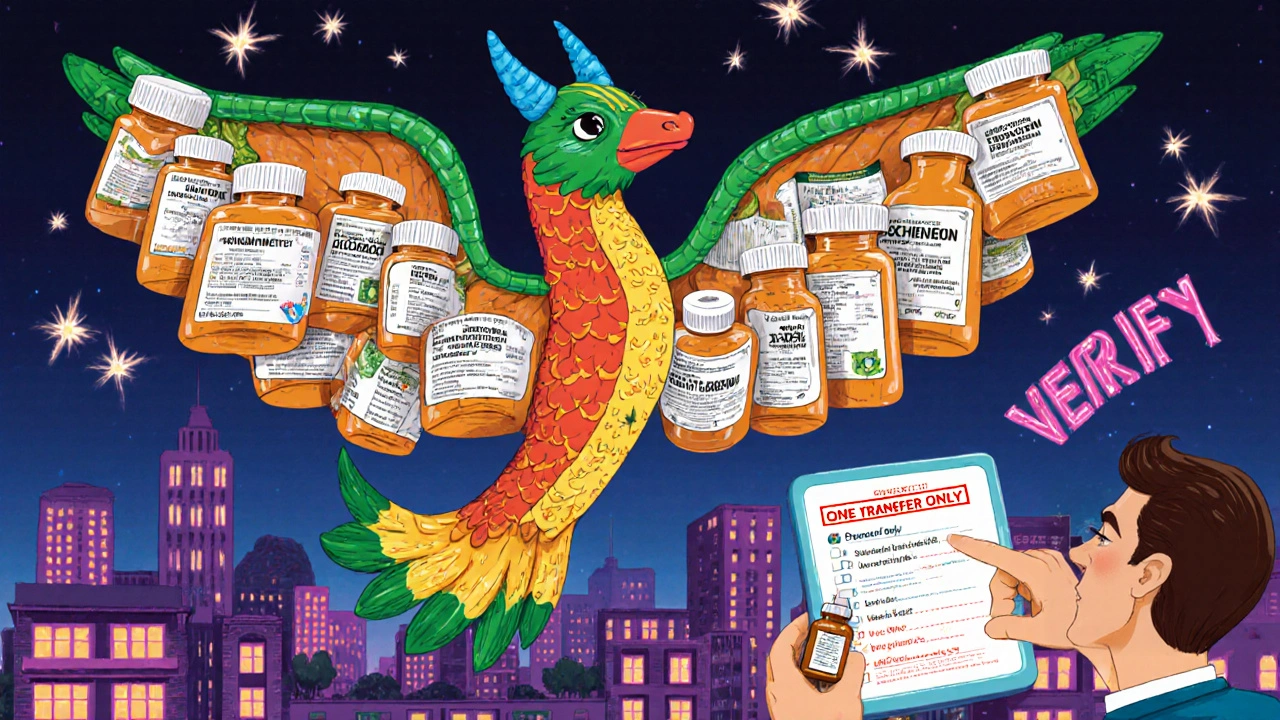
Transferring a prescription shouldn’t be a guessing game. Yet every day, patients end up waiting days for meds because the label got messed up, or the pharmacy lost the refill count. A wrong decimal point, a missing DEA number, or a faxed prescription that didn’t come through right - these aren’t just inconveniences. They’re risks. In the U.S., medication errors tied to bad labels or flawed transfers contribute to 7,000 deaths each year. That’s not a statistic you ignore. If you’re moving, switching pharmacies, or just trying to get your meds faster, knowing how to do this right matters - for you, your health, and your life.
What’s Allowed and What’s Not
Not all prescriptions are treated the same. The DEA changed the rules in August 2023, and it’s the biggest shift in decades. Before that, you couldn’t transfer a Schedule II prescription - think oxycodone, fentanyl, Adderall - at all. Now, you can, but only once. And only electronically. No faxes. No phone calls. No handwritten notes passed between pharmacies. Schedule III to V prescriptions - like codeine cough syrup or anabolic steroids - are more flexible. You can transfer those multiple times, as long as there are refills left. Non-controlled meds? Most states let you transfer them as many times as you need. But here’s the catch: even if your drug isn’t controlled, the label still has to be perfect.The Label Rules You Can’t Skip
Every prescription label - whether it’s new or transferred - must include specific details. Missing one thing can make it invalid. The FDA says every label must have:- Patient’s full name
- Drug name (no abbreviations like "HCTZ" - write "hydrochlorothiazide")
- Strength in metric units (e.g., "5 mg", not "5.0 mg" - trailing zeros are dangerous)
- Dosage form (tablet, capsule, liquid)
- Quantity dispensed
- Directions for use ("Take one by mouth twice daily")
- Prescriber’s name
- Prescription number
- Date issued
- Number of refills allowed
- Pharmacy name, phone, and address
How the Transfer Actually Works
It’s not as simple as calling the new pharmacy and saying, "Send me my pills." Here’s the real process:- You call or visit the new pharmacy and ask them to transfer your prescription. Don’t assume they can fill it. Ask if they have your drug in stock, especially if it’s a controlled substance.
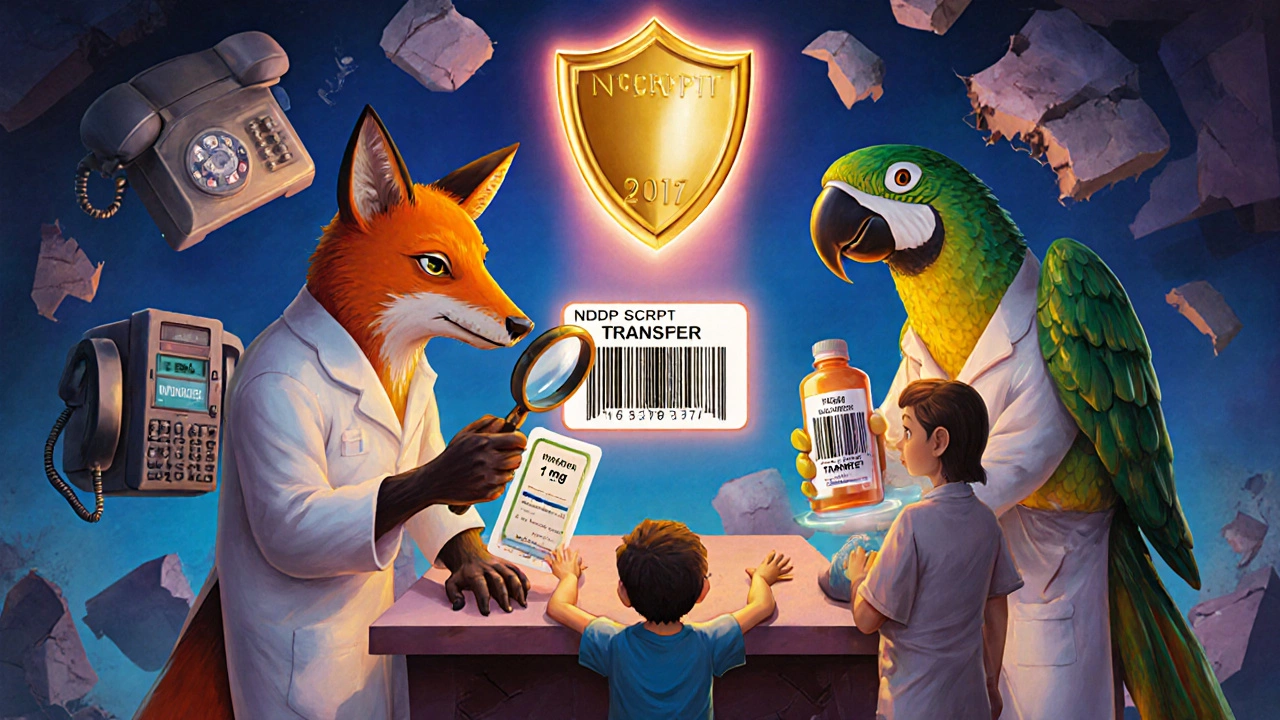
- The new pharmacy contacts the old one electronically using NCPDP SCRIPT 2017071 standards. This system is 98.7% accurate - far better than fax (82.3%) or phone (76.1%).
- The old pharmacy sends the full record: original fill date, refills used, refills left, prescriber info, DEA number, and transfer date.
- The receiving pharmacy adds "TRANSFER" to the label and includes the name and DEA number of the pharmacy that sent it.
- The original prescription is marked as transferred and invalidated. No refills can be added back.
What Happens When Systems Fail
Technology helps, but it’s not perfect. About 18% of pharmacies report data loss during transfers. Sometimes, the strength gets cut off. Sometimes, the refill count disappears. A 2022 National Community Pharmacists Association survey found that incompatible pharmacy software was the top reason for failed transfers. In California, after a 2022 law allowed outsourcing pharmacies to fill prescriptions, 23% of transfer attempts failed because patients didn’t confirm the pharmacy could handle the drug. One Reddit user described waiting five days for pain meds because the new pharmacy didn’t have oxycodone - and the old one couldn’t refill it because the transfer had already been processed. That’s why the best advice isn’t technical - it’s human. Before you transfer:- Call the new pharmacy and say: "I’m transferring a [drug name] prescription. Do you have it in stock? Can you handle controlled substances?"
- Ask them to confirm the refill count before they start the transfer.
- Get the name of the pharmacist you’re talking to. If something goes wrong, you need a name to follow up.
Why Your Pharmacist Is Your Best Ally
Pharmacists aren’t just filling bottles. They’re the last line of defense. ASHP recommends a double-check system: one pharmacist verifies the drug, dose, and instructions. A second one checks the label, packaging, and barcode. That’s not just policy - it’s practice. One 12-hospital study showed barcode verification cuts dispensing errors by 41%. And if you’re unsure? Ask. Say: "Can you confirm the strength and directions on this label?" Or: "Is this the same as my last prescription?" Most pharmacists will pause and recheck. That’s what they’re trained for.
What’s Coming in 2025
The FDA’s new Patient Medication Information (PMI) rule rolls out in 2025. It’s not just about labels - it’s about clarity. The rule requires:- Plain language directions (no medical jargon)
- Default paper labels (electronic only if you ask for it)
- Automated scanning systems that check for typos, wrong doses, or missing warnings before the bottle leaves the counter
What You Can Do Today
You don’t need to be an expert to keep yourself safe. Here’s your checklist:- Never transfer a Schedule II prescription without confirming stock. One shot. No do-overs.
- Always check the label. Compare the drug name, strength, and directions to your last bottle.
- Ask for the refill count. Write it down. If the new pharmacy says you have 3 refills left but your old bottle says 2 - stop. Ask why.
- Use electronic transfer. It’s safer than fax or phone. If the pharmacy says they can’t do it electronically, find one that can.
- Keep your old prescription bottle. Until you’ve taken your first dose from the new pharmacy, hold onto the old one. It’s your backup.
Final Thought: Accuracy Isn’t Optional
Prescription labels aren’t just paperwork. They’re instructions for your body. A misplaced decimal, a missing refill, a confusing abbreviation - these aren’t minor mistakes. They’re life-altering. The system has gotten better. The rules are clearer. But you still have to be the one who checks. Don’t assume. Don’t rush. Don’t trust blindly. Ask questions. Verify. Keep your own record. Because when it comes to your meds, no one else has your back like you do.Can I transfer a Schedule II prescription more than once?
No. As of August 2023, DEA rules allow only one electronic transfer of a Schedule II prescription (like oxycodone or Adderall) between retail pharmacies. Once it’s transferred, the original prescription is voided. You cannot return to the original pharmacy for a refill. Always confirm the receiving pharmacy has the medication in stock before initiating the transfer.
Why can’t I use "1.0 mg" on a prescription label?
Writing "1.0 mg" instead of "1 mg" can lead to a ten-fold dosing error. The decimal point and trailing zero can be mistaken for "10 mg" - especially if the label is smudged or poorly printed. The FDA and NCCMERP have documented dozens of cases where this caused serious harm. Always write whole numbers without decimals: "1 mg," not "1.0 mg."
What’s the safest way to transfer a prescription?
The safest method is electronic transfer using the NCPDP SCRIPT 2017071 standard. It maintains 98.7% data accuracy, compared to 82.3% for fax and 76.1% for phone transfers. Electronic transfers preserve all details - including refill counts, DEA numbers, and original fill dates - without human error. Avoid fax or phone transfers unless absolutely necessary, and only for Schedule III-V prescriptions.
Do I need to bring my old pill bottle when transferring?
You don’t have to, but it’s highly recommended. The old bottle has the exact drug name, strength, and directions printed on it. If there’s a mismatch between what the pharmacy says and what’s on your bottle - like a different dosage or refill count - you can catch it before you take the new medication. Keep it until you’ve taken your first dose from the new pharmacy.
What if the new pharmacy says my prescription has 3 refills, but my old bottle says 2?
Stop. Do not take the medication. Call the new pharmacy and ask them to verify the refill count with the original pharmacy. A mismatch could mean a data error, a misread prescription, or an unauthorized refill. Pharmacists are required to resolve these discrepancies before dispensing. Never assume the number on the label is correct - always compare it to your records.
Can I transfer a prescription across state lines?
Yes, but with conditions. The DEA’s 2023 rule allows interstate electronic transfers of controlled substances, as long as both pharmacies follow federal guidelines. However, state laws may add extra requirements - like documenting the receiving pharmacist’s name on the back of the original label. Always check with both pharmacies to ensure compliance. Inconsistent state rules remain a leading cause of transfer errors.
Austin Simko
November 29, 2025 AT 06:59Michelle N Allen
November 30, 2025 AT 19:16Craig Hartel
November 30, 2025 AT 20:42Chris Kahanic
December 2, 2025 AT 00:24Geethu E
December 2, 2025 AT 01:40jaya sreeraagam
December 2, 2025 AT 10:35Skye Hamilton
December 4, 2025 AT 09:58Maria Romina Aguilar
December 4, 2025 AT 23:19Brandon Trevino
December 5, 2025 AT 15:09Denise Wiley
December 5, 2025 AT 20:07Aarti Ray
December 7, 2025 AT 19:45Alexander Rolsen
December 9, 2025 AT 11:40anant ram
December 10, 2025 AT 02:18king tekken 6
December 11, 2025 AT 02:37Bruce Hennen
December 12, 2025 AT 03:49