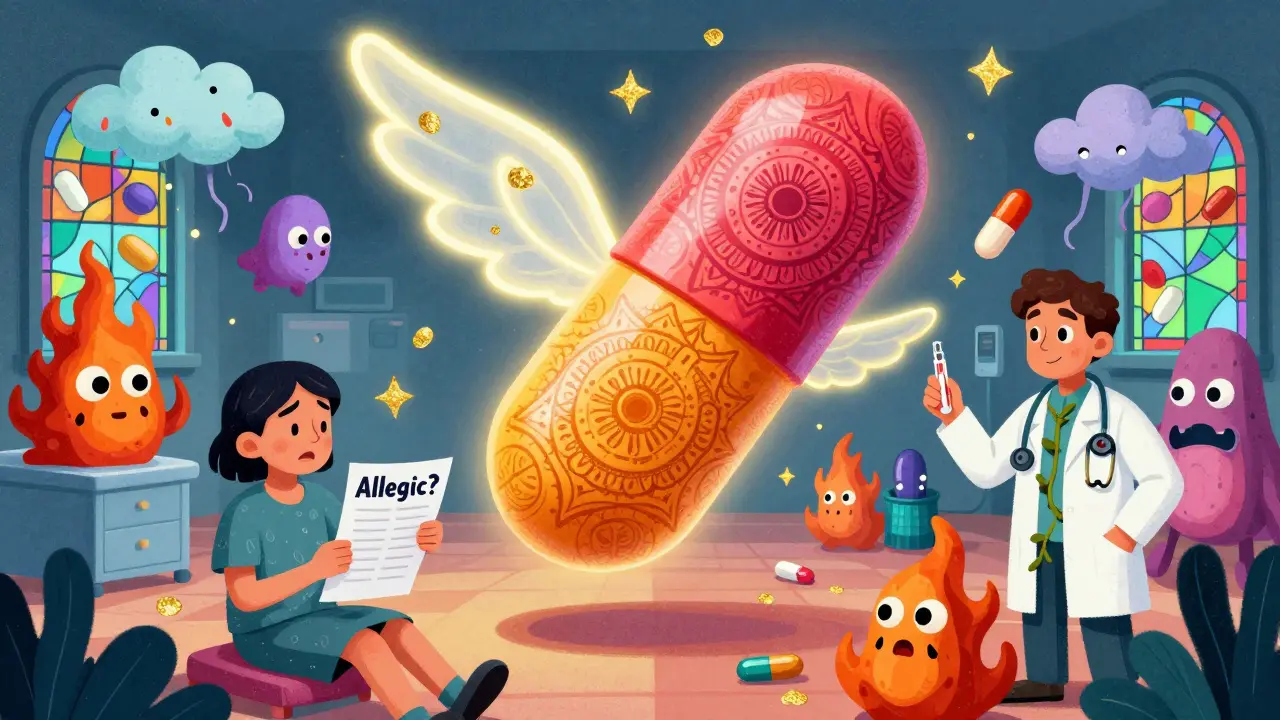
More than 1 in 10 people in the U.S. say they’re allergic to a medication. But here’s the twist: most of them aren’t. If you’ve been told you’re allergic to penicillin because you got a rash as a kid, you might be carrying around a label that’s not just wrong-it’s dangerous. The truth is, drug allergies are often misunderstood, misdiagnosed, and overreported. And the consequences aren’t just inconvenient-they’re costly, and sometimes deadly.
Penicillin: The Most Misunderstood Allergy
Penicillin is the most common drug allergy people report. About 10% of Americans say they’re allergic to it. But when you test them properly-with skin tests and a supervised dose of amoxicillin-more than 90% turn out not to be allergic at all. That’s not a small mistake. It’s a nationwide problem.Why does this matter? Because if you’re labeled penicillin-allergic, doctors avoid the safest, cheapest, and most effective antibiotics. Instead, they give you broader-spectrum drugs like vancomycin or fluoroquinolones. These aren’t just more expensive-they’re more likely to cause side effects, trigger antibiotic-resistant infections, and lead to longer hospital stays. One study found that patients with a penicillin allergy label spent half a day longer in the hospital and paid over $1,000 more per admission.
And here’s the good news: penicillin allergy testing is incredibly accurate. When you combine skin testing with an oral challenge, the negative predictive value is 97-99%. That means if the test says you’re not allergic, you’re almost certainly not. The test takes a couple of hours. It’s safe. And it’s available in most major hospitals and clinics. If you’ve been told you’re allergic to penicillin, especially if it happened more than 10 years ago, get tested. You might be able to go back to using the best antibiotic for your infection.
Other Antibiotics That Trigger Reactions
Penicillin isn’t the only culprit. Other antibiotics, especially those in the beta-lactam family-like cephalosporins and carbapenems-can also cause reactions. But cross-reactivity between penicillins and cephalosporins is much lower than people think. Older studies said 10%, but modern data shows it’s closer to 1-3%. That means if you’re allergic to penicillin, you can probably take a cephalosporin safely, especially if it’s not a first-generation one like cephalexin.Sulfa drugs are another big one. Trimethoprim-sulfamethoxazole (Bactrim) is a common antibiotic for urinary tract infections and pneumonia. About 3% of the general population reacts to it. But if you have HIV, your risk jumps to 60%. The reaction isn’t always a rash-it can be a fever, liver damage, or a life-threatening skin condition called Stevens-Johnson syndrome.
Even non-antibiotic drugs like sulfasalazine (used for rheumatoid arthritis) and furosemide (a water pill) contain a sulfa component. If you’ve had a reaction to Bactrim, talk to your doctor before taking any other sulfa-containing drug. Not all sulfa drugs are the same, but caution is key.
NSAIDs: More Than Just a Stomachache
Ibuprofen, naproxen, aspirin-these are some of the most common over-the-counter pain relievers. But they’re also among the top triggers for drug hypersensitivity. Unlike penicillin allergies, NSAID reactions aren’t usually IgE-mediated. Instead, they’re often caused by how the body processes these drugs. When you take an NSAID, your body makes less of a protective chemical called prostaglandin. That can trigger inflammation in the airways, especially if you already have asthma or nasal polyps.This is called aspirin-exacerbated respiratory disease. About 7% of adults with asthma and 14% of those with nasal polyps react this way. Symptoms include wheezing, congestion, and sometimes full-blown anaphylaxis. It’s not an allergy in the classic sense, but it’s still dangerous. If you’ve ever had trouble breathing after taking ibuprofen or aspirin, don’t assume it’s just a coincidence. See an allergist. You might need to avoid all NSAIDs and switch to acetaminophen instead.
Anticonvulsants and the Hidden Genetic Risk
If you’re on medication for seizures, bipolar disorder, or nerve pain, you might be taking carbamazepine (Tegretol) or lamotrigine (Lamictal). These drugs are effective-but they carry a serious risk: severe skin reactions like Stevens-Johnson syndrome and toxic epidermal necrolysis.The risk isn’t random. It’s genetic. People with the HLA-B*1502 gene variant are at much higher risk. This variant is common in Southeast Asian populations-about 10-15% of people in Thailand, Malaysia, and parts of China carry it. It’s rare in people of European descent. Because of this, the FDA recommends genetic testing before starting carbamazepine if you have ancestry from those regions. In Taiwan, where testing became routine, the rate of these deadly skin reactions dropped by 90%.
Lamotrigine causes rashes in 5-10% of users. Most are mild, but about 1 in 1,000 patients develop a serious reaction. The rash usually shows up within the first few weeks. If you’re starting lamotrigine, pay attention to your skin. A mild rash might be okay to monitor, but if it spreads, blisters, or you get a fever, stop the drug and get help immediately.
Chemotherapy and Biologics: When Life-Saving Drugs Turn Dangerous
Cancer treatments are powerful-and they often trigger allergic reactions. Taxanes like paclitaxel (Taxol) cause reactions in up to 41% of patients. Monoclonal antibodies like cetuximab (Erbitux) can cause severe anaphylaxis during infusion in 2% of cases. These reactions happen because the immune system sees the drug as foreign.But here’s the thing: these reactions are predictable and manageable. Hospitals use premedication-steroids and antihistamines-before giving these drugs. They also slow down the infusion rate. If you’ve had a reaction before, your oncologist can usually safely re-administer the drug using a desensitization protocol. It’s a slow, controlled process that trains your immune system to tolerate the drug. Success rates are 80-90%.
As more biologic drugs enter the market-like those for autoimmune diseases-the number of these reactions will rise. That’s why allergists are becoming a critical part of cancer and rheumatology teams.
Contrast Dyes and Imaging Tests
If you’ve ever had a CT scan with contrast dye, you might have heard you’re allergic to iodine. That’s a myth. True iodine allergy doesn’t exist. The reactions you might have had were to the chemical structure of the contrast dye, not iodine itself.Contrast reactions happen in 1-3% of patients. Most are mild-flushing, nausea, itching. Severe reactions are rare: less than 0.04%. But if you’ve had one before, you’re at higher risk for another. The good news? Premedication with steroids and antihistamines can cut the risk of a moderate or severe reaction from 12.7% down to just 1%.
If you’re scheduled for a CT scan and you’ve had a reaction before, tell your doctor. They can plan ahead. You don’t have to avoid the test-you just need the right preparation.
Why Mislabeling Costs Lives and Money
Every year, mislabeled drug allergies cost the U.S. healthcare system over $1.2 billion. Why? Because doctors avoid the best drugs. They use broader-spectrum antibiotics. They extend hospital stays. They order more tests. They prescribe drugs that are more likely to cause resistance.And it’s not just money. It’s safety. Antibiotic resistance is already a global crisis. Every time we use a less effective drug because of a false allergy label, we make it worse.
Patients, too, pay a price. They’re stuck with fewer options. They worry about every new prescription. They avoid needed treatments. A 2022 survey found that 68% of people with a drug allergy label never got tested. But 79% said they’d be willing to get tested if it meant they could take more medications safely.
What You Can Do
If you’ve been told you have a drug allergy:- Write down exactly what happened: rash? swelling? trouble breathing? when did it start?
- Did it happen more than 10 years ago? If so, you may have outgrown it.
- Ask your doctor: Was this tested? Was it IgE-mediated? Or was it a side effect?
- If it’s penicillin, ask about skin testing and an oral challenge.
- If it’s carbamazepine and you have Southeast Asian ancestry, ask about HLA-B*1502 testing.
- If it’s an NSAID and you have asthma or nasal polyps, talk to an allergist about aspirin-exacerbated respiratory disease.
You don’t have to live with a label that’s holding you back. Most drug allergies can be clarified. Most can be safely challenged. And most people who think they’re allergic aren’t.
What to Expect During Testing
A proper drug allergy evaluation has three parts:- History: Your doctor will ask detailed questions about the reaction-timing, symptoms, treatment, outcome.
- Testing: Skin tests (prick and intradermal) for penicillin and some other drugs. These are safe and highly accurate.
- Challenge: If testing is negative or inconclusive, you’ll get a small, controlled dose of the drug under supervision. This is the gold standard.
Testing for penicillin takes 2-4 hours. You’ll be monitored the whole time. The chance of a false negative is less than 1%. If you pass, you’re cleared for life-unless you have a new reaction later.
What’s Changing in 2026
The field is moving fast. In 2025, the FDA released new guidelines to standardize drug allergy testing across hospitals. More clinics are offering telehealth-based penicillin evaluations-cutting wait times from two months to two weeks.Genetic testing is becoming routine. Before prescribing abacavir (for HIV), doctors now check for HLA-B*57:01. That one test reduced allergic reactions from 8% to less than 0.5%. Similar testing for allopurinol and carbamazepine is being rolled out nationwide.
And point-of-care testing is coming. In the next few years, you might get a quick blood test in your doctor’s office to check for specific drug antibodies before you even get a prescription.
The goal? To stop labeling people as allergic when they’re not. To use the right drugs. To save lives. And to make sure no one misses out on safe, effective treatment because of an old myth.
Robin Williams
January 13, 2026 AT 21:38yo i got labeled penicillin-allergic at 8 after a rash from amoxicillin, turned 32 last month and just got tested last year-turns out i was never allergic. they gave me a full dose of amox in the clinic and i was fine. no hives, no swelling, just a weird burp. now i take amox like it’s candy. why did no one tell me this sooner??
Adam Vella
January 14, 2026 AT 14:20It is an epistemological travesty that the medical establishment continues to perpetuate diagnostic inertia in the realm of pharmacological hypersensitivity. The conflation of adverse drug reactions with true IgE-mediated allergy represents a profound failure of clinical education and evidence-based practice. The data presented here are not merely statistically significant-they are morally imperative.
When we mislabel patients, we do not merely alter prescribing patterns; we undermine the very epistemic foundations of therapeutics. The $1.2 billion annual cost is not merely a fiscal concern-it is a moral indictment of our system’s inability to reconcile empirical data with entrenched heuristic biases.
One must ask: if a diagnosis is 97-99% accurate when properly validated, why is it not universally administered? The answer lies not in medicine, but in institutional inertia. The burden of re-evaluation is placed upon the patient, not the system. This is not patient-centered care. This is patient neglect dressed in white coats.
laura Drever
January 16, 2026 AT 04:30penicillin thing is wild but i bet most ppl who think theyre allergic just had a rash from a virus and got scared. also why is everyone so surprised by this? we all know docs just guess half the time
Acacia Hendrix
January 16, 2026 AT 11:08The data on HLA-B*1502 and carbamazepine is compelling, yet still underutilized in primary care settings. The pharmacogenomic imperative is not merely a biomarker-driven paradigm shift-it is a necessary recalibration of risk stratification in polypharmacy populations. Without preemptive genotyping, we are engaging in pharmacological roulette with vulnerable demographics.
Furthermore, the absence of standardized pre-prescription screening protocols across EHR platforms constitutes a systemic failure in translational medicine. Until these genomic flags are auto-triggered at the point of prescribing, we remain mired in reactive, not proactive, therapeutics.
James Castner
January 16, 2026 AT 16:40I’ve spent 17 years in emergency medicine, and I’ve seen too many patients suffer because of outdated allergy labels. I remember one woman-78, diabetic, UTI. She’d been told she was allergic to penicillin since she was 12. We did the skin test. Negative. Gave her amoxicillin. She went home the next day. No complications. No hospitalization. Just relief.
Doctors don’t always know this. Nurses don’t always know this. Patients? They’re terrified to question it. We need to make testing routine. Not optional. Not ‘if you’re curious.’ Routine. Like cholesterol checks. Like mammograms.
And yes, it takes time. But what’s more time-consuming? A two-hour test, or a three-week hospital stay because we gave you vancomycin instead? We’re not just saving money-we’re saving dignity. We’re saving lives.
Let’s stop calling it ‘testing.’ Let’s call it ‘liberation.’
I’ve talked to patients who’ve avoided antibiotics for decades because of a childhood rash. That’s not caution. That’s trauma. And we owe them better.
I’ve trained residents to do this. I’ve pushed my hospital to make penicillin evaluation part of every new patient intake. It’s not hard. It’s just not yet standard. Let’s change that.
And if you’re reading this and you’ve been told you’re allergic to penicillin? Please. Get tested. Your future self will thank you.
And if you’re a doctor? Stop assuming. Start testing.
We can do better. We must.
Alan Lin
January 17, 2026 AT 01:29It is unconscionable that the American healthcare system continues to permit the proliferation of unverified drug allergy labels. This is not negligence-it is institutional malpractice. When a patient is mislabeled as penicillin-allergic, they are not merely denied a therapeutic option; they are condemned to a cascade of inferior, more toxic, and more expensive alternatives. This is not medical care. This is economic coercion disguised as caution.
The fact that 90% of self-reported penicillin allergies are false is not a statistic-it is a scandal. And yet, hospitals still do not mandate allergy re-evaluation. Why? Because it requires effort. Because it requires coordination. Because it requires humility.
I’ve seen patients die from C. diff infections caused by broad-spectrum antibiotics prescribed because of a false label. I’ve seen children given azithromycin for pneumonia when amoxicillin would have sufficed. I’ve seen families bankrupted by unnecessary hospitalizations.
This is not a question of access. It is a question of accountability. If your hospital does not offer penicillin challenge testing, demand it. If your doctor dismisses your request, find a new one. This is not a privilege. It is a right.
And to those who say, ‘But what if they react?’-then test them properly, under supervision, with protocols. Don’t let fear replace science.
Stop labeling. Start testing. Save lives.
Rosalee Vanness
January 18, 2026 AT 19:57my grandma was told she was allergic to sulfa drugs in the 70s after a rash-turned out it was just the sunburn she got while on vacation and she took Bactrim right after. she spent 20 years avoiding all sulfa meds, even the ones for arthritis, even though she had terrible joint pain. last year, she got tested and found out she’s fine. now she takes sulfasalazine like it’s candy and says her knees haven’t felt this good since she was 50.
it’s wild how one little label can hold you back for decades. i wish more people knew this. i told my mom and she’s going to get her penicillin test next month. i feel like we’ve been living with ghosts.
and honestly? if you’ve been told you’re allergic to something and it happened when you were a kid? chances are you’re not. our bodies change. our immune systems evolve. don’t let a 12-year-old rash decide your treatment at 45.
also, if you’re scared of testing? ask if they do oral challenges. it’s way less scary than you think. they give you a tiny bit, watch you for an hour, then a bigger bit. i watched my grandma do it. she napped through half of it.
we’ve got to stop letting fear run medicine.
Adam Rivera
January 20, 2026 AT 08:08as someone from Mexico, i’ve seen how this plays out in rural clinics here-people avoid antibiotics because of some story from 20 years ago. my cousin got labeled penicillin-allergic after a fever and rash, never got tested. now she’s in her 30s, avoids all meds, and just suffers through infections. i showed her this article and she cried. she’s booked her test next week.
we need to spread this info. not just in the US. everywhere.
Pankaj Singh
January 21, 2026 AT 20:03so let me get this straight-90% of people who think they’re allergic to penicillin aren’t? wow. what a shock. next you’ll tell me people who say they’re ‘gluten intolerant’ are just eating too much bread. this is why medicine is broken. people self-diagnose, doctors don’t challenge, and now we’re paying for it with antibiotic resistance. brilliant.
Jesse Ibarra
January 22, 2026 AT 05:19the fact that this article even needs to exist is a moral failure. we live in a society where a child’s rash from 1998 dictates adult treatment decisions, while doctors refuse to update their knowledge because ‘it’s easier this way.’
you don’t get to hide behind ‘we’ve always done it this way’ while people die from preventable infections. this isn’t medicine-it’s medical laziness with a white coat.
and if you’re a doctor reading this and you haven’t implemented allergy re-evaluation protocols in your practice? you’re not just behind the times-you’re complicit.
stop being a bystander. start being a healer.
Diana Campos Ortiz
January 23, 2026 AT 11:38i had a rash on my arm after taking amoxicillin when i was 7. my mom panicked, i got labeled allergic. 20 years later, i got tested because i kept getting sinus infections and nothing worked. turns out i’m fine. they gave me the full dose in the clinic and i fell asleep reading a book. it was so… normal.
why did no one ever tell me this was a thing? i wasted so much time being scared of meds.
if you think you’re allergic? please, just ask. it’s not scary. it’s just… smart.
Trevor Davis
January 24, 2026 AT 13:08you know what’s wild? i used to be one of those people who said ‘i’m allergic to everything.’ penicillin, sulfa, ibuprofen, you name it. turned out most of it was just side effects or bad timing. got tested for penicillin last year-negative. now i take ibuprofen without thinking. i feel like i got my life back.
but honestly? the hardest part wasn’t the test. it was admitting i’d been scared for no reason. that’s the real cost.