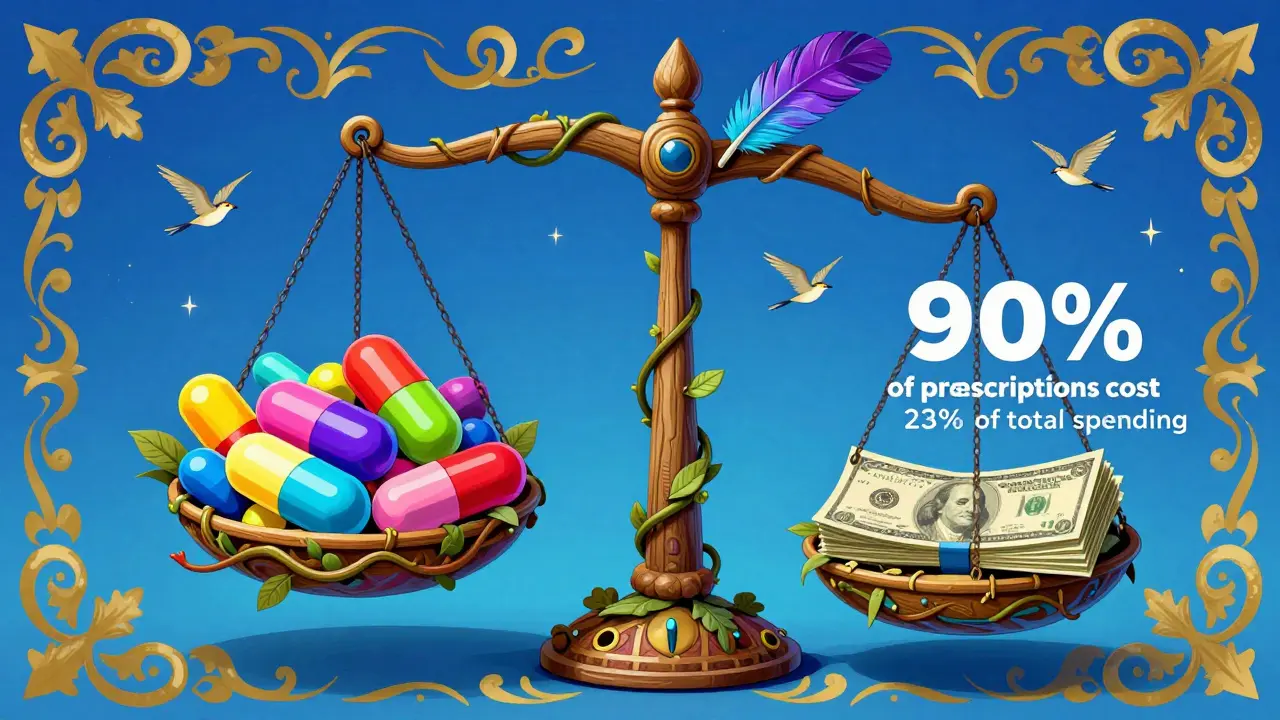
Over 90% of prescriptions in the U.S. are generic drugs, yet they account for just 23% of total drug spending. But behind that simple statistic lies a complex story of generic drug prices fluctuations, market competition, and real-world impacts on patients and pharmacies.
The Big Picture: 90% of Prescriptions, 23% of Costs
Generic drugs are pharmaceutical products containing the same active ingredients as brand-name drugs but marketed without patent protection. According to the Association for Accessible Medicines, generic drugs accounted for 90% of all prescriptions dispensed in the U.S. in 2022 but only 23% of total prescription drug spending. This means patients get most of their medications at a fraction of the cost of brand-name drugs. The Congressional Budget Office reported that generics saved the U.S. healthcare system approximately $2.2 trillion from 2008 to 2017, with annual savings exceeding $250 billion by 2017.
Year-by-Year Price Swings: Real Examples
Generic drug prices don't move in a straight line. Some drugs see dramatic changes. For example, the price of generic nitrofurantoin macrocrystals increased 1,272% between 2013 and 2018. Meanwhile, generic levothyroxine prices dropped 87% over the same period. According to ASPE's 2021 report, 8.2% of generic prescriptions experienced price surges between 100% and 500% during 2013-2014. In contrast, the FDA's 2017 report showed that approving 843 generic drugs that year generated $8.8 billion in first-year savings.
Competition Rules: How Many Manufacturers Make the Difference
Market competition directly controls generic drug prices. When only one manufacturer exists, prices stay at about 90% of the brand-name drug. Add a second competitor, and prices drop to 65%. Three competitors bring prices down to 52%, and four or more drive prices to just 15% of the brand's cost. FDA research published in December 2019 found that price reductions of 30-40% occur when the third generic competitor enters the market. But when competition is limited, prices can spike dangerously high. For instance, Dr. Aaron Kesselheim's JAMA Internal Medicine study showed that 78% of generic drug price increases exceeding 100% occurred in markets with three or fewer manufacturers.
Patient Impact: When Generic Prices Skyrocket
Price volatility affects real people. A Reddit user reported their generic lisinopril prescription jumping from $4 to $45 at Walmart over 18 months. GoodRx data confirmed a 247% price increase for this medication between January 2022 and December 2023. Medicare beneficiary surveys by KFF in January 2024 showed 37% of seniors taking generics reported cost-related nonadherence, with 28% skipping doses due to price hikes. These spikes often hit patients who rely on affordable medications for chronic conditions like high blood pressure or diabetes.
Pharmacy Struggles and Profit Margins
Pharmacies face challenges managing fluctuating generic prices. Drug Topics' May 2024 analysis found that 42% of independent pharmacies experienced margin compression on 15% of generic drugs. Some generics flipped from profitable to loss leaders within weeks. The National Community Pharmacists Association's 2023 survey reported 68% of independent pharmacies had to absorb price increases for 20% of their generic inventory, with average margin reductions of $3.75 per prescription. These pressures make it harder for pharmacies to keep affordable medications on shelves.
Regulatory Changes Shaping Today's Market
Recent laws and regulations are changing the landscape. The Inflation Reduction Act, implemented in 2024, removed the Medicaid AMP cap on rebates, leading to price decreases for some brand drugs but less direct impact on generics. The FDA's 2024 Strategic Plan for Generic Drugs includes accelerating approvals for drugs with limited competition, targeting 20% faster reviews for products with fewer than three manufacturers. The FTC's 2024 enforcement priorities specifically target unjustified price increases in markets with limited competition, with 12 ongoing investigations as of June 2024. These changes aim to stabilize prices but face challenges from manufacturing issues and market consolidation.
What's Next for Generic Drug Pricing?
Looking ahead, experts predict continued volatility but potential improvements. The Congressional Budget Office estimates generic drug prices will grow at 1.5% annually through 2030, slower than brand-name drugs. However, ASPE's May 2024 analysis warns that 15% of generic drugs face 'high vulnerability' to price spikes due to manufacturing concentration, especially in cardiovascular and central nervous system drugs. Industry leaders like Dr. Steve Miller, former Express Scripts CMO, predict increased FDA focus on competitive generic therapies will reduce high-volatility products by 25% over the next five years. But supply chain fragility remains a persistent concern, with FDA inspections identifying quality issues in 23% of foreign manufacturing facilities in 2023.
Why do some generic drug prices spike while others drop?
Price changes depend on market competition and supply chain factors. When multiple manufacturers enter the market, prices typically fall due to competition. However, if a drug has only one or two manufacturers and production issues arise (like quality problems or supply shortages), prices can skyrocket. For example, nitrofurantoin saw a 1,272% price increase between 2013-2018 due to manufacturing disruptions and limited competitors. Conversely, levothyroxine prices dropped 87% over the same period because of increased competition and stable supply.
How does competition affect generic drug prices?
The number of manufacturers directly impacts pricing. With one manufacturer, prices stay near 90% of the brand-name drug. Two competitors reduce prices to 65%, three to 52%, and four or more drive prices down to 15% of the brand's cost. FDA research shows that adding a third competitor typically causes a 30-40% price drop. However, when competition is limited (three or fewer manufacturers), prices become volatile, with 78% of extreme price increases occurring in these markets.
What role does the FDA play in generic drug pricing?
The FDA approves generic drugs and monitors manufacturing quality. Faster approvals increase competition, which lowers prices. In 2017, the FDA approved 843 generic drugs, saving $8.8 billion in first-year costs. The agency's 2024 Strategic Plan targets 20% faster reviews for drugs with few competitors to prevent price spikes. However, FDA inspections found quality issues in 23% of foreign manufacturing facilities in 2023, leading to supply shortages and price hikes for affected drugs.
How do recent laws like the Inflation Reduction Act affect generic drugs?
The Inflation Reduction Act primarily impacts brand-name drugs through Medicare rebates, but it also affects generics indirectly. By removing the Medicaid AMP cap on rebates in 2024, the law has led to price decreases for some brand drugs. For generics, the main effect is through increased scrutiny of market competition. The FTC is now investigating unjustified price increases in markets with limited competition, which may help stabilize prices for some generic drugs.
What should patients do if their generic drug price suddenly increases?
Check if there are alternative generics or use price comparison tools like GoodRx. Many pharmacies offer discounts through these services-GoodRx users typically save $112.50 per prescription on generics compared to cash prices at major chains. Talk to your pharmacist about switching to a different manufacturer's version or ask your doctor about therapeutic alternatives. For Medicare beneficiaries, review your Part D plan's formulary to find lower-cost options. Some states also have prescription drug assistance programs to help with unexpected price hikes.
Heather Burrows
February 7, 2026 AT 20:19Generic drug prices are a mess and no one cares.
Ritu Singh
February 9, 2026 AT 08:01It's important to understand that generic drug prices don't always stay low. Competition is key-when more manufacturers enter the market, prices drop significantly. For example, with four or more makers, prices go down to 15% of brand-name cost. But when only one or two companies make a drug, prices can skyrocket. We need policies that encourage more competition to keep prices affordable.
Mark Harris
February 10, 2026 AT 02:24Yo! Generics save billions but some prices go nuts. Let's push for more competition to keep costs down!
Savannah Edwards
February 12, 2026 AT 00:36As someone who's been on lisinopril for years, seeing the price jump from $4 to $45 is absolutely insane.
It's not just a number-it's people skipping doses because they can't afford it.
I've read about how pharmacies are struggling too, with 42% of independent pharmacies having margin compression.
That means they might not even have the meds on the shelf.
It's not just about the drug companies; it's about the entire system being broken.
The FDA needs to do more to ensure competition.
When there are multiple manufacturers, prices drop dramatically.
But when only one or two make a drug, it's a free-for-all for price hikes.
The Inflation Reduction Act might help a bit, but it's not enough.
We need real policy changes.
People with chronic conditions are suffering.
This isn't just a healthcare issue-it's a human rights issue.
We need to hold these companies accountable.
It's time to fix this mess before more lives are ruined.
Also, GoodRx can help people find cheaper prices, but it's not a long-term solution.
We need systemic change to prevent these price spikes.
Mayank Dobhal
February 13, 2026 AT 13:00Price spikes are killing people. We need action now.
Marcus Jackson
February 15, 2026 AT 08:32Actually, the data shows that when there are more than four manufacturers, prices drop to 15% of brand. But when only one or two make it, prices spike. So the real solution is encouraging more generic makers.
Natasha Bhala
February 16, 2026 AT 17:28Hey, generics save so much money but sometimes prices go up. Maybe we need more competition. Also, goodrx helps a lot. Just saying.
Gouris Patnaik
February 17, 2026 AT 07:27India has better drug pricing. The US system is broken due to greed.
Jesse Lord
February 17, 2026 AT 17:30So many people can't afford their meds. It's heartbreaking. We need to fix this. Maybe more competition would help. Let's talk about solutions.
AMIT JINDAL
February 18, 2026 AT 03:05Hey folks, the real issue is that the FDA isn't doing enough. They need to speed up approvals. Also, foreign manufacturers are causing problems. 😒 But I know everything about this. Check my PhD in pharmacology.
Catherine Wybourne
February 18, 2026 AT 20:53Oh, generics are great except when they cost $45 for a $4 drug. 🤦♀️ Maybe we should stop letting pharma companies play games. Just saying.
Ashley Hutchins
February 20, 2026 AT 18:14Generic prices are a disaster. Pharma companies are greedy. We need to regulate them. End of story.