
Phenytoin-Warfarin Interaction Tracker
Track your INR levels during phenytoin and warfarin therapy to identify dangerous interaction phases. This tool visualizes the biphasic interaction pattern described in the article and provides safety guidance based on your current status.
Current Interaction Phase:
Enter your data to see analysis...
This tool shows typical interaction patterns. Actual response may vary based on individual factors. Always follow your healthcare provider's guidance.
When you take phenytoin and warfarin together, your body doesn’t just handle two medications-it handles a chemical tug-of-war that can send your blood clotting levels spinning out of control. This isn’t a rare edge case. It’s a well-documented, dangerous dance that happens in thousands of patients every year. And if you’re one of them, missing the signs could mean a stroke, a bleed, or worse.
What’s Really Happening in Your Blood?
Phenytoin, an old-school seizure drug, and warfarin, the classic blood thinner, don’t just coexist-they actively mess with each other. The problem isn’t one thing. It’s two separate reactions that happen at different times, and they flip your INR (that number doctors use to measure how fast your blood clots) in opposite directions. Right after you start phenytoin, your INR might spike. Why? Because phenytoin is like a bully at a protein party. Warfarin sticks to albumin, a protein in your blood, to stay inactive. About 99% of it is bound this way. Phenytoin, which is also highly protein-bound, pushes warfarin off those spots. Suddenly, more warfarin is floating around free and active. That’s when your INR jumps-sometimes within 24 to 72 hours. You might feel fine, but your blood is thinning faster than your doctor expects. Then, about a week later, things flip again. Phenytoin starts telling your liver to make more of a specific enzyme: CYP2C9. This enzyme breaks down warfarin, especially the more powerful S-warfarin form. Within 7 to 14 days, your body starts clearing warfarin up to twice as fast. Your INR drops. You’re no longer protected from clots. If your dose hasn’t been adjusted, you could develop a clot in your leg, lung, or brain. This back-and-forth is why experts call it a biphasic interaction. It’s not one change. It’s two. And both are dangerous if you’re not watching closely.Why Some People Are at Higher Risk
Not everyone reacts the same way. Your genes play a big role. If you carry a variant of the CYP2C9 gene-like CYP2C9*2 or CYP2C9*3-you’re a slow metabolizer. That means even small amounts of phenytoin can cause a bigger drop in warfarin levels. Your body can’t keep up, and your INR crashes harder and faster. Your albumin level matters too. If you’re malnourished, have liver disease, or are elderly, your albumin might be below 3.5 g/dL. When that happens, even a small displacement of warfarin can cause a big spike in free drug. One study showed patients with low albumin had INR spikes nearly twice as high as those with normal levels. And phenytoin itself is tricky. It doesn’t follow normal dose-response rules. A 10% increase in your phenytoin dose might not change your blood levels much-but a 15% increase could send them through the roof. That’s called nonlinear pharmacokinetics. It makes dosing unpredictable, especially when you’re already juggling warfarin.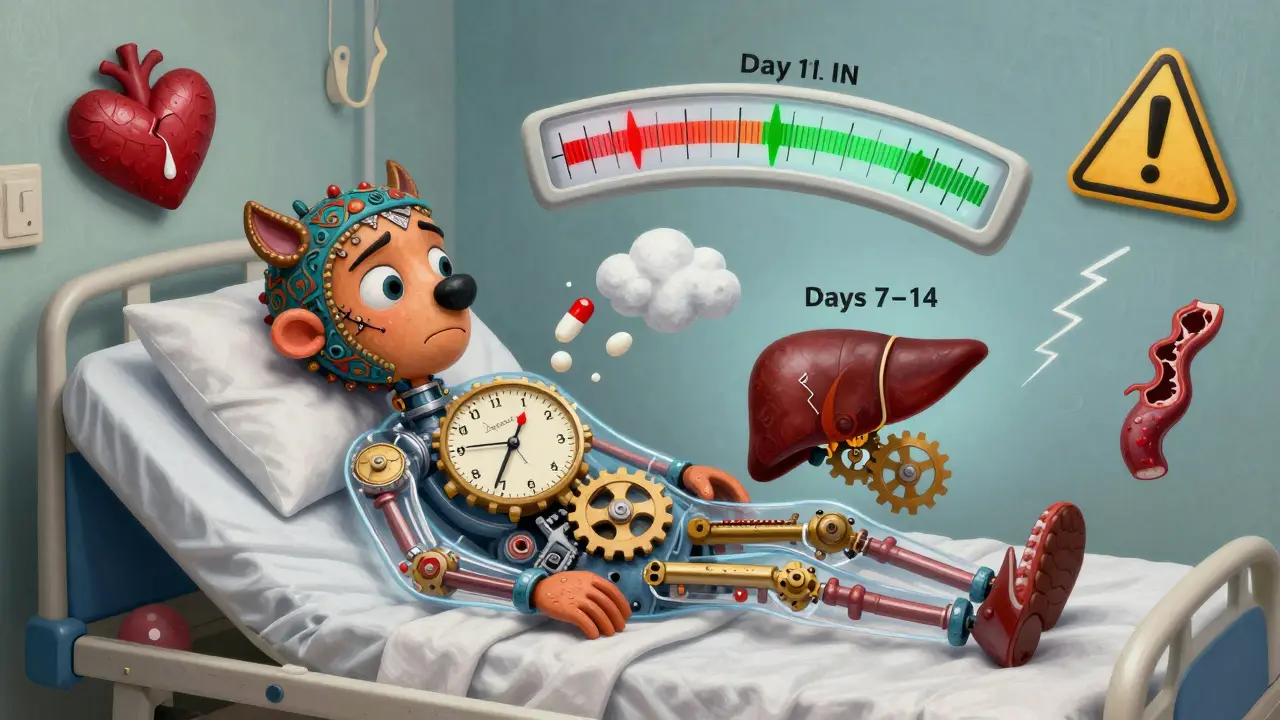
What Doctors Actually Do (And What They Shouldn’t)
Here’s the hard truth: You don’t adjust warfarin on day one. Not even close. If you’re stable on warfarin and your doctor adds phenytoin, the first rule is: don’t change the warfarin dose yet. Instead, monitor INR every 2 to 3 days for the first two weeks. That’s the standard at major anticoagulation clinics like UCSD. Why? Because you need to see the whole pattern. The spike will come, then fade. The drop will follow. You can’t guess which phase you’re in just by looking at the numbers. Some doctors try to preemptively increase warfarin by 25% or 50% when phenytoin starts. That’s a mistake. You might overshoot and cause a dangerous bleed when the enzyme induction kicks in. The same logic applies when you stop phenytoin. Your liver slows down enzyme production. Warfarin builds up. INR creeps up over 10 to 14 days. That’s when you need to reduce warfarin by 25% to 50%. Waiting too long can lead to bleeding. And yes-your doctor should also check your phenytoin levels. Warfarin doesn’t just affect phenytoin. It can slightly raise phenytoin concentrations too. That’s less common, but it happens. If you’re having side effects like dizziness, tremors, or slurred speech, your phenytoin might be too high.When You Should Consider Alternatives
This interaction is so messy that many experts now say: don’t start phenytoin if you can avoid it. For seizure control, there are better options if you’re on warfarin. Levetiracetam (Keppra), gabapentin, and pregabalin don’t induce liver enzymes. They don’t displace proteins. They don’t mess with INR. They’re safer, easier, and just as effective for many types of seizures. Even if you’re not on warfarin, phenytoin has other problems. It causes gum overgrowth, skin rashes, bone loss, and cognitive fog. It’s not the first-line drug anymore in most hospitals. But in emergency rooms, ICUs, or places with limited resources, it’s still used because it’s cheap and works fast for status epilepticus. And here’s the catch: If you’re on warfarin because you have a mechanical heart valve or a genetic clotting disorder, you can’t just switch to a DOAC (like apixaban or rivaroxaban). Those newer blood thinners get broken down by the same enzymes phenytoin induces. They become useless. So for some patients, warfarin is the only option-and phenytoin is the only seizure drug that works. That leaves you stuck in this high-risk zone.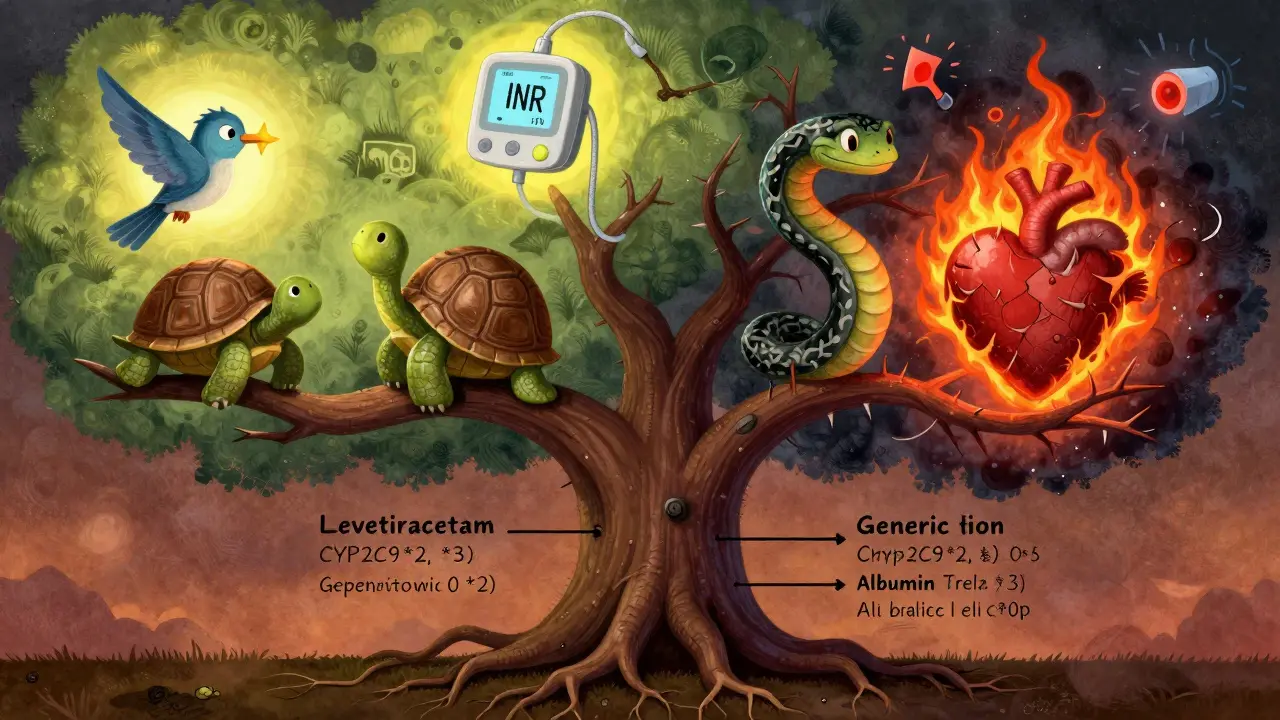
What You Need to Do Right Now
If you’re taking both drugs:- Get your INR checked every 2-3 days for the first 2 weeks after starting or stopping phenytoin.
- Don’t change your warfarin dose unless your doctor tells you to.
- Watch for signs of bleeding: unusual bruising, nosebleeds, dark stools, headaches, or weakness.
- Watch for signs of seizures returning: strange smells, staring spells, jerking movements.
- Ask your pharmacist or doctor if you’re a candidate for genetic testing for CYP2C9 or VKORC1. It won’t change everything, but it can help predict how you’ll react.
- Ask: Is there a safer seizure medicine I could switch to?
Why This Still Matters in 2026
You might think: “Isn’t warfarin outdated? Don’t people use newer blood thinners now?” Yes-but not everyone can. About 2.6 million Americans still take warfarin. And phenytoin? It’s still used in 15-20% of epilepsy cases, especially in older adults, trauma patients, and those with limited access to newer drugs. This interaction isn’t going away. It’s not rare. It’s not theoretical. It’s happening right now in clinics across the country. And here’s the real kicker: This interaction causes about 15% of all serious warfarin-related adverse events in patients taking enzyme-inducing drugs. That’s not a small number. That’s preventable harm. The solution isn’t new drugs. It’s better monitoring. Better communication. Better awareness. If you’re on both of these medications, you’re not just taking pills-you’re managing a ticking clock. The first tick is the INR spike. The second is the INR crash. The third? The bleeding. Or the clot. Don’t wait for a crisis. Ask your doctor: “Are we watching both sides of this interaction?” If they say yes, you’re in good hands. If they say no-ask again.Can phenytoin cause bleeding even if my INR is normal?
Yes. During the first few days after starting phenytoin, it can displace warfarin from proteins, increasing the active amount in your blood-even if your total warfarin level looks fine. INR measures clotting time, not free drug concentration. So if your INR hasn’t caught up yet, you could still be at risk for bleeding. That’s why frequent INR checks are critical during the first week.
How long does it take for phenytoin to affect warfarin levels?
The effect happens in two phases. Protein displacement starts within 24 to 72 hours and peaks in 3 to 5 days. Enzyme induction takes longer-usually 7 to 10 days to become noticeable, and up to 14 days to fully develop. That’s why monitoring needs to last at least 2 to 3 weeks after starting or stopping phenytoin.
Should I stop taking phenytoin if I’m on warfarin?
Not unless your doctor recommends it. Stopping phenytoin suddenly can trigger seizures. Instead, talk to your doctor about switching to a safer antiepileptic like levetiracetam or gabapentin. If you must stay on phenytoin, your warfarin dose will need to be adjusted carefully, and your INR must be monitored closely.
Can I take over-the-counter painkillers like ibuprofen with phenytoin and warfarin?
Avoid NSAIDs like ibuprofen and naproxen. They increase bleeding risk on their own and can interfere with how warfarin works. Acetaminophen (Tylenol) is generally safer, but even that can affect liver enzymes if taken in high doses. Always check with your pharmacist before taking any new medication, supplement, or herbal product.
What’s the best way to track my INR at home?
Point-of-care INR monitors are now widely available and covered by most insurance plans. These small devices let you test your blood at home with a finger prick. They’re especially helpful when you’re managing a complex interaction like phenytoin and warfarin. Ask your doctor for a referral to a home monitoring program-it can reduce hospital visits and catch dangerous INR shifts faster.