
Switching from a brand-name medication to a generic version for a chronic condition can feel like a leap into the unknown. You’ve been taking the same pill every day for years. It’s familiar. It works. Now your pharmacy says you need to switch - and it’s cheaper. But what if it doesn’t work the same? What if you feel worse? You’re not alone. Millions of people with diabetes, high blood pressure, thyroid disease, or depression face this exact moment. And most of them end up doing just fine - if they know what to expect.
Why Generics Are the Standard for Chronic Conditions
Generic maintenance medications aren’t cheap knockoffs. They’re FDA-approved copies of brand-name drugs, required to deliver the exact same active ingredient, in the same strength, at the same rate, into your bloodstream. The FDA’s bioequivalence rules mean that a generic atorvastatin (the cholesterol drug in Lipitor) must release its active ingredient within 80-125% of the brand’s rate. That’s not a guess - it’s science. And it’s why 90% of all prescriptions filled in the U.S. are for generics today.For chronic conditions, this matters more than ever. Diabetes, high blood pressure, asthma, depression - these aren’t short-term fixes. They’re lifelong treatments. And the cost adds up. Brand-name Lipitor costs nearly $380 for a 30-day supply. The generic? Less than $1. Insulin? Brand-name Lantus runs $345. The authorized generic? Under $100. For people on fixed incomes, especially seniors on Medicare, generics aren’t just a nice option - they’re the only way to stay on treatment.
Studies show people who take generics stick with their meds 12-15% more often than those on brand-name versions. Why? Because they can afford them. And better adherence means fewer hospital visits. One study found switching to generics led to 23% fewer hospitalizations for heart disease and diabetes complications. That’s not just saving money - it’s saving lives.
When Generics Might Cause Trouble - And How to Spot It
Most people transition smoothly. But not everyone. The exceptions aren’t random. They cluster around drugs with a narrow therapeutic index - meaning the difference between an effective dose and a harmful one is tiny. These include:- Levothyroxine (for hypothyroidism)
- Warfarin (a blood thinner)
- Phenytoin (for seizures)
For these, even small changes in how the drug is absorbed can shift your lab results. A 2021 study in the Journal of Managed Care & Specialty Pharmacy found 1-3% of patients needed to stick with brand-name versions to keep their levels stable. For thyroid patients, switching between generic manufacturers can cause TSH levels to bounce up and down. One patient might feel fine on one generic brand, then start feeling tired, gaining weight, or having heart palpitations after switching to another generic made by a different company.
It’s not that the generic is bad. It’s that the inactive ingredients - the fillers, dyes, coatings - can affect how quickly the drug dissolves in your stomach. For most drugs, that doesn’t matter. For levothyroxine, it can.
Psychiatric meds like antidepressants also trigger more anxiety. A 2023 survey by the National Alliance on Mental Illness found 34% of patients worried generics wouldn’t work as well - even though clinical trials show no difference in effectiveness. Some people report feeling “off,” even if their blood levels are normal. It’s often psychological at first. But if you feel worse after switching, don’t ignore it.
What to Do When You Switch - A Realistic 30-Day Plan
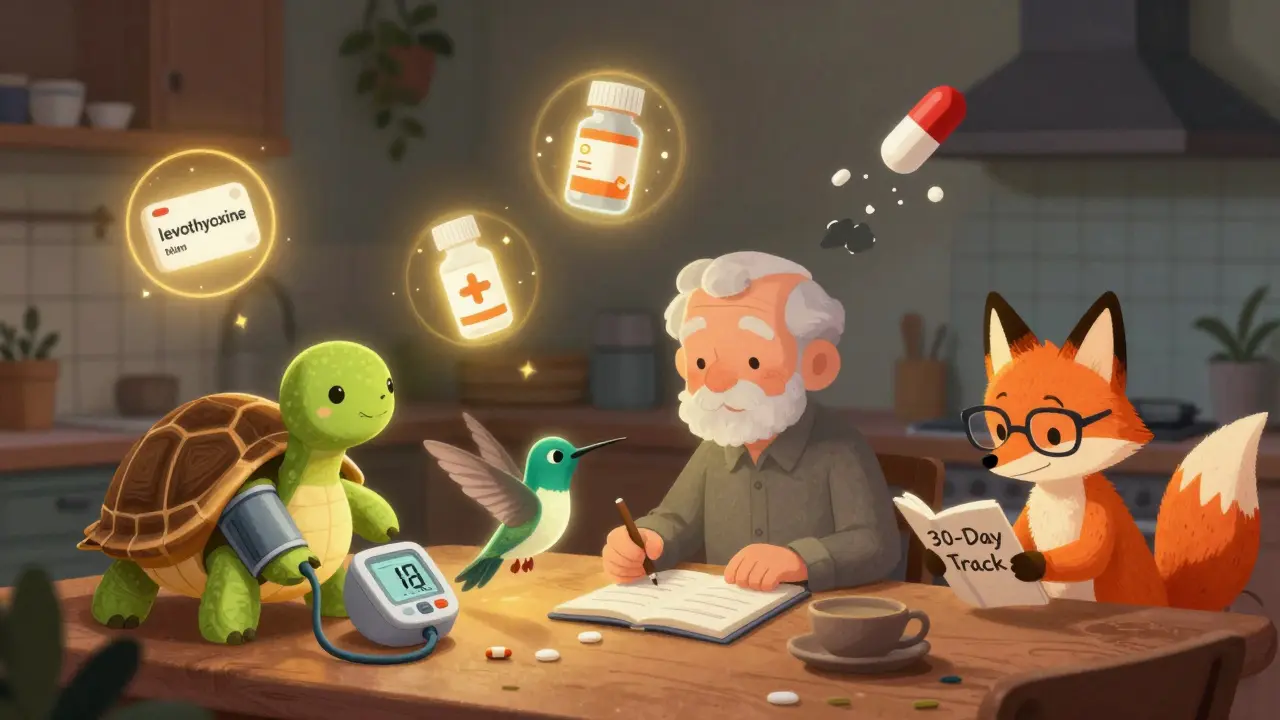
You don’t need to panic. But you do need to be proactive. Here’s what works:- Track your symptoms daily. Use a notebook, phone app, or even a sticky note. Note energy levels, mood, sleep, heart rate, joint pain, or any new side effects. Write down your blood pressure or blood sugar numbers if you monitor them.
- Don’t switch manufacturers mid-transition. If your first generic is made by Teva, and you refill and get one from Mylan, that’s another change. Stick with the same generic manufacturer for at least 30 days. Many pharmacies can special-order the same one if you ask.
- Give it time. Your body adjusts. Minor side effects like mild nausea or headaches often fade within 1-2 weeks. If they last longer than 30 days, talk to your doctor.
- Check your labs. If you’re on thyroid meds, warfarin, or seizure drugs, ask your doctor to retest your levels 4-6 weeks after switching. That’s the golden window to catch any drift before it becomes a problem.
- Ask your pharmacist. They know which generics are in stock and which ones other patients report issues with. They can also flag if your new generic has a different dye or filler you might be sensitive to.
The American Pharmacists Association recommends a 30-day transition period. That’s not arbitrary. It’s the time it takes for your body to stabilize on a new formulation - and for you to see if your symptoms stay controlled.
When You Can (and Should) Ask for the Brand Name
You’re not stuck with whatever the pharmacy gives you. If you’ve been on a brand-name drug for years and feel fine, you can request it. But insurance will likely deny it unless you prove a medical need.Here’s what works:
- Get a letter from your doctor saying you’ve tried two generic versions and had adverse effects or lab abnormalities.
- For levothyroxine, many endocrinologists will support keeping you on one brand - especially if your TSH has been stable for months.
- For insulin, the Inflation Reduction Act caps out-of-pocket costs at $35/month for Medicare patients. That makes generics and biosimilars more accessible, but if you’re still struggling, ask about patient assistance programs.
Approval rates for brand-name exceptions are low - only 14% for maintenance meds - but they’re not zero. Be prepared with data: your symptom log, lab results, and a clear explanation of why the switch didn’t work for you.
What’s Changing in 2026 - And What It Means for You
The FDA approved 79 new generic maintenance drugs in the first half of 2023 alone - including the first generics for Jardiance (diabetes) and Entresto (heart failure). More are coming. Eliquis, a top blood thinner, loses its patent in 2026, which could slash its price by 90%.But there’s a catch. The number of manufacturers making each generic has dropped. In 2010, there were 15 companies making atorvastatin. Now there are 8. That’s good for competition - but risky if one factory has a supply issue. The Government Accountability Office warned in 2022 that this concentration could lead to shortages.
That’s why staying consistent with your generic manufacturer matters more now than ever. If your pharmacy switches your generic without telling you, ask why. You have the right to know.
Real Stories - What Patients Actually Experience
On Reddit, a thread titled “Switched from Synthroid to generic and felt awful” had 147 comments. Sixty-three percent said they felt worse - fatigue, brain fog, weight gain. Thirty-seven percent said they felt fine or even better. The difference? Many of the people who struggled switched manufacturers multiple times. Those who stayed with one generic - even if it wasn’t the brand - stabilized within two months.A Drugs.com survey of 2,450 people showed:
- 41% noticed no difference
- 32% said they could finally afford their meds and felt better because of it
- 19% had minor side effects that faded
- 8% stopped taking the generic because they believed it didn’t work
Here’s the key: the 8% who quit? Most didn’t check their labs. They assumed the pill wasn’t working - when their condition may have been progressing naturally.
One woman in Birmingham, 68, switched from brand-name metoprolol to generic after her Medicare plan changed. She felt dizzy at first. She tracked her blood pressure daily. After three weeks, it was more stable than before. She kept the generic. Her monthly bill dropped from $87 to $4.
You’re Not Choosing Between Cheap and Effective - You’re Choosing Between Access and Stability
Generics aren’t a compromise. They’re a breakthrough. For most people with chronic conditions, they’re the reason they can keep taking their meds year after year. The science is clear: they work the same. The savings are massive - $313 billion a year for the U.S. healthcare system.But medicine isn’t just science. It’s experience. If you’re one of the small group who feels different after switching - whether it’s a thyroid issue, a mood shift, or unexplained fatigue - trust yourself. Document it. Talk to your doctor. Ask for a lab test. Don’t let cost pressure silence your body’s signals.
The goal isn’t to never switch. It’s to switch smart. Stay consistent. Monitor your health. Advocate for yourself. And know this: you’re not alone. Millions are doing the same thing - and most of them are thriving on generics.
Are generic maintenance medications really as effective as brand-name ones?
Yes, for the vast majority of patients. The FDA requires generics to have the same active ingredient, strength, dosage form, and absorption rate as the brand-name drug. Bioequivalence testing ensures the drug enters your bloodstream at the same rate and level. Studies show no difference in outcomes for conditions like high blood pressure, diabetes, and high cholesterol. Only a small group - around 1-3% - with narrow therapeutic index drugs like levothyroxine or warfarin may need to stick with one version.
Why do some people feel worse after switching to a generic?
It’s usually not the active ingredient. The difference lies in inactive ingredients - fillers, dyes, coatings - which can affect how quickly the drug dissolves. For most people, this doesn’t matter. But for those on thyroid, seizure, or blood-thinning meds, even small changes in absorption can shift lab results or cause side effects. Psychological factors also play a role: if you expect the generic to be weaker, you may notice symptoms you didn’t before. Tracking your symptoms for 30 days helps separate real changes from perception.
Should I ask my doctor to keep me on my brand-name medication?
Only if you’ve had a documented issue with generics - like lab values going out of range or symptoms returning after switching. For most chronic conditions, generics are the standard of care. Insurance will only approve brand-name drugs if you’ve tried two generics and had clear problems. For drugs like levothyroxine, many endocrinologists will support staying on one version if you’re stable. Always bring your symptom log and lab results to the conversation.
Can I switch between different generic brands?
It’s possible, but not recommended - especially for narrow therapeutic index drugs. Each generic manufacturer uses different inactive ingredients. Switching between them can cause your body to react differently each time. If you’re stable on one generic, ask your pharmacy to fill your prescription with the same manufacturer each time. Most can do this if you request it.
How long does it take to adjust to a new generic medication?
Most people adjust within 1-2 weeks. Minor side effects like headaches or stomach upset usually fade. For medications that affect lab levels - like thyroid or blood thinners - it can take 4-6 weeks for your body to fully stabilize. That’s why doctors recommend rechecking blood tests around 30-45 days after switching. If you’re still feeling off after 30 days, contact your provider.
Are there any new generic medications coming out soon?
Yes. In 2023, the FDA approved generics for Jardiance (diabetes) and Entresto (heart failure). In 2026, Eliquis - a top blood thinner - will lose its patent, opening the door for multiple generic versions. This will likely drive prices down even further. The FDA is also accelerating approvals for complex generics like inhalers and injectables used in asthma and multiple sclerosis, making them more accessible in the coming years.
Robin Van Emous
January 27, 2026 AT 17:59Switched my levothyroxine last year from Synthroid to a generic, and honestly? I didn’t notice a thing. I track my TSH every 3 months, and it’s been rock solid. I think the fear around generics is way overblown for most people.
Angie Thompson
January 28, 2026 AT 23:03OMG YES 🙌 I was SO scared to switch from my brand-name antidepressant… like, I had nightmares about turning into a zombie 😵💫 But I stuck with the generic for 30 days, tracked my mood in my journal, and guess what? I felt better than ever! My bank account is happy, my brain is clear, and I’m not crying over pill bottles anymore 💪💖
rasna saha
January 30, 2026 AT 14:51I’m from India, and generics are all we have here-no choice, really. But I’ve seen friends with diabetes and hypertension do just fine on them. The key is consistency. Don’t keep switching brands. Find one that works, stick with it, and talk to your pharmacist. They know what’s what.
Ashley Porter
January 30, 2026 AT 18:08From a pharmacokinetic standpoint, the bioequivalence window of 80–125% AUC and Cmax is statistically robust for population-level outcomes-but individual variability in CYP450 metabolism, gastric pH, and GI motility can absolutely create clinically meaningful deviations in narrow-therapeutic-index drugs. That’s why TDM is non-negotiable for levothyroxine and warfarin patients.
shivam utkresth
February 1, 2026 AT 00:00Man, I used to think generics were just ‘cheap junk’ until I saw my uncle’s insulin bill drop from $400 to $90. He’s been on the same generic for 2 years now, no issues. But yeah, if you’re on thyroid meds? Don’t play around. Stick with one maker. My cousin switched from Teva to Mylan and went from chill to panic attacks in a week. Weird, right?
Kipper Pickens
February 1, 2026 AT 06:13It’s funny how people treat generics like they’re some kind of betrayal. The FDA doesn’t approve junk. If you’re having issues, it’s either the filler, the placebo effect, or you’re not monitoring properly. I’ve been on generic metoprolol for 5 years. My BP is better than when I was on the brand. Science wins again.
Aurelie L.
February 2, 2026 AT 06:56I switched and got a panic attack. That’s it. I’m not a scientist. I just know I felt like I was dying. So I went back to the brand. End of story.
Joanna Domżalska
February 3, 2026 AT 01:39Everyone’s acting like generics are some miracle. But let’s be real-pharma companies push generics because they’re profitable, not because they’re better. And don’t get me started on the FDA’s ‘bioequivalence’ loophole. If your body reacts differently, it’s not ‘in your head.’ It’s corporate greed dressed up as science.