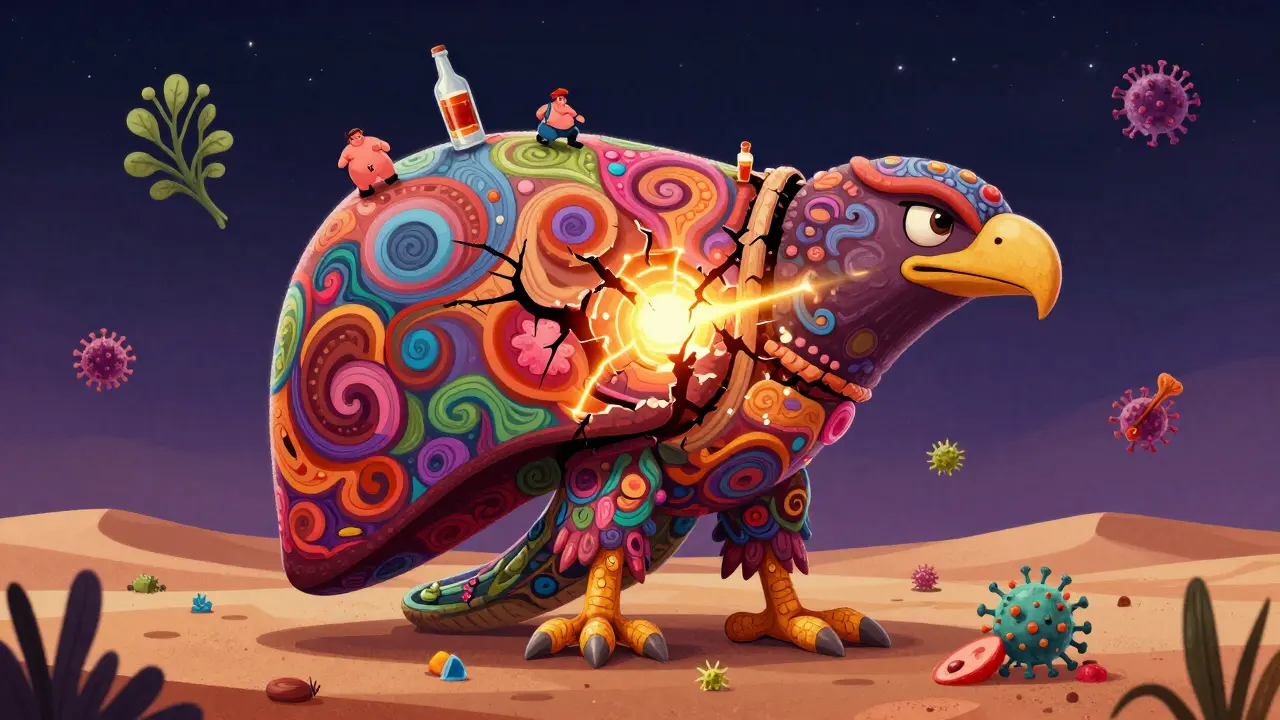
When your liver starts to scar, it’s not just a minor bump in the road-it’s a warning sign that your body is struggling to keep up. Cirrhosis isn’t a single disease. It’s the end result of years of damage, where healthy liver tissue gets replaced by tough, fibrous scar tissue. This isn’t something that happens overnight. It creeps in silently, often without symptoms, until one day, your body can’t ignore it anymore. By then, the damage is serious-and irreversible.
What Happens When the Liver Scars?
Your liver is one of the most resilient organs in your body. It can regenerate, detoxify blood, make proteins, and store energy-all at the same time. But when it’s under constant attack-from alcohol, hepatitis, fatty liver, or other toxins-it tries to heal itself. Each time it repairs, it leaves behind a bit of scar tissue. Over time, these scars pile up. They don’t just sit there; they twist and tighten, squeezing blood vessels and blocking the flow of nutrients and bile.
That’s when cirrhosis kicks in. The liver’s normal structure breaks down. Instead of smooth, functional tissue, you get nodules of regenerating cells wrapped in thick bands of scar tissue. This isn’t just a change in appearance-it changes how your whole body works. Blood pressure in the portal vein spikes (portal hypertension), fluids leak into your belly (ascites), toxins build up in your brain (hepatic encephalopathy), and your blood can’t clot properly.
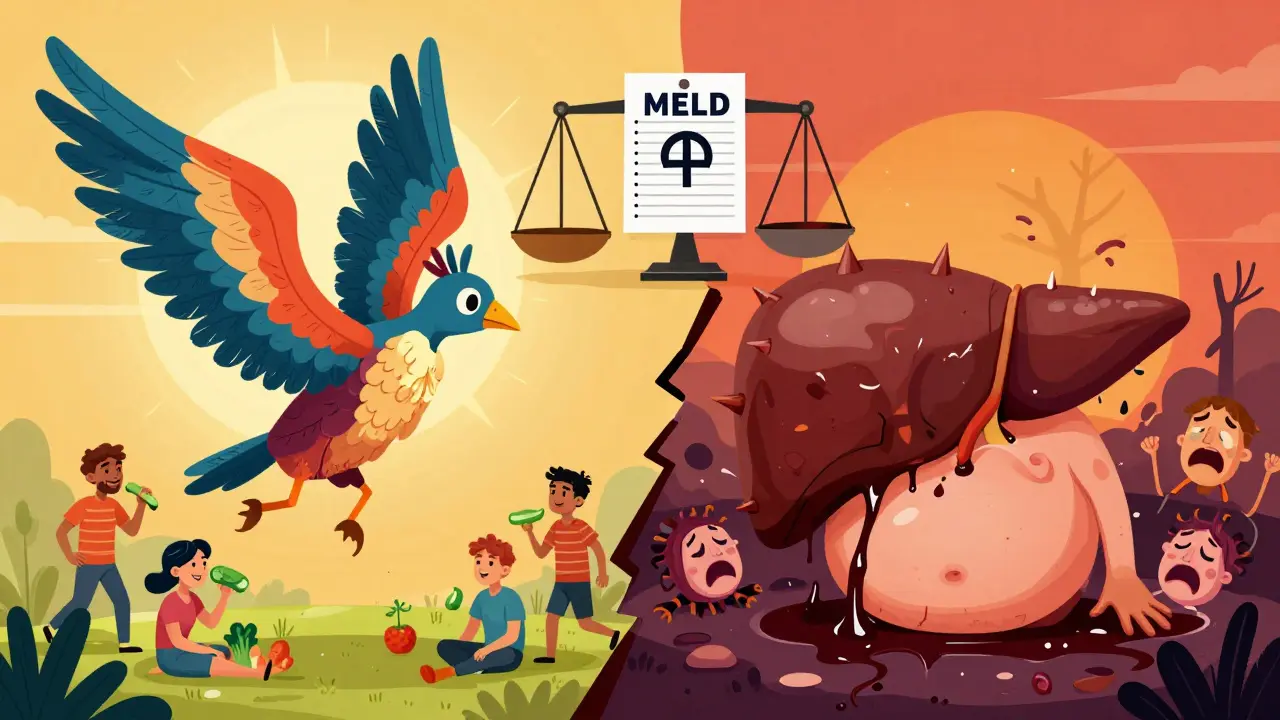
Doctors measure this damage with tools like the MELD score (Model for End-Stage Liver Disease), which uses blood tests for bilirubin, creatinine, and INR to predict survival. A score above 15 means you’re at high risk. A score over 20? Without a transplant, your chances drop sharply.
Compensated vs. Decompensated: The Critical Divide
Not all cirrhosis is the same. There’s a huge difference between compensated and decompensated cirrhosis-and it’s the line between managing a chronic condition and facing a life-threatening crisis.
In compensated cirrhosis, your liver is scarred, but it’s still doing enough to keep you alive. You might feel fine. Maybe you’re tired sometimes, or your abdomen feels slightly swollen. Blood tests show abnormalities, but you’re not in the hospital. Many people live like this for years. The key? Catch it early. If you stop drinking, lose weight, or treat hepatitis, you can slow or even stabilize the damage.
Decompensated cirrhosis is when the liver finally gives out. You start showing clear, dangerous signs: fluid in your belly that won’t go away, confusion or memory loss, vomiting blood from swollen veins in your esophagus, or jaundice so severe your skin turns yellow. At this stage, survival rates plummet. Studies show only 20-50% of people live five years without a transplant.
That’s why staging matters. The Child-Pugh score (A, B, or C) and MELD score aren’t just numbers-they’re survival predictors. A Child-Pugh C score means your one-year survival is about 45%. That’s not a statistic. That’s a wake-up call.
What Causes Cirrhosis Today?
For decades, alcohol was the top cause. But that’s changed. In the U.S., non-alcoholic fatty liver disease (NAFLD) now causes nearly a quarter of all cirrhosis cases. It’s tied to obesity, diabetes, and metabolic syndrome-conditions that have exploded in recent years. Alcohol still plays a big role, especially in younger adults and in parts of Eastern Europe, where cirrhosis death rates are nearly triple those in Western Europe.
Hepatitis B and C are still major players. Hepatitis C, in particular, used to be a silent killer. But now, with direct-acting antivirals, it’s often curable-if caught early. Many people don’t know they have it until their liver is already scarred. That’s why routine blood work matters. A simple ALT or AST test can flag trouble before symptoms show.
Other causes include autoimmune hepatitis, bile duct diseases like primary biliary cholangitis, and rare genetic disorders like hemochromatosis. But here’s the thing: if you have any of these, and you keep exposing your liver to stress-alcohol, excess sugar, uncontrolled diabetes-you’re speeding up the clock.
Can Cirrhosis Be Reversed?
This is the question most people ask. The short answer: once cirrhosis is established, the scar tissue doesn’t vanish. You can’t undo it with pills or diets. But you can stop it from getting worse. And in some cases, especially with early-stage cirrhosis, the liver can partially recover function.
Studies show that if someone with early cirrhosis stops drinking alcohol completely, their survival rate improves dramatically. In one 2023 study, 70% of patients with alcohol-related cirrhosis who quit drinking had no progression of disease over five years. That’s not a cure-but it’s a second chance.
For NAFLD, weight loss is the most powerful tool. Losing just 7-10% of your body weight can reduce liver fat and inflammation. Some patients even see a drop in fibrosis scores. New drugs like obeticholic acid are approved for certain types of cirrhosis, but they’re not magic bullets. They slow progression, not reverse it.
The biggest mistake? Waiting until you’re sick to act. By the time you feel bad, the damage is often too far gone.
When Is a Liver Transplant the Only Option?
If you’ve reached decompensated cirrhosis, a transplant isn’t just a good idea-it’s often the only thing that will save your life. In the U.S., cirrhosis accounts for about 40% of all liver transplants. That’s more than any other reason.
But getting a transplant isn’t like walking into a store and picking one up. There’s a waiting list. As of 2023, over 14,000 people in the U.S. were waiting for a liver. Only about 8,800 transplants were done that year. That means roughly 1 in 8 people on the list will die before they get one.
Who gets priority? The MELD-Na score. It’s a formula that weighs how sick you are-based on your blood test results. The higher your score, the higher your priority. That’s why doctors push so hard to catch cirrhosis early. If you’re still in the compensated stage, you’re not high enough on the list. But if you’re in decompensated cirrhosis, your score jumps, and so does your chance of getting a liver.
Transplant success rates are strong. About 80% of patients survive five years after transplant. But it’s not the end of the story. You’ll need lifelong immunosuppressants to prevent rejection. You’ll need regular checkups. You’ll have to avoid infections, certain foods, and alcohol forever. It’s a second life-but it comes with rules.
What Happens If You Don’t Get a Transplant?
Without a transplant, decompensated cirrhosis leads to one of three things: liver failure, internal bleeding, or infection. Each is deadly.
Ascites can lead to spontaneous bacterial peritonitis-an infection in the belly fluid that kills 30% of patients if not treated fast. Variceal bleeding-ruptured veins in the esophagus-can cause you to vomit blood and collapse. Hepatic encephalopathy can make you confused, drowsy, or even comatose. These aren’t rare complications. They’re expected outcomes without intervention.
Some patients get temporary help: paracentesis to drain belly fluid, banding for bleeding veins, or lactulose for brain fog. But these are stopgaps. They don’t fix the liver. They just buy time.
And time is running out. The average survival after decompensation is less than two years without transplant. That’s why doctors don’t wait. They start the evaluation early-even if you’re still feeling okay.
Living With Cirrhosis: Daily Realities
People with cirrhosis aren’t just patients. They’re people managing a constant, invisible burden.
One man on Reddit said he lost 15 pounds in a month because he couldn’t keep food down. Another described forgetting her own birthday because of brain fog. Fatigue isn’t just being tired-it’s being so drained you can’t walk to the mailbox. Sodium restriction isn’t a suggestion. It’s a strict limit: under 2,000 mg a day. That means no canned soup, no deli meats, no soy sauce. Even a single bag of chips can trigger fluid buildup.
Medications change too. Your liver can’t process drugs the way it used to. Over-the-counter painkillers like ibuprofen can be dangerous. Antibiotics, sedatives, even some vitamins need to be adjusted. Many patients end up seeing multiple specialists-gastroenterologists, nutritionists, addiction counselors, mental health providers.
And the emotional toll? It’s huge. Depression and anxiety are common. Many feel guilty, especially if alcohol played a role. Others feel abandoned by the system. One patient review gave their doctor a 2.8 out of 5, writing: “They didn’t explain what decompensated meant until I was in the ER.”
Support groups, nurse navigators, and liver clinics help. But access is uneven. In rural areas, only 35% of counties have a hepatologist. That means many patients travel hours just for a checkup.
What’s Next? Hope on the Horizon
Science is moving fast. Non-invasive tests like MRI elastography can now detect cirrhosis with 90% accuracy-no biopsy needed. That’s a game-changer for early diagnosis.
Researchers are testing drugs that target fibrosis itself. One, called simtuzumab, showed a 30% slowdown in scar tissue growth in early trials. Others are exploring stem cells and bioartificial livers-devices that can temporarily take over liver function while patients wait for a transplant.
And organ availability? It’s improving. New techniques like normothermic machine perfusion keep donor livers alive longer outside the body, increasing the number of usable organs by 22%. That means more people get transplants-and faster.
But the biggest breakthrough won’t come from a lab. It’ll come from awareness. If more people get screened for hepatitis, lose weight, cut back on sugar, and stop drinking before it’s too late, we could prevent millions of cases.
Cirrhosis isn’t inevitable. It’s the result of choices-some made years ago, others still within your power to change. The liver is resilient. But it’s not invincible. Listen to it before it screams.
Can cirrhosis be reversed naturally?
Cirrhosis itself-the scar tissue-cannot be reversed. But if caught early, stopping the cause (like alcohol or hepatitis) can prevent further damage and allow the liver to regain some function. Weight loss and diet changes can improve fatty liver disease, which may slow or stabilize cirrhosis. However, once significant scarring is present, no diet, supplement, or herbal remedy can remove it.
How do you know if cirrhosis is getting worse?
Signs include new or worsening swelling in the belly or legs, yellowing of the skin or eyes, confusion or memory problems, vomiting blood, black or tarry stools, and extreme fatigue. Blood tests showing rising bilirubin, falling albumin, or increasing INR also signal decline. If you have cirrhosis and notice any of these, seek medical help immediately.
Is a liver transplant the only cure for cirrhosis?
Yes, for advanced cirrhosis, a liver transplant is the only cure. Medications can manage symptoms and slow progression, but they cannot replace the function of a scarred liver. Transplantation replaces the damaged organ with a healthy one, allowing normal liver function to return. However, it requires lifelong medication and monitoring to prevent rejection.
Can you live a normal life with cirrhosis?
If cirrhosis is caught early and the cause is controlled, many people live for years with few symptoms. But it’s not a return to “normal.” You’ll need to follow strict dietary rules, avoid alcohol and certain medications, and attend regular checkups. Fatigue and brain fog are common. Quality of life improves significantly after a successful transplant, but lifelong care is still required.
What foods should you avoid with cirrhosis?
Avoid high-sodium foods like canned soups, processed meats, pickles, soy sauce, and fast food. Limit protein if you have hepatic encephalopathy, but don’t cut it too low-your body still needs it. Avoid raw shellfish, which can cause dangerous infections. Alcohol is strictly forbidden. Drink plenty of water, eat vegetables, lean proteins, and whole grains. A registered dietitian can create a personalized plan.
How long can you live with cirrhosis without a transplant?
It depends on the stage. With compensated cirrhosis, many live 10-15 years or more with proper care. Once decompensated, survival drops to about 2-5 years without a transplant. Factors like age, other health conditions, and whether you stop drinking or lose weight affect outcomes. The MELD score gives the most accurate prediction: higher scores mean shorter survival.
Are there alternatives to liver transplant?
Currently, no alternatives fully replace a liver transplant. Temporary support options include artificial liver devices (like MARS) or stem cell therapies, but these are experimental and only help stabilize patients while they wait. They don’t cure cirrhosis. Research into bioengineered livers and regenerative medicine is ongoing, but none are available for routine use yet.
Early detection saves lives. If you have risk factors-obesity, diabetes, heavy alcohol use, or a history of hepatitis-get tested. Blood work, ultrasound, and FibroScan can catch cirrhosis before it’s too late. Don’t wait for symptoms. By then, it’s already too late to fix the damage.
Jan Hess
January 15, 2026 AT 04:57Iona Jane
January 16, 2026 AT 09:40Jaspreet Kaur Chana
January 18, 2026 AT 02:56Haley Graves
January 19, 2026 AT 06:32Diane Hendriks
January 20, 2026 AT 11:08ellen adamina
January 20, 2026 AT 20:58Tom Doan
January 21, 2026 AT 02:46Annie Choi
January 22, 2026 AT 09:56Ayush Pareek
January 23, 2026 AT 07:43Nicholas Urmaza
January 25, 2026 AT 01:21Sarah Mailloux
January 26, 2026 AT 10:37Nilesh Khedekar
January 27, 2026 AT 20:28Jami Reynolds
January 29, 2026 AT 11:35