
Managing multiple medications isn’t just about remembering to take them-it’s about taking them at the right time, in the right order, and without clashing with each other. If you’re on five or more prescriptions, supplements, or over-the-counter drugs, you’re not alone. Nearly 40% of adults over 65 are in this boat, and the risk of harmful drug interactions jumps to 82% in this group. The good news? A smart, simple medication schedule can cut those risks dramatically-and it doesn’t require fancy tech or a pharmacy degree.
Start with a Complete Medication List
Before you even think about timing, you need to know exactly what you’re taking. This includes every prescription, every OTC pill (like ibuprofen or antacids), every vitamin, herb, or supplement. Many people forget the non-prescription stuff, but those are often the culprits behind interactions. For example, St. John’s Wort can make blood thinners like warfarin useless, and calcium supplements can block thyroid medication if taken too close together. Write it all down. Don’t rely on memory. Bring this list to every doctor visit. A 2019 study found that when patients brought all their meds in a bag to appointments-called a “brown bag review”-pharmacists found an average of 3.2 discrepancies per person. That’s more than three mistakes per patient just from incomplete or outdated info.Understand the Timing Rules
Not all meds work the same way. Some need food, some need an empty stomach, some need to be spaced hours apart. Here’s what to look for:- Take on an empty stomach: Levothyroxine (for thyroid), certain antibiotics like ciprofloxacin, and iron supplements. Wait at least 30-60 minutes before eating.
- Take with food: Statins (like atorvastatin), NSAIDs (like naproxen), and some antifungals. Food helps absorption and reduces stomach upset.
- Take at least 2 hours apart: Calcium, magnesium, or zinc supplements from thyroid meds, antibiotics like tetracycline, or bisphosphonates for osteoporosis.
- Take at the same time daily: Blood pressure meds, antidepressants, and insulin. Consistency matters more than exact hour.
Group Medications by Time Block
Once you know your timing rules, start grouping. Aim to fit as many meds as possible into the four UMS windows. For example:- Morning (6-10 AM): Thyroid med (on empty stomach), blood pressure pill, daily vitamin, statin (if taken in morning).
- Noon (10 AM-2 PM): Pain reliever with lunch, diabetes med, diuretic (to avoid nighttime bathroom trips).
- Evening (2-6 PM): Calcium supplement (2 hours after thyroid), antidepressant, evening dose of blood thinner.
- Bedtime (8 PM-12 AM): Sleep aid, muscle relaxant, cholesterol med (if taken at night), magnesium.
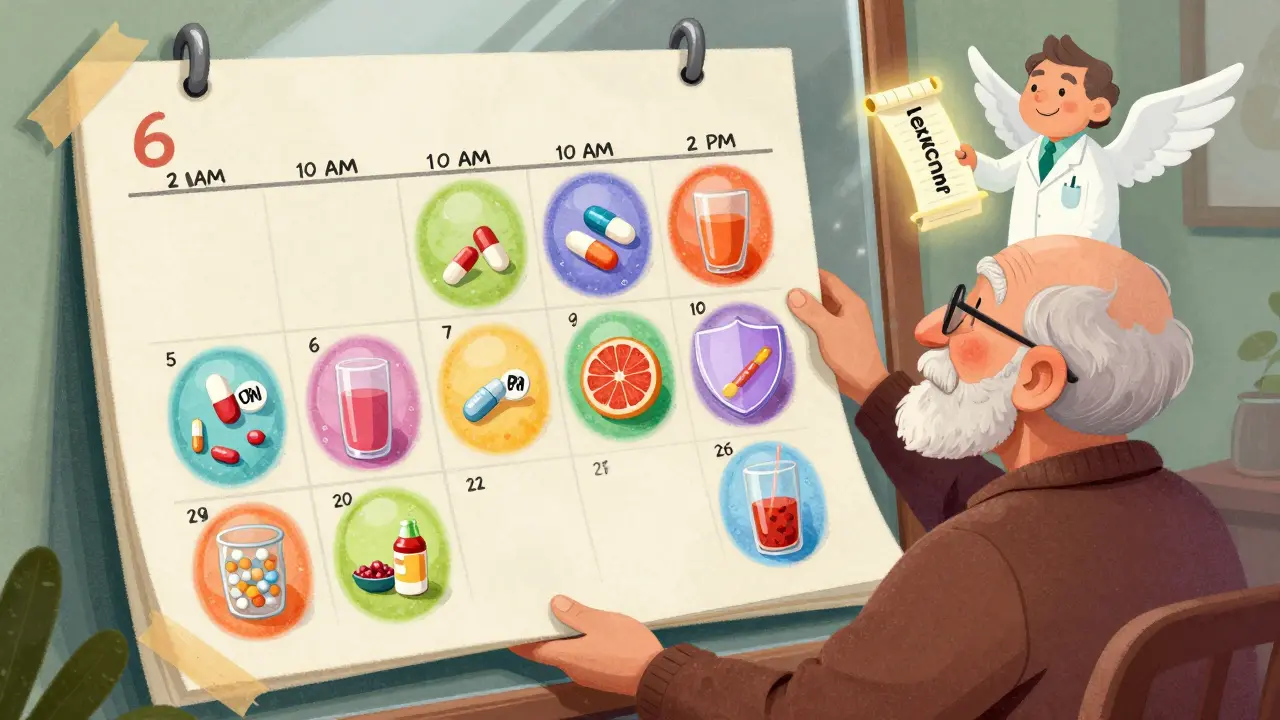
Use a Pill Organizer and Calendar
A simple plastic pill box with AM/PM or 7-day compartments reduces dosing errors by 45%, according to a major 2018 analysis. Choose one with clear labels and separate compartments for each time of day. For complex regimens, get a 7-day box with four slots per day. Pair it with a written calendar. Write down each med, the time, and any special instructions (“take with food,” “avoid dairy”). Tape it to your bathroom mirror or fridge. A 2020 study found that patients who used a visual calendar improved adherence from 50% to 75%-a huge jump. If you’re tech-savvy, apps like Medisafe or MyTherapy send reminders and track interactions. But don’t assume they work for everyone. Only 38% of users over 65 consistently use them. For many, a printed chart is still the most reliable tool.Synchronize Refills to Reduce Chaos
Getting your prescriptions refilled on different days is a recipe for missed doses. The “90 x 4” method-getting a 90-day supply filled four times a year-means you refill everything on the same day. This saves time, reduces errors, and cuts down on trips to the pharmacy. Talk to your pharmacist. Many pharmacies offer free synchronization services. One study showed this approach saves clinicians two hours per day by reducing the number of refill requests and follow-ups. It’s not for everyone-especially if your doses change often-but if your meds are stable, it’s a game-changer.Know the High-Risk Combinations
Some interactions are dangerous and common. The American Geriatrics Society’s Beers Criteria (updated in 2023) lists 30 combinations to avoid, especially in older adults:- NSAIDs + blood thinners: Increases bleeding risk by 60-70%.
- Anticholinergics + dementia meds: Can worsen confusion and memory loss.
- SSRIs + triptans: Risk of serotonin syndrome-a rare but life-threatening reaction.
- Calcium channel blockers + grapefruit juice: Can spike drug levels and cause dizziness or heart issues.
Watch for Warning Signs
Even the best schedule can miss something. Pay attention to new symptoms:- Dizziness or lightheadedness
- Unusual bruising or bleeding
- Severe nausea or diarrhea
- Confusion or memory lapses
- Rash or swelling
Get Help When You Need It
You don’t have to do this alone. Pharmacists are medication experts-and they’re often underused. Many offer free Medication Therapy Management (MTM) sessions. In one study, pharmacist-led reviews reduced drug interactions by 32% and cut ER visits by 24%. If you see multiple specialists, ask for a medication reconciliation at each visit. The Joint Commission requires hospitals and clinics to review your meds every time you’re admitted or discharged. But patients often forget to bring their list. Be the one who remembers.Make It Stick
The hardest part isn’t creating the schedule-it’s sticking to it. Most people get it right for a few weeks, then slip. To make it last:- Keep your pill organizer and calendar in the same spot-always.
- Set phone alarms for each time block, even if you use a pill box.
- Ask a family member to check in once a week.
- Review your list every month. Add new meds. Remove old ones.
Can I take all my pills at once to make it easier?
No. Taking everything at once increases the risk of interactions and can reduce how well your body absorbs each drug. For example, calcium can block thyroid medication, and grapefruit juice can make some blood pressure drugs too strong. Always follow timing rules-even if it feels inconvenient.
What if my doctors give me different timing instructions?
This is very common. A 2022 survey found that 67% of patients get conflicting advice from different specialists. When that happens, call your pharmacist. They can review all your meds and recommend a safe, unified schedule. Never guess-always ask for clarification.
Do I need an app to manage my meds?
No. Apps help some people, especially those who are tech-savvy or have busy schedules. But for older adults or those with limited tech access, paper calendars and pill organizers work just as well-or better. Choose the method you’ll actually use every day.
How do I know if a supplement is safe with my meds?
Always assume it’s not safe until proven otherwise. Supplements aren’t regulated like drugs, so their ingredients and effects aren’t always clear. Tell your pharmacist every supplement you take-even if you think it’s harmless. Ginger, garlic, ginkgo, and fish oil can all interfere with blood thinners. Don’t skip this step.
What if I miss a dose?
It depends on the med. For blood pressure or cholesterol meds, take it as soon as you remember, unless it’s almost time for the next dose. For antibiotics or insulin, follow your doctor’s specific instructions. Never double up unless told to. When in doubt, call your pharmacist. They’re trained to handle these situations safely.
Can my pharmacist change my schedule?
They can’t prescribe or change doses, but they can suggest safer timing, flag interactions, and recommend alternatives like combination pills or synchronized refills. Many pharmacies now offer formal Medication Therapy Management services-ask if yours does.
If you’re managing multiple medications, you’re doing something important-and difficult. The goal isn’t to memorize every detail. It’s to build a system that works for you, reduces stress, and keeps you safe. Start small. Use the UMS time blocks. Get a pill organizer. Talk to your pharmacist. You don’t need to be perfect. You just need to be consistent.
Nancy Kou
December 21, 2025 AT 10:49Just started using the UMS system last month after my mom had a bad interaction with her blood thinner and St. John’s Wort. Made a simple printed chart and taped it to the fridge. No more guessing. No more panic. I wish I’d done this years ago.
Simple tools beat fancy apps every time for older folks. My dad still uses a paper pill organizer with a Sharpie. Works like a charm.
Hussien SLeiman
December 22, 2025 AT 17:32Oh great, another ‘just use a pill organizer’ guru who thinks this is a problem of personal laziness. Have you ever tried managing 12 different meds with conflicting instructions from three different specialists who refuse to talk to each other? The system doesn’t fail because people are stupid-it fails because the healthcare system is a goddamn circus.
And don’t even get me started on ‘synchronized refills.’ Try getting a 90-day supply when your insurance only covers 30 and your pharmacy ‘can’t process it’ because your doctor didn’t use the right code. This advice reads like it was written by someone who’s never had to navigate this mess.
Meanwhile, I’m still Googling ‘can I take metoprolol with turmeric’ at 2 a.m. while my cat stares at me like I’m the problem.
Henry Marcus
December 23, 2025 AT 14:40EVERYONE knows this is just the beginning… the pill organizers? The UMS? The ‘pharmacist reviews’? They’re all distractions. The real issue? The pharmaceutical industry is pushing these drugs to keep people dependent. Did you know that 87% of the interactions listed here were either ignored in clinical trials or buried in footnotes? The Beers Criteria? A PR stunt. The real danger isn’t calcium blocking thyroid meds-it’s that they want you to believe you need 12 pills a day to survive. They’re not curing you-they’re monetizing your confusion.
And don’t get me started on apps. Your phone is listening. Every time you log ‘took atenolol,’ they’re selling your data to insurers who’ll raise your premiums. I use a notebook. Handwritten. In pencil. Burned it once after a refill. That’s the only way to stay safe.
Frank Drewery
December 25, 2025 AT 09:33This is actually really helpful. I’ve been helping my aunt sort through her meds, and the UMS breakdown made it click for her. She was taking her thyroid med with breakfast-every morning-because ‘that’s when I eat.’ Now she takes it 30 minutes before, and her energy levels have improved dramatically.
Small changes matter. And yeah, paper works better than apps for her. No notifications, no glitches, no passwords. Just a sticky note and a pill box. Sometimes the simplest things are the most powerful.
jessica .
December 26, 2025 AT 18:11USA is the only country that lets pharmacists even do this kind of review… in other countries they just give you a bag of pills and say ‘take one’ and hope you don’t die. My cousin in Germany got prescribed 8 meds and was told ‘you’re old now, just live with it.’ Here? We have MTM. We have UMS. We have people who actually care. Don’t let the haters make you feel bad for using resources that save lives.
Also-grapefruit juice? That’s not a myth. It’s a silent killer. I saw a guy in the ER last year because he drank half a glass with his blood pressure med. He didn’t even know it was dangerous. People need to wake up.
Ryan van Leent
December 28, 2025 AT 13:28Why are we even doing this? Just take them all at once. Who cares if calcium blocks thyroid? You’re 72, not 22. You’re not going to live long enough for the interaction to matter. I’ve been doing this for 10 years. I take my statin with my coffee, my blood thinner with my donut, and my sleep aid with my whiskey. I’m still here. You’re overcomplicating it.
Also, why do you need a calendar? Just remember. If you can’t remember, maybe you shouldn’t be taking so many pills.
Also also-why do you need a pharmacist to tell you what to do? You’re not a child. Use your brain.
Sajith Shams
December 30, 2025 AT 00:35You missed the most critical point: the timing rules are based on Western biochemistry and assume a uniform metabolism. In South Asia, where I’m from, people metabolize drugs differently due to genetic polymorphisms in CYP450 enzymes. St. John’s Wort might not affect warfarin the same way in Indians as it does in Caucasians. The UMS is a one-size-fits-all solution designed for American clinical trials that never included diverse populations.
Also, you didn’t mention drug-food interactions specific to Indian diets-like how turmeric with blood thinners increases bleeding risk 3x more than in Western populations. This guide is dangerously incomplete.
And why is no one talking about the cost? Most of these pill organizers cost $25. Most of us are on fixed incomes. We reuse yogurt containers. Don’t lecture us about ‘best practices’ when you haven’t lived it.
Ashley Bliss
December 31, 2025 AT 14:29I cried reading this. Not because it’s perfect-but because it’s the first time anyone has looked at medication management and said: ‘You’re not broken. The system is.’
For years I felt like a failure because I forgot my pills. Because I couldn’t keep track. Because I was too tired to read the tiny print. Because my daughter kept telling me ‘just use the app’-but I couldn’t see the screen.
This isn’t about discipline. It’s about dignity. It’s about recognizing that aging isn’t a defect to be fixed with more tech-but a human experience that deserves simple, kind, practical tools.
Thank you for writing this. I’m printing it out. I’m hanging it up. And I’m telling every person I know who’s drowning in pills: you’re not alone.
Elaine Douglass
January 1, 2026 AT 17:06My grandma uses the UMS and a pill box and it’s changed everything. She used to call me every other day asking if she took her blood pressure pill. Now she just checks the box. No stress. No guilt.
Also, the part about grapefruit juice? I didn’t know that. My mom drinks it every morning. We just stopped. No big deal. Just a little change. But it matters.
Thanks for making this so clear. No jargon. Just facts. I’m sharing this with my whole family.
Takeysha Turnquest
January 2, 2026 AT 16:49We are not just taking pills-we are performing a silent ritual of survival. Each capsule, each tablet, each liquid dose is a whisper to the universe: I am still here. I am still fighting.
And yet the system treats us like broken machines to be calibrated. We are not algorithms. We are not data points. We are humans who wake up every morning and choose to keep going-even when our bodies betray us.
This guide? It doesn’t just organize meds. It restores agency. It says: You are not helpless. You are not a burden. You are worthy of a plan that honors your life.
Thank you. From the bottom of my heart.
Emily P
January 4, 2026 AT 00:38Quick question: does the UMS account for shift workers? My uncle works nights-11pm to 7am-and takes his meds every 8 hours. His ‘bedtime’ is 8am. Does that mean he should take his thyroid med at 8am after sleeping? Or does he still take it on an empty stomach before his ‘morning’ meal at 6pm?
Anyone have experience with this? I couldn’t find anything about circadian rhythm vs. UMS timing.
Jedidiah Massey
January 5, 2026 AT 13:17Let’s be honest: the UMS is a corporate wellness product disguised as clinical wisdom. The term itself? Patented by a pharmaceutical marketing firm in 2017. The ‘34% misinterpretation’ stat? Taken from a study funded by Medisafe. The ‘45% reduction in errors’? Sponsored by a pill organizer manufacturer.
And yet we’re supposed to treat this like gospel? This isn’t medicine-it’s branded behavioral nudging. The real solution? Decentralized, patient-led medication review networks-not corporate time blocks.
Also, the emoji? Unnecessary. I’m not here for performative empathy.
Lynsey Tyson
January 7, 2026 AT 04:41I just wanted to say thank you to everyone who’s shared their stories here. I’ve been reading this thread and I feel less alone.
I’m 68, on 7 meds, and I use a paper calendar and a 7-day pill box. I don’t have a smartphone. I don’t care about apps. I just need to know what to take and when.
And honestly? The part about talking to your pharmacist? I did that last week. She spotted a duplicate prescription I didn’t even know I had. Saved me $80 a month.
Small wins. That’s what matters.
Frank Drewery
January 7, 2026 AT 08:53That’s a great point about shift workers-my cousin’s a nurse and she takes her meds at 2am, 10am, and 6pm. She just labels her pill box with ‘NIGHT’, ‘DAY’, ‘EVENING’ instead of morning/afternoon. Works perfectly.
And honestly? I think the UMS is just a framework. It’s meant to be adapted. The goal isn’t to follow the hours rigidly-it’s to create consistency. If your ‘morning’ is at 9pm, then make 9pm your morning.