
When your body goes into anaphylaxis, time isn’t just important-it’s life or death. A severe allergic reaction can shut down your airway, drop your blood pressure, and stop your heart in under five minutes. Epinephrine is the only thing that can stop it. But if you don’t know how to use the auto-injector correctly, it won’t help. Even if you’ve seen it done a dozen times, panic can make you forget the steps. That’s why knowing exactly what to do-before it happens-is the difference between walking away and ending up in the ICU.
What Happens During Anaphylaxis?
Anaphylaxis isn’t just a bad rash or a stuffy nose. It’s your immune system going into overdrive, flooding your body with chemicals that cause blood vessels to leak, your airways to swell, and your heart to struggle. Symptoms can show up fast: hives, swelling of the lips or tongue, wheezing, dizziness, vomiting, or a feeling like you’re going to pass out. Sometimes, people think it’s just a bad reaction and wait to see if it gets better. That’s the biggest mistake. Every minute counts. The longer you wait, the harder it is to reverse. Studies show that giving epinephrine within 5 to 15 minutes cuts the risk of dying by 75%.How Epinephrine Works
Epinephrine, also called adrenaline, is the body’s natural emergency hormone. The auto-injector gives you a precise dose right where it’s needed-deep into the muscle of your outer thigh. It works fast: within seconds, it tightens blood vessels to raise your blood pressure, opens up your airways so you can breathe, and helps your heart pump more effectively. It doesn’t cure the allergy, but it buys you time. You still need to call 911 after using it. But without epinephrine, antihistamines like Benadryl won’t cut it. They might help with itching, but they won’t stop your body from shutting down.Which Auto-Injector Do You Have?
There are a few brands on the market, and they work differently. Knowing which one you have matters.- EpiPen is the most common. It’s a simple push device: remove the blue safety cap, jab it into your thigh, hold for 3 seconds. It comes in two strengths: 0.15 mg for kids 33-66 pounds, and 0.3 mg for anyone over 66 pounds.
- Auvi-Q talks to you. It gives voice instructions: ‘Pull off the red safety cap,’ ‘Place against thigh,’ ‘Press firmly until you hear a click.’ This helps when you’re panicking. It also beeps when the dose is done.
- Adrenaclick is cheaper but trickier. You have to pull off two caps and then push a plunger manually. It’s not automatic, so it takes more steps-and more time.
- Neffy is new. It’s a nasal spray, no needle. You spray one dose into each nostril. It works for most people, but if you have a stuffy nose or don’t spray correctly, it might not deliver the full dose.
Most people in the U.S. have an EpiPen. But if you’re worried about cost, Adrenaclick is about $195 cash-much less than EpiPen’s $679. Auvi-Q is expensive but has great support programs. Neffy is a good option if you’re terrified of needles, but you still need to practice the technique.
Step-by-Step: How to Use an Epinephrine Auto-Injector
Follow these steps exactly. Don’t skip anything. Don’t guess.- Recognize the signs. Swelling, trouble breathing, dizziness, nausea, or a feeling of doom? Don’t wait. If you’re unsure, use it anyway. Better safe than sorry.
- Call 911 immediately. Even if you feel better after the shot, you still need emergency care. Anaphylaxis can come back hours later.
- Remove the safety cap. For EpiPen, that’s the blue cap. For Auvi-Q, it’s the red one. Don’t touch the orange tip-that’s where the needle comes out.
- Place it against the outer thigh. You can inject through clothing. No need to remove pants. Aim for the middle of the outer thigh, not the front, back, or buttocks. The muscle there is thick and easy to hit.
- Push hard until you hear a click. Hold it there. Don’t jab and pull. Hold for 3 full seconds. For Auvi-Q, listen for the voice saying, ‘Injection complete.’
- Massage the area for 10 seconds. This helps the medicine absorb faster.
- Keep the person lying down. If they’re dizzy or passing out, lay them flat. If they’re vomiting or having trouble breathing, turn them on their side. Don’t let them stand or walk.
- Use a second dose if needed. If symptoms don’t improve after 5-10 minutes, or if they come back, use the second injector. Always carry two.
Common Mistakes (And How to Avoid Them)
People mess up more often than you think. Here’s what goes wrong-and how to fix it.- Waiting too long. 42% of people don’t use the injector until it’s too late. If you have symptoms, use it. Don’t wait for a doctor.
- Not holding it long enough. 61% of users pull it out too soon. You need 3 full seconds. Count it out: ‘One-Mississippi, two-Mississippi, three-Mississippi.’
- Wrong injection site. Injecting into the belly or arm doesn’t work as well. The thigh is the only approved spot.
- Forgetting to call 911. The injector saves your life temporarily. You still need a hospital.
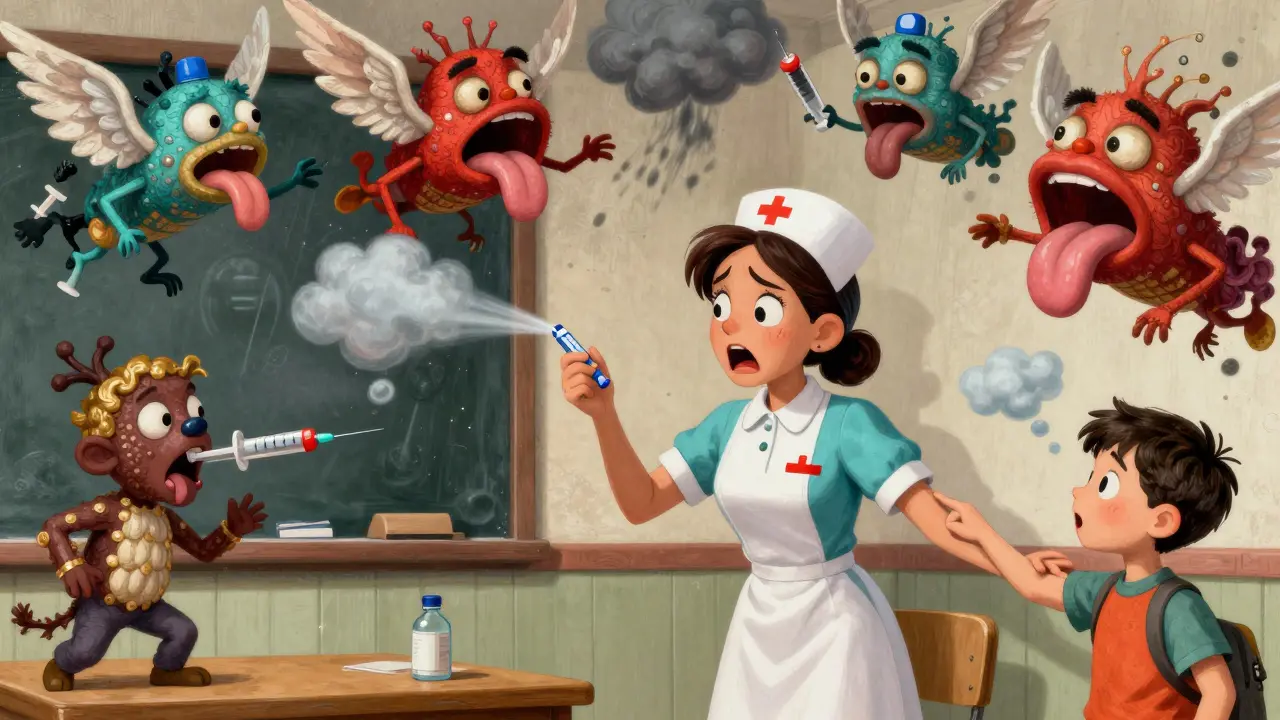
- Not practicing. 72% of school nurses report mistakes during drills. Practice with a trainer device every 6 months.
Storage and Expiration
Epinephrine doesn’t last forever. It breaks down in heat and light. Keep it at room temperature-between 59°F and 86°F. Don’t leave it in the car in summer. Don’t put it in the fridge. Check the expiration date every time you get a refill. Most last 18 months. If the liquid looks cloudy or has particles, throw it out. Even if it’s not expired, if it’s been through a heatwave, replace it.What to Do After Using It
After you inject:- Stay lying down. Don’t sit up or stand.
- Keep the used injector. Paramedics will want to see it.
- Be ready for side effects: racing heart, shaking, anxiety. These are normal. They’ll fade in 10-20 minutes.
- Go to the ER anyway. You might need more treatment. Biphasic reactions-where symptoms return hours later-are real.

Training and Practice
You can’t just read this and expect to get it right in a crisis. You need to practice. Get a trainer device from your pharmacy-they’re cheap or free. Practice on an orange or a pillow. Get someone to watch you. Do it every 6 months. Schools, workplaces, and camps should have trained staff. If yours doesn’t, ask for it. The American Academy of Pediatrics says universal training in schools could prevent hundreds of deaths each year.When Not to Use It
Epinephrine is for anaphylaxis. Don’t use it for mild reactions like a rash or sneezing. That’s what antihistamines are for. Using it unnecessarily can cause a spike in blood pressure or heart rate. But if there’s any doubt-swelling, trouble breathing, dizziness-use it. The risks of not using it are far greater.Real Stories
One mother in Ohio says her daughter had a peanut reaction at school. The nurse grabbed the EpiPen but forgot to take off the blue cap. The child went into cardiac arrest. She survived, but only because a teacher had trained with Auvi-Q and knew to call 911 and start CPR. Another dad in Texas used his Auvi-Q during his son’s reaction. The voice guide told him exactly what to do while he was shaking. His son’s breathing improved in 90 seconds.These aren’t rare cases. They happen every day. And they’re preventable.
Can I use an epinephrine auto-injector through clothing?
Yes. You can inject through jeans, pants, or even thick fabric. The needle is designed to pierce clothing. Don’t waste time removing clothes. Just push the injector firmly against the outer thigh.
What if I accidentally inject myself?
If you accidentally inject your finger or hand, go to the ER immediately. Epinephrine in the hand can cut off blood flow and cause tissue damage. Don’t panic-this is rare, but it’s serious. Call 911 and bring the injector with you.
Is it safe to use an expired epinephrine auto-injector?
If it’s only a few weeks past expiration and the liquid is clear, it’s better than nothing. But don’t rely on it. Replace it as soon as possible. Studies show expired injectors still deliver some epinephrine, but not reliably. Never use one that’s cloudy or has particles.
Can children use epinephrine auto-injectors?
Yes. Children as young as infants can use them, but the dose depends on weight. Use 0.15 mg for kids 33-66 pounds and 0.3 mg for anyone over 66 pounds. Schools and caregivers should be trained to use the correct strength. Always carry two.
Do I need to carry two injectors?
Always. About 20% of anaphylaxis cases require a second dose. If symptoms return or don’t improve after 5-10 minutes, use the second one. Keep one at home, one at school, one in your bag. Never leave home without at least one.
What if I’m not sure if it’s anaphylaxis?
If you have symptoms like swelling, trouble breathing, dizziness, or vomiting-use it. Don’t wait for a doctor’s confirmation. The side effects of epinephrine (racing heart, shaking) are temporary and harmless compared to the risk of untreated anaphylaxis, which can be fatal.
Katelyn Slack
January 6, 2026 AT 09:47i just used my epipen for the first time last month and i still can’t believe i didn’t drop it or stab my thumb. the red cap is so easy to miss. thanks for the reminder to practice.
Rachel Wermager
January 7, 2026 AT 22:36Let’s be clear: epinephrine auto-injectors are classified as Class II medical devices under FDA 21 CFR 870.4080, and their pharmacokinetics are optimized for intramuscular delivery into the vastus lateralis due to its high perfusion rate and low adipose deposition. Subcutaneous administration, which occurs when users hesitate or misapply, reduces bioavailability by up to 40%. The 3-second hold isn’t arbitrary-it’s pharmacodynamically calibrated to achieve peak plasma concentration within 5-10 minutes. If you’re not using a trainer device quarterly, you’re gambling with your life.
Saylor Frye
January 8, 2026 AT 19:39you know what’s funny? people treat this like it’s rocket science. it’s literally just push and hold. if you can open a jar of pickles, you can use an epipen. the real problem is the $700 price tag and the fact that no one actually trains for it until it’s too late.
Matt Beck
January 10, 2026 AT 04:03epinephrine… it’s not just a drug, it’s a *metaphor* 🌪️. it’s the body’s last scream before silence. the needle? a silent knight riding in on a steed of adrenaline. 🏇💥 when you inject, you’re not just saving a life-you’re defying entropy. i’ve seen people cry after using it. not from pain. from awe. the universe whispered, ‘not today,’ and they listened. 🙏
Kelly Beck
January 11, 2026 AT 19:13Okay, I know this sounds cheesy but I just want to say-you’re doing amazing just by reading this and caring enough to learn. Seriously. I used to be terrified of needles too, but I practiced with a trainer on my orange every Saturday morning with my 8-year-old. Now she’s the one reminding me to check the expiration date. 🌞💛 You don’t have to be brave-you just have to be prepared. And you already are. Keep going. You’ve got this. 💪❤️
Katie Schoen
January 12, 2026 AT 03:57so i used my epipen on a kid at a birthday party once. turned out it was just a weird peanut butter reaction. kid was fine. i was the one who panicked. but hey, i didn’t die. and now i carry two. and i practice on my pillow. and yes, i still feel like a drama queen for doing it. but i’d rather be the drama queen than the ghost.
Beth Templeton
January 14, 2026 AT 03:19just push. 3 seconds. done. stop overthinking it.
Ryan Barr
January 15, 2026 AT 02:17Adrenaclick? That’s the one with the two caps, right? Pathetic. If you can’t afford an EpiPen, you shouldn’t be trusted with a life-saving device. It’s not a tool-it’s a privilege.
Wesley Pereira
January 15, 2026 AT 19:06my brother’s school had a drill last year. 3 out of 5 teachers missed the safety cap. one of them used the wrong leg. i’m not even mad. i’m just… disappointed. we pay $2000 a year for school insurance and they can’t train staff properly? come on. we need mandatory quarterly drills. not just for kids. for EVERYONE who works around food. #epipenemergency
Dana Termini
January 16, 2026 AT 14:05i’ve had anaphylaxis twice. both times i used the epipen. both times i called 911. both times i survived. i don’t say this to brag. i say it because i want you to know: it works. even when you’re scared. even when you’re shaking. even when you think you’re doing it wrong. just do it. and then call for help. that’s it.
Jeane Hendrix
January 17, 2026 AT 08:37just curious-has anyone tried using neffy with a stuffy nose? i’ve got chronic allergies and wonder if it’s reliable for me. also, does the nasal spray work the same speed as the injector? i’m trying to decide which to get next refill.
Joann Absi
January 18, 2026 AT 04:07AMERICA IS THE ONLY COUNTRY THAT MAKES YOU PAY $700 FOR A LIFE-SAVING INJECTION. 🇺🇸💔 I’m not mad, I’m just disappointed. In Germany, it’s covered. In Canada, it’s $15. Here? You’re a commodity. Your life? A bill. And now you’re supposed to be grateful someone wrote a blog about it? Wake up. This isn’t about technique. It’s about capitalism killing people one allergic reaction at a time. 🌍✊
Mukesh Pareek
January 20, 2026 AT 02:53epinephrine auto-injectors are a classic example of pharmacological over-engineering. The alpha-adrenergic receptor agonism is well-documented, yet the delivery mechanism remains suboptimal for global deployment. Why not develop a sublingual formulation with sustained release? Or a transdermal patch calibrated to body mass index? The current paradigm is archaic. You’re treating symptoms, not systems. This is why anaphylaxis mortality remains stubbornly high in Western nations-poor systems design, not poor user compliance.
Molly McLane
January 21, 2026 AT 04:34i’m a school nurse and i’ve seen so many kids panic during drills. one kid froze because he thought the injector was going to explode. another screamed and ran. we started using orange slices to practice. now they all know the ‘push and hold’ rhythm. it’s not about being perfect. it’s about being ready. and if you’re reading this? you already are.
Kelly Beck
January 22, 2026 AT 22:31just saw someone reply saying they used it on a kid who was fine… and honestly? that’s the win. i know it feels like you wasted it. but you didn’t. you were the reason they got to eat another birthday cake. 🎂💛 you’re not a hero for using it-you’re a hero for being prepared. keep carrying two. keep practicing. keep being the calm in the storm.