
Vitamin K Calculator for Warfarin Patients
Calculate your daily vitamin K intake from foods and see if it's within the safe range for stable INR levels while on warfarin therapy.
Daily Vitamin K Intake
For most patients on warfarin, the safe range is 75-100 mcg per day for consistent INR control. This tool helps you track your intake based on the foods in the article. Your target range may vary based on your specific dose and INR.
Note: Sudden changes in vitamin K intake can affect your INR. This tool helps you stay consistent. Always follow your doctor's recommendations for diet and medication management.
When you're on warfarin, your diet isn't just about eating healthy-it's about eating the same healthy. One day you eat a big salad with kale and spinach; the next day you skip the greens and have pasta. That difference can throw your blood clotting off balance, and it doesn’t take much to make it happen.
Why Vitamin K Matters With Warfarin
Warfarin works by blocking vitamin K’s role in making blood clot. Without enough vitamin K, your body can’t produce the proteins that help your blood coagulate. That’s the whole point-you want your blood to clot slower to prevent dangerous clots in your legs, lungs, or brain. But if your vitamin K intake jumps around, your INR (International Normalized Ratio) goes up and down. INR is the test doctors use to measure how long it takes your blood to clot. For most people on warfarin, the goal is to keep it between 2.0 and 3.0. Go below that, and you’re at risk for clots. Go above it, and you risk bleeding.Studies show that a 100-microgram increase in daily vitamin K can drop your INR by half a point or more. That’s enough to move you out of the safe range. And it’s not just about eating too much-it’s about inconsistency. People who vary their vitamin K intake by more than 50% from day to day are over three times more likely to have unstable INR levels than those who eat about the same amount every day.
What Foods Are High in Vitamin K?
Vitamin K1, the kind that affects warfarin, comes mostly from plants. The top sources aren’t hidden-they’re in your fridge right now:- Cooked kale: 1,062 mcg per cup
- Cooked spinach: 889 mcg per cup
- Cooked Brussels sprouts: 156 mcg per cup
- Raw Swiss chard: 299 mcg per cup
- Raw broccoli: 85 mcg per cup
- Asparagus: 70 mcg per cup
- Green tea: 41-88 mcg per serving
These aren’t rare foods. They’re common, healthy choices. But if you suddenly start eating two cups of kale every day when you used to eat none, your INR will drop fast. The same thing happens if you go on a cleanse, start juicing, or switch to a vegan diet loaded with greens. One patient reported his INR plummeting from 2.8 to 1.9 after eating kale salads for three days straight. He needed a 15% warfarin dose increase to get back on track.
It’s Not About Avoiding Vitamin K-It’s About Consistency
Many people think they need to cut out spinach and broccoli entirely. That’s wrong. The American Heart Association, the Anticoagulation Forum, and the Mayo Clinic all agree: don’t avoid vitamin K. Just keep it steady.Think of it like this: your body gets used to a certain level of vitamin K. Warfarin adjusts to that level. If the level stays the same, your INR stays stable. If it swings, your INR swings with it. One patient maintained a stable INR for eight years by eating exactly two cups of cooked spinach every Tuesday and Thursday. No more, no less. That’s the secret-not restriction, but routine.
Even if you eat a lot of vitamin K, you can still be safe-if you do it every day. A 2023 study found that people who ate a moderate, consistent amount (75-100 mcg per day) had better INR control than those who ate very little. Why? Because the body responds predictably to steady input. Chaos is what breaks things, not the number itself.
What About Vitamin K2?
You might hear about vitamin K2 from fermented foods like natto, cheese, or egg yolks. K2 doesn’t affect warfarin the same way as K1. Most of the vitamin K in Western diets is K1, and it’s the one that matters for your INR. So while natto is super high in K2, you don’t need to stress about it unless you eat it daily. If you do, be consistent with it too.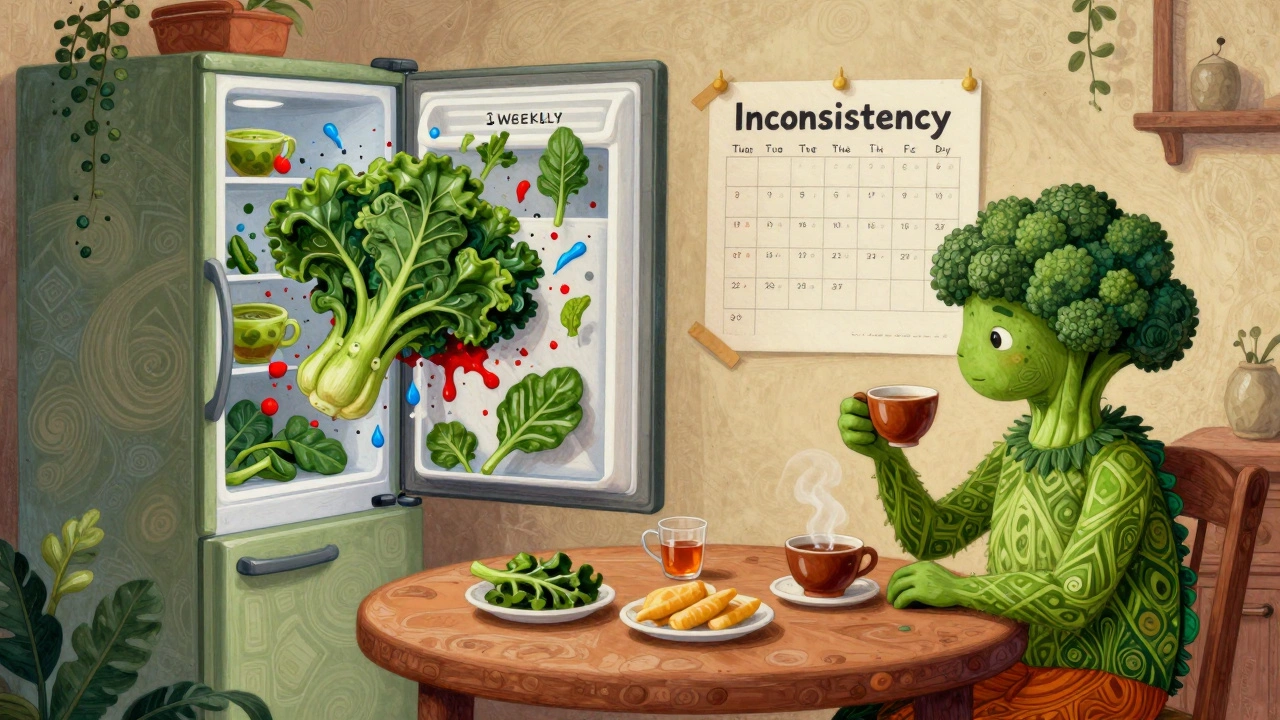
Real-Life Challenges
People on warfarin face real hurdles:- Seasonal changes: Kale and spinach aren’t always available or affordable.
- Restaurant meals: You never know how much oil, butter, or greens are in your salad.
- Well-meaning diets: Starting a “clean eating” plan can mean doubling your greens overnight.
One survey of over 1,200 warfarin users found that 68% struggled with inconsistent vegetable intake because of seasons or cost. Another 45% had INR spikes after switching to healthier diets. That’s not because the diet was bad-it was because it changed too fast.
How to Stay on Track
Here’s what actually works, based on real patient success and clinical guidelines:- Measure your greens. Don’t guess. Use a measuring cup. Two cups of raw spinach is 85 mcg. One cup of cooked kale is over 1,000 mcg. Knowing the difference matters.
- Stick to your routine. If you eat spinach on Monday and Thursday, do it every week. If you skip it for a week, your INR will rise. If you eat extra one day, your INR will drop.
- Track what you eat. Keep a simple food log for a few days each month. Note the leafy greens, broccoli, and green tea. You don’t need to log everything-just the big ones.
- Be careful with supplements. If you take a multivitamin, make sure it has the same amount of vitamin K every day. Some brands change their formulas. Check the label.
- Plan ahead for holidays and travel. Restaurants, buffets, and unfamiliar foods are risky. Eat what you usually eat, or ask for no extra greens.
Patients who get personalized advice from a dietitian who understands anticoagulation are 20% more likely to stay in range. You don’t need a fancy plan-just a plan that’s yours and stays the same.
What If You Eat Too Much Vitamin K?
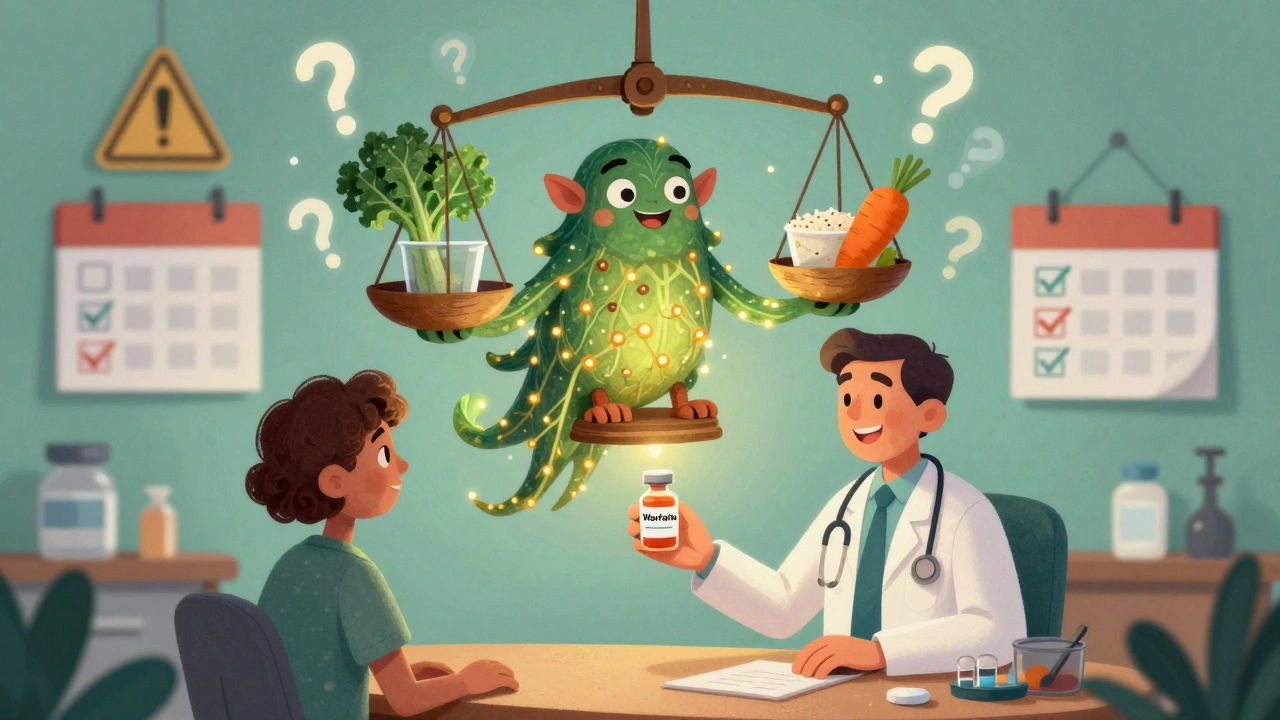
If you accidentally eat a huge amount-like a big bowl of kale soup or a green smoothie with five types of leafy greens-don’t panic. Don’t skip your warfarin. Don’t try to fix it yourself.Call your doctor or anticoagulation clinic. They may adjust your dose slightly the next day. If your INR drops below 2.0 after a big meal, they might increase your warfarin by 10-20%. That’s normal. It’s not a mistake-it’s part of managing the medication.
If your INR gets too high (above 10) and you’re not bleeding, doctors may give you a small dose of vitamin K (1-2.5 mg) to bring it down quickly. That’s a medical decision, not something you do on your own.
What About Other Medications and Supplements?
Warfarin doesn’t just react with food-it reacts with other drugs and supplements. Antibiotics, aspirin, fish oil, garlic pills, and even some herbal teas can change how warfarin works. Always tell your doctor about anything new you start, even if it’s “natural.”Some people think turmeric or ginger is safe because it’s “anti-inflammatory.” But they can thin your blood too. That’s dangerous when combined with warfarin. Stick to what you know. Don’t add new supplements without checking first.
How Often Should You Get Tested?
When you’re stable, you’ll usually get an INR test every 2-4 weeks. But if you change your diet, start a new medicine, or get sick, you’ll need to test more often-maybe weekly until things settle. Don’t skip tests because you feel fine. Your INR doesn’t have symptoms. Only the test tells you what’s happening.You’re in Control
The CDC says it plainly: “It’s up to you to decide how much vitamin K you choose to eat… just keep it about the same amount each day.”Warfarin isn’t a punishment. It’s a tool. And your diet is your partner in making it work. You don’t need to eat bland food. You don’t need to give up your favorite vegetables. You just need to be predictable. Eat your greens the same way, the same amount, most days. That’s how you stay safe, avoid hospital visits, and live well on warfarin.
Can I still eat spinach if I’m on warfarin?
Yes, you can-and you should, if you’ve been eating it regularly. The key isn’t avoiding spinach, but keeping your intake consistent. If you normally eat one cup of cooked spinach twice a week, keep doing that. Don’t suddenly eat three cups one week and none the next. Consistency keeps your INR stable.
What happens if I eat a lot of kale one day?
Eating a large amount of kale or other high-vitamin K foods in one day can cause your INR to drop within a few days, making your blood clot faster. You won’t feel it, but your next blood test might show your INR is too low. Call your doctor-they may adjust your warfarin dose slightly the next day. Don’t skip your dose or try to fix it yourself.
Do I need to avoid all green vegetables?
No. Avoiding green vegetables is outdated advice and can actually hurt your health. The goal is consistency, not elimination. Many people on warfarin eat leafy greens every day and stay perfectly stable. What matters is not how much you eat, but whether you eat the same amount each day.
Can I drink green tea while on warfarin?
Yes, but keep your intake steady. One to two cups of green tea per day is fine if that’s your usual amount. Green tea contains vitamin K and can affect INR. If you suddenly start drinking five cups a day, your INR could drop. If you rarely drink it, don’t start drinking it regularly without telling your doctor.
Should I take a vitamin K supplement?
Only if your multivitamin already has it-and you take it every day. Don’t start taking extra vitamin K supplements unless your doctor recommends it. Even small doses can interfere with warfarin. If you take a multivitamin, make sure it’s the same brand and dose every day.
How long does it take for vitamin K to affect my INR?
It usually takes 2-4 days for changes in vitamin K intake to show up in your INR. That’s why it’s important to keep eating the same amount every day, not just on the day before your blood test. A big meal one day might not affect your next test, but it could change your INR by the time of your following test.
Can I eat out at restaurants safely?
Yes, but be careful. Ask for your salad without extra greens, or choose dishes with known ingredients. Avoid dishes labeled as “healthy,” “green,” or “detox,” as they often contain large amounts of kale, spinach, or broccoli. Stick to your usual portions, and if you’re unsure, keep your meals simple-grilled chicken, rice, and steamed carrots are safe bets.
nikki yamashita
December 12, 2025 AT 22:45Just eat your spinach the same days every week and you’ll be fine. No drama needed.
Robert Webb
December 13, 2025 AT 10:26I’ve been on warfarin for seven years now, and the biggest shift for me wasn’t learning what to avoid-it was realizing that consistency isn’t about restriction, it’s about rhythm. Like brushing your teeth or taking a morning walk, it becomes part of your daily cadence. I eat two cups of cooked kale every Sunday and Wednesday, no more, no less. I don’t count grams, I don’t stress over a missed day-I just reset. My INR has been rock solid since I stopped treating it like a diet and started treating it like a habit. Your body doesn’t care about perfection; it just wants predictability.
Nathan Fatal
December 13, 2025 AT 17:20People treat vitamin K like it’s some dangerous toxin, but it’s not. It’s a nutrient your body needs. Warfarin doesn’t make you allergic to greens-it makes you need routine. I used to panic every time I ate a salad. Now I just measure. One cup of cooked spinach = Tuesday and Thursday. Done. No guilt, no fear. Your doctor isn’t trying to cage you in broccoli jail-they’re giving you the tools to live without bleeding out or clotting up. That’s not a burden. That’s freedom.
Adam Everitt
December 14, 2025 AT 18:12so like… if u eat kale on monday but not tues, does ur inr just… float away? like, is it that sensitive? i mean, i get the idea, but it sounds kinda wild that one meal can throw off a med that’s been in your system for days…
Rob Purvis
December 14, 2025 AT 18:13Yes, it’s that sensitive-and here’s why: warfarin’s half-life is about 40 hours, so it builds up gradually, and vitamin K is metabolized quickly. A sudden spike in K1 overwhelms the blocked pathway, and your liver starts making clotting factors again. That’s why your INR drops within 2–4 days, not immediately. And yes, it’s wild-but it’s biology, not magic. The fact that you can stabilize it with routine? That’s actually beautiful. It means you’re not helpless-you’re in control. Just measure, log, repeat.
Audrey Crothers
December 15, 2025 AT 21:56I used to skip my greens for weeks because I was scared… then I ate a huge kale smoothie one morning and panicked for a week. My nurse laughed and said, ‘Honey, you didn’t break anything-you just gave your doctor data.’ Now I eat spinach every Thursday like clockwork. It’s my little ritual. And yes, I even have a sticky note on my fridge. 😊
Laura Weemering
December 17, 2025 AT 13:43The real issue here is the medical-industrial complex’s obsession with quantifying everything. Why must we reduce nutrition to micrograms and INR fluctuations? Why not simply trust the body’s innate regulatory mechanisms? The obsession with consistency is a symptom of a system that fears unpredictability-and patients are forced to become data-entry clerks for their own physiology. It’s not medicine. It’s surveillance with a prescription.
wendy b
December 18, 2025 AT 11:32Actually, your ‘innate regulatory mechanisms’ are precisely why you need monitoring. Your body doesn’t have a ‘reset button’ for warfarin interactions-it’s a pharmacokinetic dance that requires calibration. The fact that you’re dismissing clinical evidence as ‘surveillance’ reveals a fundamental misunderstanding of anticoagulation therapy. This isn’t about control-it’s about preventing strokes, pulmonary emboli, and intracranial hemorrhages. If you want to be a pseudo-philosopher, at least read the guidelines before you opine.