
For decades, cancer treatment meant chemotherapy, radiation, or surgery-harsh, blunt tools that attacked tumors but also damaged healthy tissue. Today, a quieter revolution is underway: the body’s own immune system is being trained to hunt down cancer cells. Two therapies, checkpoint inhibitors and CAR-T cell therapy, are at the heart of this shift. They don’t just kill cancer-they help the immune system remember how to do it, often for years. But they’re not magic bullets. Each has unique strengths, serious risks, and limits that still leave many patients without answers.
How Checkpoint Inhibitors Unleash the Immune System
Your immune system has built-in brakes. These are called checkpoints-molecular signals that stop T cells from attacking healthy cells. Cancer cells exploit this. They put up flags like PD-L1 to trick T cells into thinking they’re harmless. That’s where checkpoint inhibitors come in. These are lab-made antibodies, given through an IV, that block those flags. Anti-PD-1 drugs like pembrolizumab and nivolumab, or anti-CTLA-4 like ipilimumab, take the brakes off. Suddenly, T cells see the cancer for what it is and attack. The first of these, ipilimumab, got FDA approval in 2011 for melanoma. Since then, they’ve become standard for lung, kidney, bladder, and several other cancers. But here’s the catch: only 20 to 40% of patients respond. Why? Many tumors are “cold”-they don’t attract immune cells in the first place. No T cells in the tumor? No matter how hard you unblock the brakes, nothing happens. That’s why checkpoint inhibitors work better in cancers with high mutation rates, like melanoma or smoking-related lung cancer. These tumors have more weird-looking proteins that the immune system can recognize. Side effects are different from chemo. Instead of nausea or hair loss, you get immune-related reactions. The immune system, no longer restrained, might attack the thyroid (causing fatigue and weight gain), the skin (rash in up to 40% of patients), or the gut (colitis in 10-15%). These are manageable if caught early, but they can be life-threatening if ignored.CAR-T Therapy: Engineering Your Own Cancer Fighters
CAR-T therapy is like giving your immune system a GPS and a weapon. It starts with a simple idea: take T cells from your blood, genetically reprogram them to hunt cancer, then flood your body with them. The process is complex. First, doctors do a leukapheresis-pulling out your T cells through a machine. Those cells go to a lab, where a virus delivers a gene that makes a chimeric antigen receptor (CAR). This CAR is designed to latch onto a specific protein on cancer cells, like CD19 on B-cell leukemias. The modified T cells are grown in bioreactors until there are hundreds of millions. Then, after a round of chemo to clear space, they’re infused back into you. The results can be stunning. In kids with relapsed acute lymphoblastic leukemia, complete response rates hit 60 to 90%. For some adults with lymphoma, CAR-T has turned terminal diagnoses into long-term remission. The first approved therapy, tisagenlecleucel, hit the market in 2017. But it’s not simple. The most dangerous side effect is cytokine release syndrome (CRS). As CAR-T cells multiply and attack, they flood the body with inflammatory signals. This can cause high fever, low blood pressure, and organ failure. About half to 70% of patients get CRS. Another risk is immune effector cell-associated neurotoxicity syndrome (ICANS), which can lead to confusion, seizures, or trouble speaking-seen in 20 to 40% of cases. Both require ICU-level care. And then there’s the cost. Each treatment runs between $373,000 and $475,000. Manufacturing takes 3 to 5 weeks. Not every hospital can do it. In the U.S., 87% of CAR-T treatments happen at academic medical centers, even though they make up only 15% of cancer facilities.
Why Solid Tumors Are Still a Battle
Checkpoint inhibitors and CAR-T therapy have transformed blood cancers. But for solid tumors-lung, breast, colon, pancreatic-progress has been slow. Why? Solid tumors create a fortress. They build physical barriers, recruit suppressor cells, and pump out chemicals that paralyze T cells. Even if you engineer perfect CAR-T cells, they can’t get inside. Or if they do, they get exhausted or turned off by PD-L1 on the tumor. The data shows it. In most solid tumor trials, CAR-T therapy achieves less than 10% objective response. Checkpoint inhibitors help some, but rarely enough. That’s why researchers are now combining both. Imagine CAR-T cells that don’t just target cancer-they also secrete their own checkpoint blocker right at the tumor site. That’s what Dr. Rafiq’s team did in 2018. They engineered CAR-T cells to release a PD-1-blocking fragment. In mice, this cut immune side effects by 37% while boosting tumor killing. It’s like giving your soldiers a shield and a weapon in one suit. Newer versions are even smarter. Some CAR-T cells now carry genes for IL-12, a cytokine that wakes up other immune cells. Others are designed to resist the tumor’s suppressive signals. And scientists are looking at new checkpoints-LAG-3, TIM-3-that cancer uses to hide. One promising target is PTP1B, an internal brake inside T cells. Blocking it in mouse models of breast cancer boosted tumor-fighting T cells by 2.3 times when combined with CAR-T therapy. This isn’t just about adding drugs-it’s about rewiring the immune system at the cellular level.The Access Problem: Who Gets These Life-Saving Treatments?
These therapies are not just scientifically complex-they’re socially unequal. A 2020 review found Black patients were 31% less likely to get CAR-T therapy than white patients. Medicaid patients had 23% lower access than those with private insurance. Why? The treatment requires specialized centers, long follow-ups, and financial navigation. Many community hospitals can’t offer it. Patients without strong support systems get left behind. Checkpoint inhibitors are easier to get-they’re off-the-shelf drugs. But even here, disparities exist. Cost, insurance denials, and lack of specialist referrals still block access. The European Medicines Agency approved its first CAR-T therapy in August 2018-ten months after the FDA. Regulatory systems vary, and global supply chains are uneven. In low-income countries, these treatments might as well be science fiction.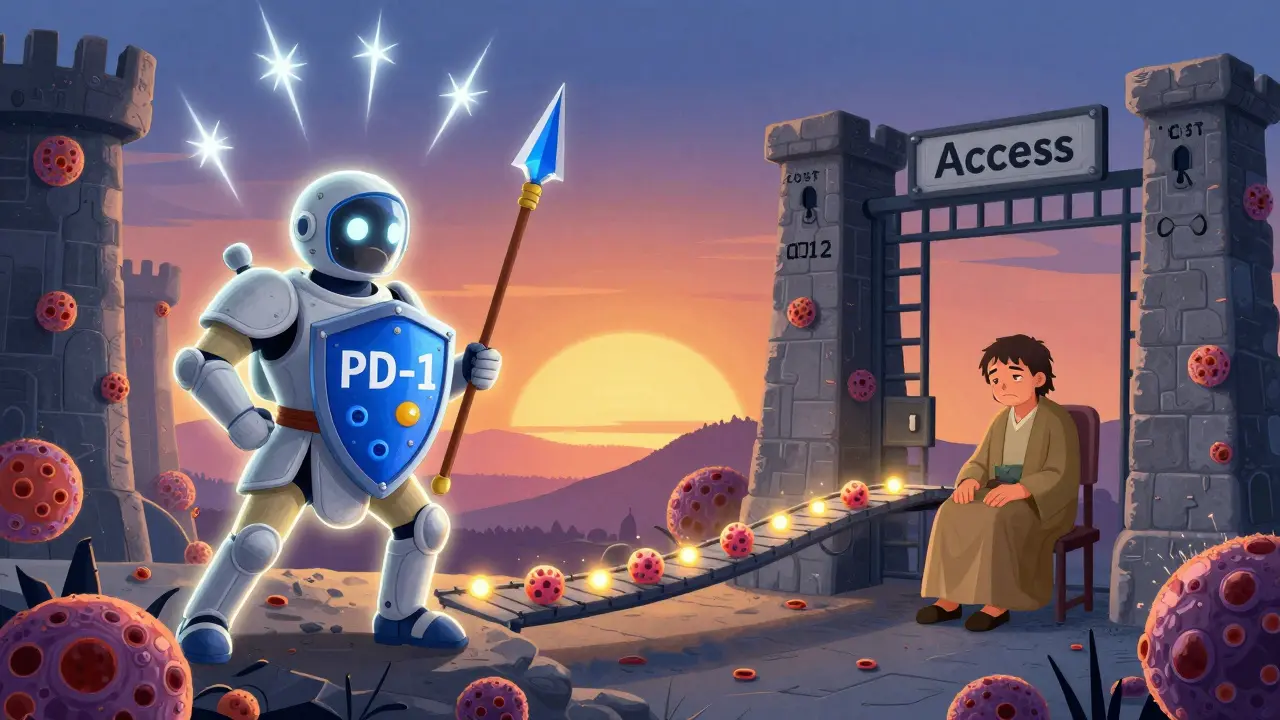
The Future: Smarter, Safer, More Accessible
The next wave of immunotherapy isn’t just about new drugs-it’s about smarter delivery. “Off-the-shelf” CAR-T cells, made from donor T cells, could cut wait times from weeks to days. Companies are testing these now. If they work, they could slash costs and make treatment available in more hospitals. Localized delivery is another big leap. Instead of flooding the whole body with checkpoint blockers, engineering CAR-T cells to release them only where the tumor is reduces toxicity. Early trials show a 42% drop in immune pneumonitis compared to giving both drugs separately. And the pipeline is full. As of March 2024, 47 active clinical trials are testing CAR-T plus checkpoint inhibitors, with 68% focused on solid tumors. The goal? Turn “cold” tumors “hot”-fill them with immune cells that can finally fight back. The science is advancing fast. But the real challenge isn’t just in the lab. It’s in making sure every patient-no matter where they live or how much they earn-gets a chance at these treatments.What This Means for Patients Today
If you or someone you know has cancer, ask: Is immunotherapy an option? Not all cancers respond. But for melanoma, lung, lymphoma, or leukemia, it might be life-changing. Check if your tumor has high PD-L1 levels or a high mutation burden-those are signs checkpoint inhibitors might work. For blood cancers, ask about CAR-T eligibility, especially if standard treatments failed. Know the risks. Fatigue, fever, and rash are common. But if you get sudden confusion, trouble breathing, or high fever after treatment, seek help immediately. These aren’t side effects to ignore. And remember: these therapies aren’t one-size-fits-all. What works for one person might not work for another. But the direction is clear: the immune system is no longer just a bystander in cancer care. It’s the frontline.Are checkpoint inhibitors and CAR-T therapy the same thing?
No. Checkpoint inhibitors are IV drugs that remove brakes on the immune system, letting T cells attack cancer. CAR-T therapy is a personalized treatment where your own T cells are removed, genetically modified to target cancer, multiplied in a lab, and infused back into you. One is a drug; the other is a living therapy.
Which cancers respond best to CAR-T cell therapy?
CAR-T therapy works best in certain blood cancers: relapsed or refractory B-cell acute lymphoblastic leukemia (ALL) in children and young adults, and some types of non-Hodgkin lymphoma like diffuse large B-cell lymphoma. Response rates can be as high as 60-90% in these cases. It has shown limited success in solid tumors like lung or breast cancer so far.
Why are checkpoint inhibitors less effective in some cancers?
Checkpoint inhibitors need T cells already present in the tumor to work. In “cold” tumors-like pancreatic or prostate cancer-there are few or no T cells inside. The immune system doesn’t recognize the cancer as a threat, so even removing the brakes doesn’t trigger a response. Tumors with high mutation rates (like melanoma) are more visible to the immune system and respond better.
What are the biggest side effects of CAR-T therapy?
The two most serious side effects are cytokine release syndrome (CRS) and immune effector cell-associated neurotoxicity syndrome (ICANS). CRS causes high fever, low blood pressure, and organ stress, affecting 50-70% of patients. ICANS can lead to confusion, seizures, or trouble speaking, seen in 20-40% of cases. Both require urgent medical care and are managed with drugs like tocilizumab and steroids.
How much does CAR-T therapy cost?
In the U.S., CAR-T therapy costs between $373,000 and $475,000 per treatment. This includes the complex manufacturing process, hospital stay, and monitoring for side effects. Insurance often covers it for approved indications, but prior authorization and out-of-pocket costs vary. The high price and manufacturing delays limit access, especially outside major cancer centers.
Can you combine checkpoint inhibitors with CAR-T therapy?
Yes, and it’s one of the most promising areas of research. Giving both together can help CAR-T cells survive longer and work better in solid tumors. But combining them systemically increases toxicity. Newer approaches engineer CAR-T cells to release checkpoint blockers only inside the tumor, reducing side effects while boosting effectiveness. Over 40 clinical trials are testing this right now.
Is immunotherapy better than chemotherapy?
It’s not a simple “better.” Chemotherapy kills fast-growing cells, including cancer and healthy ones, causing side effects like hair loss and nausea. Immunotherapy works differently-it trains your immune system to target cancer specifically. It often causes fewer long-term side effects and can lead to durable remissions. But it doesn’t work for everyone, and when it does, it can cause unique immune-related side effects. The best choice depends on cancer type, stage, and individual factors.
Akshaya Gandra _ Student - EastCaryMS
January 4, 2026 AT 02:48sooo... this CAR-T thing is like making your own soldiers to fight cancer? mind blown. 🤯
Dee Humprey
January 5, 2026 AT 16:57My aunt had melanoma and got pembrolizumab. She’s been in remission for 4 years now. No chemo, no hair loss-just regular blood tests and fatigue. It’s not perfect, but it’s a miracle compared to what we had 10 years ago.
Joseph Snow
January 6, 2026 AT 09:42Let’s be real-this is Big Pharma’s latest money grab. They’ve been pushing ‘miracle cures’ since the 80s. Checkpoint inhibitors? CAR-T? All just repackaged chemo with a fancy name and a $500K price tag. And don’t get me started on the ‘cold tumor’ excuse-sounds like they’re just giving up on hard cases.
melissa cucic
January 6, 2026 AT 13:22I find it fascinating how these therapies force us to reconsider the boundary between biology and engineering-when we begin to reprogram human cells as if they were software, we’re not just treating disease; we’re redefining what it means to be human. The ethical implications are staggering, and yet, we rarely discuss them outside of academic circles.
en Max
January 6, 2026 AT 21:05While the mechanistic rationale for checkpoint inhibitors and CAR-T therapy is scientifically compelling, the clinical translation remains constrained by significant heterogeneity in tumor microenvironments, immune evasion mechanisms, and host immune competence. Furthermore, the logistical and economic barriers to scalable implementation are non-trivial, particularly in resource-limited settings.
Angie Rehe
January 7, 2026 AT 19:42Why are we even talking about this like it’s some breakthrough? It’s just another way for hospitals to charge $400K for a treatment that only works on 30% of people. And don’t even get me started on how they push this on desperate patients while ignoring nutrition, stress, and environmental toxins-things that actually matter.
Jacob Milano
January 8, 2026 AT 23:18This is the closest thing we’ve had to a real cure since penicillin. I mean, imagine your own cells, tweaked like a superhero suit, hunting down cancer like it’s a wanted poster. It’s not sci-fi anymore-it’s Tuesday in some lab. And yeah, it’s expensive and messy, but if it keeps someone alive for another decade? Worth every penny.
Enrique González
January 9, 2026 AT 06:58My cousin got CAR-T for lymphoma. He was in the hospital for 3 weeks. Fever, shaking, confused for days. But now? He’s coaching soccer. No chemo. No more scans showing tumors. I don’t care how much it costs-it’s not a treatment. It’s a second chance.
saurabh singh
January 9, 2026 AT 14:15in india, we barely have access to basic chemo, let alone this. but i’m so happy for those who can get it. maybe one day, we’ll have cheap, local versions-like how we made generic HIV drugs. hope over despair, ya?
Allen Ye
January 11, 2026 AT 05:35What’s being ignored here is the philosophical shift: we are no longer treating disease as an external invader to be eradicated, but as a systemic failure of self-regulation that must be corrected through internal recalibration. The immune system isn’t just being activated-it’s being re-educated, re-architected, and in a very real sense, re-soul-ed. This isn’t medicine anymore; it’s ontological engineering. And yet, society still treats it like a drug prescription. We are dancing on the edge of a new biological paradigm, and most people are still checking their insurance cards.
Jennifer Glass
January 12, 2026 AT 20:00It’s wild how much we’ve learned about the immune system in just the last 15 years. I used to think cancer was just ‘bad cells’-now I see it as a whole ecosystem of deception, suppression, and adaptation. The fact that we can now outsmart it with biology instead of brute force? That’s the real win.
John Wilmerding
January 13, 2026 AT 19:13Dr. Rafiq’s engineered CAR-T cells releasing PD-1 blockers locally are brilliant. Reducing systemic toxicity while enhancing tumor-specific activity is the holy grail. This approach could revolutionize solid tumor treatment-if manufacturing scalability and cost can be addressed.
Peyton Feuer
January 14, 2026 AT 05:20just read this whole thing on my lunch break. i’m not a scientist but… this gave me chills. like, seriously. we’re living in the future and most people are scrolling tiktok. we should be talking about this everywhere.
Siobhan Goggin
January 14, 2026 AT 21:53I work in palliative care. I’ve seen patients go from bedridden to hiking in the mountains after CAR-T. It’s not perfect, but it’s hope-and that’s something we don’t give enough of in medicine.
Jay Tejada
January 16, 2026 AT 04:54yeah sure, it works… for the rich. meanwhile, my cousin in Delhi can’t even get a CT scan. but hey, at least we got the fancy science, right? 😒