
QT Prolongation Risk Assessment Tool
How Safe Are You?
This tool helps you assess your risk of developing dangerous heart rhythm problems when taking macrolide antibiotics (like azithromycin or clarithromycin). Your results will show your risk level and personalized recommendations.
Your Risk Assessment
When you pick up a prescription for azithromycin or clarithromycin, you’re likely thinking about clearing up a stubborn sinus infection or bronchitis. You’re not thinking about your heart. But here’s the quiet truth: macrolides - a common class of antibiotics - can quietly mess with your heart’s electrical rhythm, and in rare but deadly cases, trigger a life-threatening arrhythmia called Torsades de Pointes. This isn’t science fiction. It’s documented in FDA safety alerts, peer-reviewed studies, and real hospital cases. The risk is low for most people. But for others - especially those over 65, on multiple meds, or with existing heart conditions - it’s not worth gambling with.
How Macrolides Slow Down Your Heart’s Electrical Signal
Macrolides like azithromycin, clarithromycin, and erythromycin work by stopping bacteria from making proteins. That’s why they’re so widely used for pneumonia, strep throat, and ear infections. But they also have a hidden side effect: they block a specific potassium channel in heart cells called IKr. This channel is responsible for helping the heart reset after each beat. When it’s blocked, the heart takes longer to recharge - and that delay shows up on an ECG as a longer QT interval.
This isn’t just a lab curiosity. In controlled studies, clarithromycin can stretch the QT interval by 10 to 20 milliseconds. Azithromycin does less - about 5 to 10 ms - but it’s still enough to matter in the wrong person. The longer the QT interval, the more likely the heart’s rhythm can go haywire. That’s when Torsades de Pointes can kick in: a chaotic, fast heartbeat that can turn into cardiac arrest if not caught fast.
Not All Macrolides Are Created Equal
Here’s where it gets practical: not all macrolides carry the same risk. Clarithromycin is the biggest offender. Data from the FDA’s adverse event database shows it’s involved in nearly 6 out of 10 reported cases of QT prolongation, even though it’s prescribed far less often than azithromycin. Why? It blocks the IKr channel more strongly. Erythromycin is next in line - it’s older, harder on the stomach, and carries a moderate risk. Azithromycin was once thought to be safer because it doesn’t interfere much with liver enzymes that break down other drugs. But that changed after a landmark 2012 study in the New England Journal of Medicine found azithromycin was linked to a 2.88 times higher risk of cardiovascular death compared to amoxicillin.
That study sparked a firestorm. Critics pointed out that people getting azithromycin were often sicker to begin with - they had more infections, more heart disease, more meds. When researchers adjusted for all those factors, the risk dropped almost to zero. So which is it? Is azithromycin safe or not? The truth is in the middle. For a healthy 30-year-old with a sinus infection, the risk is tiny - less than 1 in 100,000. For a 72-year-old with heart failure, low potassium, and on a beta-blocker? That risk jumps over 20 times higher.
The Real Danger Isn’t the Antibiotic - It’s the Combo
The biggest threat isn’t macrolides alone. It’s what they’re mixed with. Over 40% of macrolide prescriptions in cardiac patients, according to a 2022 JAMA Internal Medicine study, were given alongside another drug that also prolongs the QT interval. Think about it: you’re on a statin, a blood pressure pill, an antidepressant, and now a course of clarithromycin. Each of those drugs alone might nudge your QT interval up by a few milliseconds. Together? They can push it over the edge.
The CredibleMeds database - the gold standard for drug-induced arrhythmia risk - lists over 100 drugs that can prolong QT. That includes common ones like fluoxetine (Prozac), citalopram (Celexa), ondansetron (Zofran), and even some antifungals. If you’re taking any of these and your doctor prescribes a macrolide, you’re stacking the deck. A 2021 case series in the Journal of Clinical Medicine found that 8 out of 12 patients who had Torsades after taking clarithromycin were also on at least one other QT-prolonging drug. That’s not coincidence. That’s a preventable disaster.
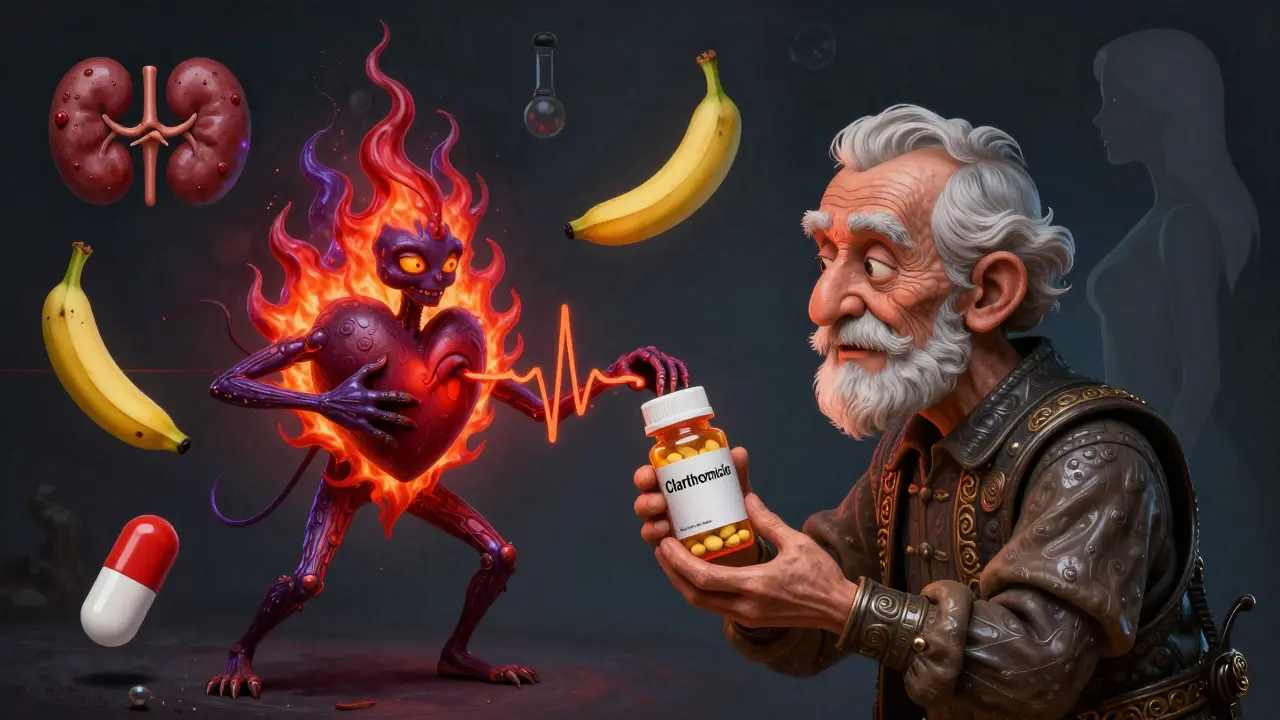
Who’s Most at Risk? The 7 Red Flags
Not everyone needs to panic. But if you have any of these, you should ask your doctor: is this antibiotic really the safest choice?
- Female sex - Women are 2 to 3.5 times more likely to develop Torsades than men.
- Age 65+ - Your heart’s electrical system slows down naturally with age.
- Heart disease - Past heart attack, heart failure, or enlarged heart? Your risk doubles.
- Low potassium or magnesium - Even mild imbalances make your heart more sensitive to QT prolongation.
- Slow heart rate - Bradycardia gives the heart more time to develop dangerous rhythms.
- Kidney or liver problems - Your body can’t clear the drug as fast, so levels build up.
- Family history of sudden cardiac death or long QT syndrome - You might have a hidden genetic vulnerability.
If you check off two or more of these, you’re in the high-risk zone. And that’s when you need to push back.
What Should You Do Before Taking a Macrolide?
Here’s a simple checklist you can use before your next antibiotic prescription:
- Ask: “Is there a non-macrolide option?” For many respiratory infections, doxycycline or amoxicillin work just as well - and don’t touch your QT interval.
- Check your meds list. Pull out every pill you’re taking. Look up each one on CredibleMeds.org (or ask your pharmacist). If more than one is flagged for QT prolongation, don’t add another.
- Get a basic blood test. A simple electrolyte panel can catch low potassium or magnesium. Fixing that alone can cut your risk in half.
- Request an ECG if you’re over 65 or have heart issues. A baseline QT measurement before starting the drug gives you a reference point. If your QT is already 470 ms or higher, avoid macrolides entirely.
- Know the warning signs. Dizziness, fainting, palpitations, or sudden shortness of breath while on the antibiotic? Stop it and get help immediately.
Some hospitals now have built-in alerts in their electronic systems. Kaiser Permanente cut risky prescriptions by 28% after adding QT risk flags. If your doctor’s office doesn’t have that, you have to be your own advocate.

The Future: Safer Antibiotics and Better Tools
There’s hope on the horizon. Solithromycin, a newer macrolide-like drug, was tested in clinical trials and showed no QT prolongation. It was rejected by the FDA in 2016 - not because of heart risks, but because of liver toxicity. That tells us: we can design antibiotics without this side effect. We just need to prioritize it.
Meanwhile, tools like the University of Arizona’s 10-point QT Risk Score are being used in some clinics. It assigns points for age, sex, kidney function, electrolytes, and other meds. A score of 7 or higher means you’re in the danger zone. Simple, fast, and free to use.
Macrolides aren’t going away. They’re cheap, effective, and widely available. But we need to stop treating them like harmless pills. They’re powerful drugs with real cardiac consequences. The goal isn’t to scare you off antibiotics - it’s to make sure you get the right one for your body.
What If You’ve Already Taken One?
If you’ve taken azithromycin or clarithromycin recently and feel fine, you’re probably okay. Most people are. But if you’re over 65, have heart disease, or are on other QT-prolonging drugs, don’t ignore subtle symptoms. A skipped beat, a sudden dizzy spell, or feeling like you’re about to pass out - even if it’s gone by the time you get to the doctor - should be reported. That could be your body’s first warning.
And if you’re planning to take another course in the future? Don’t assume it’s safe just because it worked before. Your health changes. Your meds change. Your heart changes. What was low risk last year might be high risk now.
Can azithromycin really cause heart problems?
Yes, azithromycin can prolong the QT interval and, in rare cases, trigger Torsades de Pointes - a dangerous heart rhythm. The absolute risk is low for healthy people, but it rises sharply in those over 65, with heart disease, low potassium, or taking other QT-prolonging drugs. The 2012 NEJM study found a 2.88 times higher risk of cardiovascular death compared to amoxicillin in high-risk groups.
Which macrolide is safest for the heart?
Azithromycin has the lowest QT-prolonging effect among the common macrolides, followed by erythromycin. Clarithromycin carries the highest risk. But even azithromycin isn’t risk-free if you have multiple risk factors. For the safest option, consider non-macrolide antibiotics like amoxicillin or doxycycline - they don’t affect the QT interval at all.
Should I get an ECG before taking a macrolide?
If you’re over 65, have heart disease, kidney problems, or take other QT-prolonging drugs, yes. A baseline ECG helps identify if your QT interval is already long. If it’s above 450 ms in men or 470 ms in women, macrolides should be avoided. Even if you’re younger, if you’ve had unexplained fainting or a family history of sudden cardiac death, an ECG is worth asking for.
Can low potassium make macrolides more dangerous?
Absolutely. Low potassium (hypokalemia) makes heart cells more sensitive to QT prolongation. Studies show it increases the risk of Torsades by over 3 times. Many people on diuretics or with poor diets have mild low potassium without symptoms. A simple blood test can catch this - and correcting it can reduce your risk dramatically.
Are there antibiotics that don’t affect the heart?
Yes. Amoxicillin, doxycycline, and cephalexin are common antibiotics with no known QT-prolonging effects. For many infections - like strep throat, sinusitis, or skin infections - these are just as effective as macrolides. Ask your doctor if one of these is appropriate for your condition.
What should I do if I feel dizzy or faint while on a macrolide?
Stop taking the antibiotic immediately and seek medical attention. Dizziness, palpitations, or fainting could signal the start of a dangerous heart rhythm. Don’t wait to see if it passes. Call your doctor or go to urgent care. Bring your medication list with you - that’s critical for diagnosis.
Final Thought: Knowledge Is Your Shield
Antibiotics save lives. But they’re not harmless. Macrolides are useful, but they’re not the default choice for everyone. The real danger isn’t the drug itself - it’s the blind assumption that it’s safe. If you’re on multiple meds, over 65, or have heart issues, your next antibiotic prescription shouldn’t be chosen on convenience. It should be chosen with care. Ask questions. Demand a risk check. Your heart will thank you.
Aadil Munshi
December 17, 2025 AT 17:27Meanwhile, real killers like sugar, sitting, and chronic stress get a free pass. Funny how that works.
Frank Drewery
December 18, 2025 AT 21:34Danielle Stewart
December 19, 2025 AT 23:04It's not about fear. It's about awareness.
If you're on 3+ meds and over 65, your heart isn't a teenager anymore. It's a 1998 Honda Civic with 200k miles - it still runs, but you don't just throw in any fuel and hope for the best.
Ask for the ECG. Ask for the blood work. Ask for the alternative. You deserve to be heard.
mary lizardo
December 20, 2025 AT 01:35jessica .
December 21, 2025 AT 07:43Ryan van Leent
December 22, 2025 AT 12:03Sajith Shams
December 23, 2025 AT 21:58Erica Vest
December 25, 2025 AT 05:19Also, azithromycin's QT effect is dose-dependent. A 3-day course is negligible. A 10-day course? Different story. Always check duration.
Chris Davidson
December 25, 2025 AT 21:45Dikshita Mehta
December 27, 2025 AT 05:03Knowledge isn't just power - it's the only thing keeping people alive these days.
Chris Clark
December 28, 2025 AT 07:02Don't be like me. Ask. Check. Speak up. Your heart isn't a suggestion.