
What if the key to sleeping through the night isn’t more time in bed-but less? For people with chronic insomnia, spending eight, nine, even ten hours in bed only to get five or six hours of actual sleep isn’t laziness-it’s a broken system. Your brain has learned to associate your bed with wakefulness, worry, and frustration. Sleep Restriction Therapy flips that script. It doesn’t add more sleep. It takes away the extra time you spend lying awake-and forces your body to rebuild a strong, natural sleep drive.
How Sleep Restriction Therapy Actually Works
Sleep Restriction Therapy (SRT) isn’t about sleeping less because you’re tired. It’s about sleeping less on purpose-so you can sleep better. The idea is simple: if you’re only sleeping five hours a night but spending seven in bed, your body isn’t building enough sleep pressure. You’re not tired enough to fall asleep fast, and you wake up too easily. SRT cuts your time in bed down to match your actual sleep time. No more lying there staring at the ceiling. No more naps. Just strict, scheduled sleep.
This isn’t a guess. It’s based on data. You track your sleep for seven days using a sleep diary. You write down when you get into bed, when you fall asleep, when you wake up, and how many times you stir during the night. From that, you calculate your average total sleep time. If you’re averaging 5.5 hours, that becomes your new time-in-bed limit. You go to bed only when you’re sleepy, and you get up at the same time every day-no exceptions, even on weekends.
The science behind this is solid. The American Academy of Sleep Medicine lists SRT as a guideline treatment for chronic insomnia, backed by decades of research. Studies show it reduces the time it takes to fall asleep by up to 50%, cuts nighttime awakenings, and increases sleep efficiency-the percentage of time in bed actually spent sleeping. When sleep efficiency hits 85-90% for three nights in a row, you slowly add 15 to 30 minutes to your time in bed. You keep doing this until you’re sleeping 7 to 8 hours, but only spending that much time in bed.
Why It’s Better Than Sleeping Pills
Medication might help you fall asleep tonight. But tomorrow? You’ll still be anxious about sleep. And the next night? You might need a higher dose. Sleep pills like benzodiazepines or z-drugs work by suppressing brain activity-they don’t fix the root problem. When you stop taking them, insomnia often comes back worse than before. That’s called rebound insomnia.
SRT is different. It doesn’t drug your brain. It retrains it. A 2023 meta-analysis found SRT improved sleep efficiency 47% more than sleep hygiene advice alone. In 10 out of 10 studies, people using SRT reduced the time they spent lying awake in bed. At six months, 78% of people who completed SRT still had better sleep. Compare that to only 32% of people who used medication.
And it’s not just about sleep quality. People who’ve done SRT report feeling more alert during the day, less anxious about sleep, and more in control of their lives. One Reddit user, SleepSeeker89, wrote: “After three weeks of strict SRT, my sleep efficiency jumped from 68% to 89%. I fall asleep in 15 minutes instead of hours.” That’s not luck. That’s rewiring.
The Step-by-Step Process
SRT isn’t something you wing. It’s a protocol. Here’s how it works in practice:
- Track your sleep for 7 days. Use a notebook or app. Record bedtime, sleep onset, wake time, and awakenings. Calculate your average total sleep time.
- Set your initial time-in-bed limit. Match it to your average sleep time. If you sleep 5.5 hours, you get 5.5 hours in bed. That means if you want to wake up at 6 a.m., you go to bed at 12:30 a.m.
- Stick to a fixed wake time. No matter what. Even if you slept two hours. Even if it’s Sunday. This anchors your circadian rhythm.
- Don’t nap. Not even for 10 minutes. Napping kills sleep pressure.
- Only go to bed when sleepy. No reading in bed. No scrolling. No watching TV. Bed is for sleep only.
- Wait for improvement. After three nights with 85-90% sleep efficiency, add 15 minutes to your time in bed. Keep going until you’re sleeping 7-8 hours efficiently.
Most people see results in 2 to 3 weeks. Full improvement usually takes 6 to 8 weeks. It’s not fast, but it’s lasting.
What to Expect in the First Few Weeks
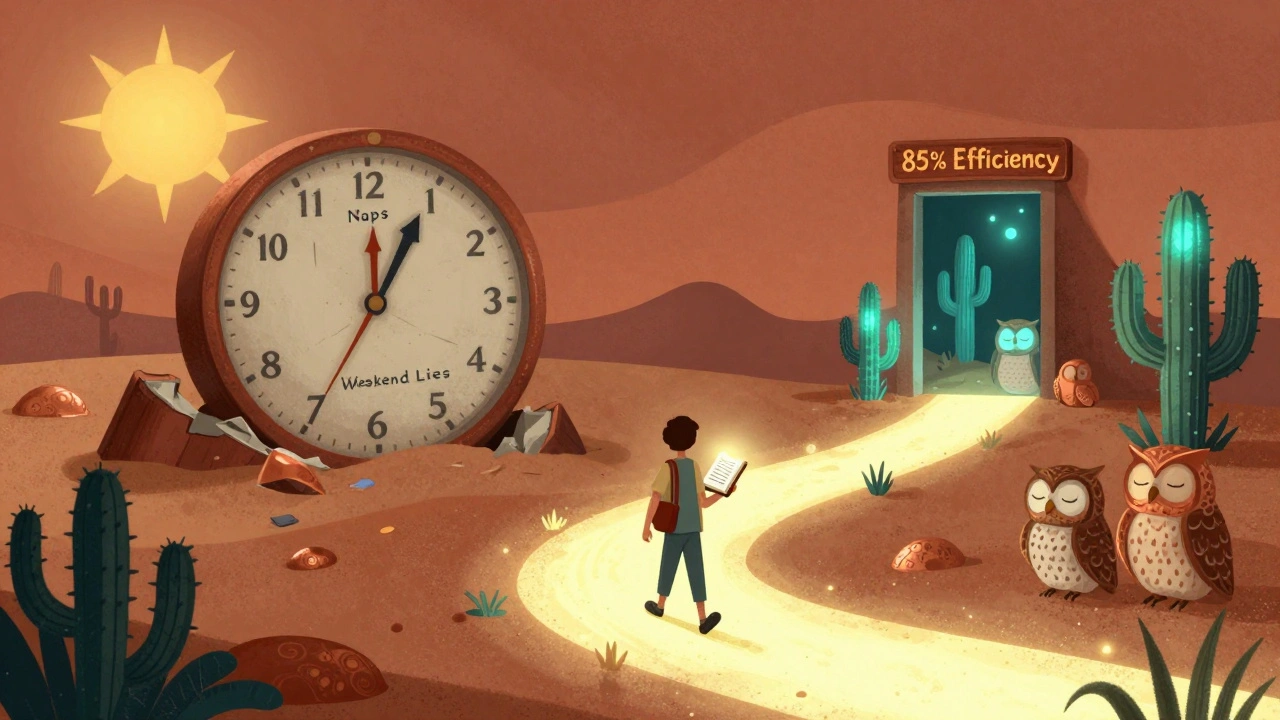
Let’s be honest: the first week is rough. You’ll be tired. You might feel foggy. You might snap at your partner. You might question if this is worth it. That’s normal. SRT works by creating controlled sleep deprivation to rebuild your sleep drive. You’re not being punished-you’re being reset.
According to Sleepstation’s 2023 survey of over 1,200 users, 68% reported significant daytime fatigue during the first 1-2 weeks. But here’s the catch: that fatigue drops sharply after week two. People who stuck with it said the fatigue became manageable, and by week four, they felt more energized than they had in years.
Don’t drive or operate heavy machinery if you’re too sleepy. Take it easy. Rest when you can-just not in bed. Sit on the couch. Walk outside. Drink water. The key is to avoid reinforcing the idea that lying down equals rest.
Who Should Avoid SRT
SRT isn’t for everyone. If you have severe depression, bipolar disorder, or untreated anxiety, the sleep deprivation can make symptoms worse. Dr. Michael Grandner from the University of Arizona warns that SRT can heighten anxiety in people already worried about sleep. For these people, SRT should be paired with cognitive therapy to reframe negative thoughts about sleep.
Shift workers also struggle with SRT. If your schedule changes every few days, maintaining a fixed wake time is nearly impossible. SRT works best for people with regular routines.
If you’re pregnant, have a history of seizures, or suffer from severe sleep apnea, talk to a doctor first. SRT is behavioral, but it still stresses your system. It’s not dangerous, but it’s not risk-free.

How to Make It Stick
The biggest reason people quit SRT? They cheat. They stay in bed longer on weekends. They nap. They get frustrated and go to bed early when they’re tired. That breaks the rhythm.
Success comes down to three things:
- Consistent wake time. 89% of people who succeeded said this was the most important factor.
- Detailed sleep tracking. 76% used a diary or app to stay honest with themselves.
- Combining SRT with stimulus control. This means: if you can’t sleep in 20 minutes, get up. Go to another room. Do something boring. Come back only when sleepy. This breaks the association between bed and wakefulness.
Apps like CBT-i Coach (free from the VA) and Sleepio can guide you through the process. They track your data, give you feedback, and help you adjust your schedule. They’re not magic, but they’re a lot easier than doing it alone.
Why SRT Is the Future of Insomnia Treatment
The global insomnia market is worth over $1 billion-but most of it still goes to pills. Only 15% of people with chronic insomnia get CBT-I, which includes SRT. Why? Lack of access. Few therapists are trained in it. Insurance doesn’t always cover it.
But that’s changing. In January 2024, the American College of Physicians said digital CBT-I programs are just as effective as in-person therapy. FDA-cleared apps like Somryst are now delivering SRT remotely with 64% success rates. The NIH is funding research to personalize SRT using circadian biomarkers. By 2027, experts predict CBT-I will be used in 28% of insomnia cases-up from 18% today.
Forty percent of Fortune 500 companies now offer CBT-I through employee wellness programs. That’s not just trend-following. It’s smart business. People who sleep better are more productive, take fewer sick days, and report higher job satisfaction.
Final Thought: Sleep Isn’t About Time. It’s About Quality.
You don’t need more hours in bed. You need better sleep. SRT doesn’t promise you’ll sleep eight hours every night. It promises you’ll sleep deeply, consistently, and without fear. It gives you back control. It turns your bed from a place of frustration into a place of rest.
If you’ve tried counting sheep, melatonin, chamomile tea, and sleep masks-and still wake up exhausted-SRT might be the only thing that works. It’s hard. It’s boring. It’s not glamorous. But for people with chronic insomnia, it’s the most reliable path to real, lasting sleep.
Can I do Sleep Restriction Therapy on my own?
Yes, many people successfully complete SRT using sleep diaries and apps like CBT-i Coach or Sleepio. But it’s easier-and safer-with guidance from a CBT-I-certified therapist. If you have anxiety, depression, or other health conditions, working with a professional reduces risk and improves success.
How long does it take to see results from SRT?
Most people notice improvements in sleep efficiency within 2 to 3 weeks. Falling asleep faster and waking up less often usually happens by week 4. Full results-7 to 8 hours of consolidated sleep-typically take 6 to 8 weeks. Patience and consistency are key.
Is daytime sleepiness during SRT dangerous?
It can be. Drowsiness during the first week or two is common. Avoid driving, operating machinery, or making important decisions when you’re overly tired. Plan low-risk activities during this phase. Most people adapt quickly, and daytime sleepiness drops significantly after the initial adjustment period.
Can I use melatonin or other supplements with SRT?
It’s not recommended. Melatonin may help slightly with sleep onset, but it can interfere with your body’s natural sleep drive, which SRT is trying to rebuild. Stick to behavioral changes only during the therapy. Once your sleep is stable, you can reassess whether supplements are needed.
What if I can’t stick to the schedule on weekends?
Weekend deviations are the #1 reason SRT fails. If you sleep in on Saturday, you’ll struggle to fall asleep Sunday night. The fixed wake time is non-negotiable. If you can’t commit to waking up at the same time every day, SRT won’t work. Consider it a test of your commitment to better sleep.
How much does Sleep Restriction Therapy cost?
If you’re doing it yourself with a sleep diary, it’s free. If you use a digital platform like Sleepio or CBT-i Coach, costs range from $50 to $300. In-person CBT-I therapy with a licensed provider can cost $300 to $2,500. Insurance rarely covers it fully-only 12 states require coverage as of 2024. But the long-term savings-fewer doctor visits, less medication, better productivity-often outweigh the upfront cost.
Sarah Clifford
December 11, 2025 AT 10:43Regan Mears
December 13, 2025 AT 07:28Rebecca Dong
December 13, 2025 AT 16:21Michelle Edwards
December 14, 2025 AT 17:14Doris Lee
December 15, 2025 AT 03:53Michaux Hyatt
December 15, 2025 AT 17:17Frank Nouwens
December 16, 2025 AT 23:16Kaitlynn nail
December 17, 2025 AT 02:11Aileen Ferris
December 18, 2025 AT 01:16