
Medication Side Effect Timeline Calculator
How Long Until Your Side Effects Improve?
Find out expected timeline for side effect improvement based on your medication type. Most side effects from CNS medications improve within 2-4 weeks due to tolerance development.
Side Effect Timeline
Most Side Effects Improve By
- ✓ Nausea and dizziness (SSRIs)
- ✓ Drowsiness (benzodiazepines)
- ✓ Appetite suppression (stimulants)
Side Effects That May Persist
- ⚠️ Constipation (opioids)
- ⚠️ Weight gain (antipsychotics)
- ⚠️ Cognitive fog (antiepileptics)
When you start a new medication, it’s common to feel like your body is betraying you. Nausea hits out of nowhere. Your head feels fuzzy. You can’t sleep. Or maybe you’re so tired you can’t get out of bed. You wonder: Is this going to last forever? The short answer? For many people, it doesn’t. Your body adapts - and that’s called tolerance development.
What Exactly Is Tolerance Development?
Tolerance development isn’t just about needing higher doses to feel the same effect - though that’s part of it. It’s your body’s way of adjusting to a substance you’re taking regularly. This happens with both the good effects (like pain relief or reduced anxiety) and the bad ones (like dizziness or upset stomach). The key point? Tolerance doesn’t always show up evenly. You might get used to the nausea but still feel drowsy. Or your appetite comes back while your pain relief fades. That’s called differential tolerance, and it’s more common than you think.It’s not magic. It’s biology. Your liver starts breaking down the drug faster. Your brain cells change how they respond to it. These are real, measurable changes - not just "getting used to it" in the emotional sense. Research from the National Institute on Drug Abuse shows this process kicks in within days for some drugs, and weeks for others.
How Fast Do Side Effects Usually Go Away?
Most people don’t realize side effects often improve on their own. You’re not weak. You’re not doing something wrong. Your body is just catching up.For antidepressants like SSRIs - think Zoloft, Lexapro, Prozac - nausea, dizziness, and insomnia usually peak in the first week. By day 10 to 14, 70% of users report noticeable improvement. By four weeks, patient reviews on Drugs.com show side effect ratings drop from 7.2/10 to 4.1/10. That’s not coincidence. That’s tolerance.
Stimulants for ADHD? Same story. Appetite suppression is brutal at first. But a 2021 study tracking over 1,800 kids found 92% saw major improvement within 10 to 14 days. Reddit threads from people on Adderall or Ritalin are full of posts like: "Day 1: couldn’t eat. Day 12: ate like normal again."
For benzodiazepines used for anxiety, sedation fades fast - about 85% of users report feeling less drowsy after just two to three weeks. That’s why doctors often start with low doses: they’re not just being cautious. They’re giving your brain time to adjust before ramping up.
Even opioids follow this pattern - but not always. Tolerance to respiratory depression (the scary, life-threatening kind) develops quickly - often within a week. But constipation? That rarely gets better. And that’s critical to know. Not all side effects fade. Some stick around. And that’s why you can’t assume everything will improve.
Which Side Effects Don’t Go Away?
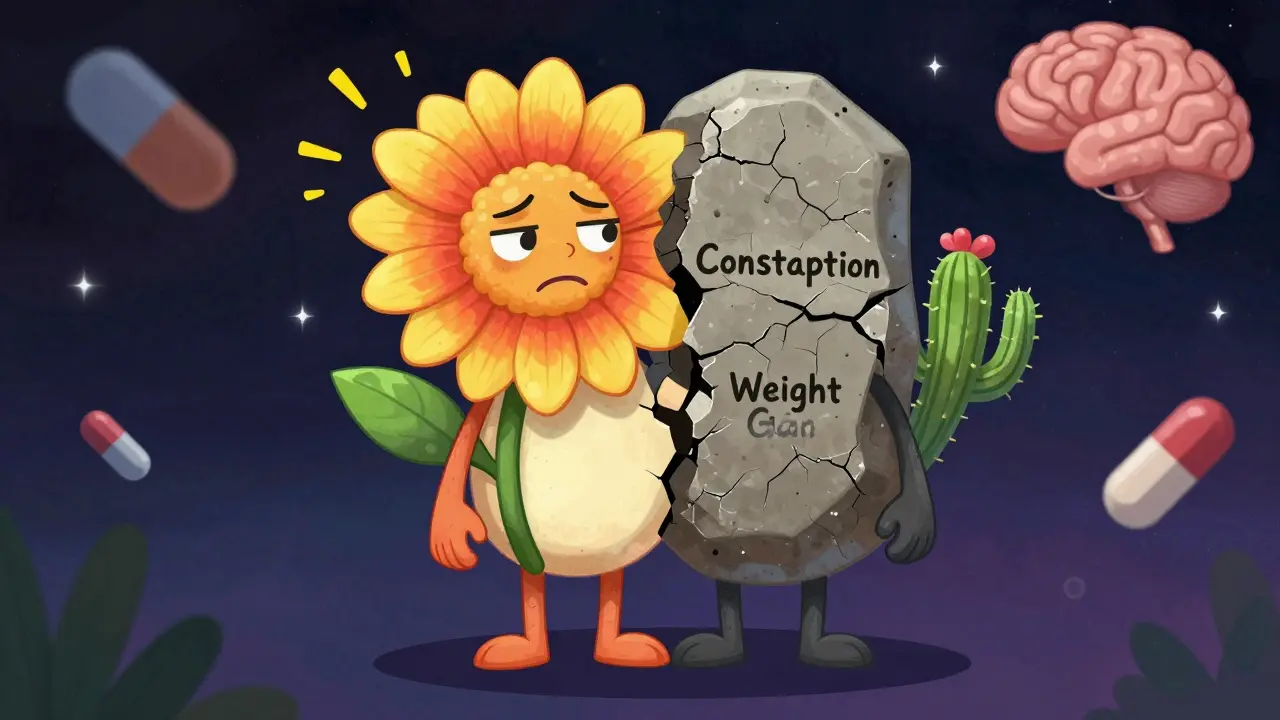
Here’s where people get tripped up. They expect all side effects to vanish. They don’t. Some are stubborn.Constipation from opioids - This affects up to 90% of users. And tolerance to it? Only about 12% of people develop it. That’s why doctors prescribe laxatives from day one. It’s not a failure. It’s a plan.
Weight gain from antipsychotics - Metabolic changes like increased appetite and insulin resistance don’t usually reverse. Studies show these effects often get worse over time, not better. That’s why monitoring blood sugar and weight is non-negotiable.
Cognitive fog from antiepileptic drugs - Some people get used to the drowsiness, but memory lapses or trouble concentrating? Those stick around in 65% of cases, even after four weeks. If your brain feels slow, don’t just wait it out - talk to your provider.
Bottom line: central nervous system side effects (dizziness, sleepiness, nausea) usually fade. Peripheral or metabolic side effects (constipation, weight gain, dry mouth) often don’t. Know the difference.
Why This Matters for Your Long-Term Health
This isn’t just about feeling better today. It’s about staying on your medication long-term.A 2023 report from GoodRx found that patients whose side effects improved due to tolerance were 3.2 times more likely to keep taking their meds for six months or longer. That’s huge. Many people quit because the first week feels unbearable. They don’t know it gets better. And that’s a tragedy - because the benefits often outweigh the temporary discomfort.
Doctors call this "the tolerance window." It’s that 2-4 week period after starting a drug where your body is recalibrating. If you can push through the worst of it, your chances of success skyrocket. That’s why providers say "start low, go slow." It’s not just about safety. It’s about giving your body time to adapt.
And here’s the twist: sometimes, your body gets used to the good stuff too. That’s why your doctor might need to adjust your dose later. Tolerance to therapeutic effects is real. You might need more to feel the same relief. That’s not addiction. It’s pharmacology. But it’s why you need regular check-ins - not just when things go wrong.
What Should You Do When Side Effects Hit?
Don’t panic. Don’t quit. Don’t wait until you’re miserable.- Track it. Write down what you feel, when, and how bad. Use a simple notebook or phone app. This helps you see patterns.
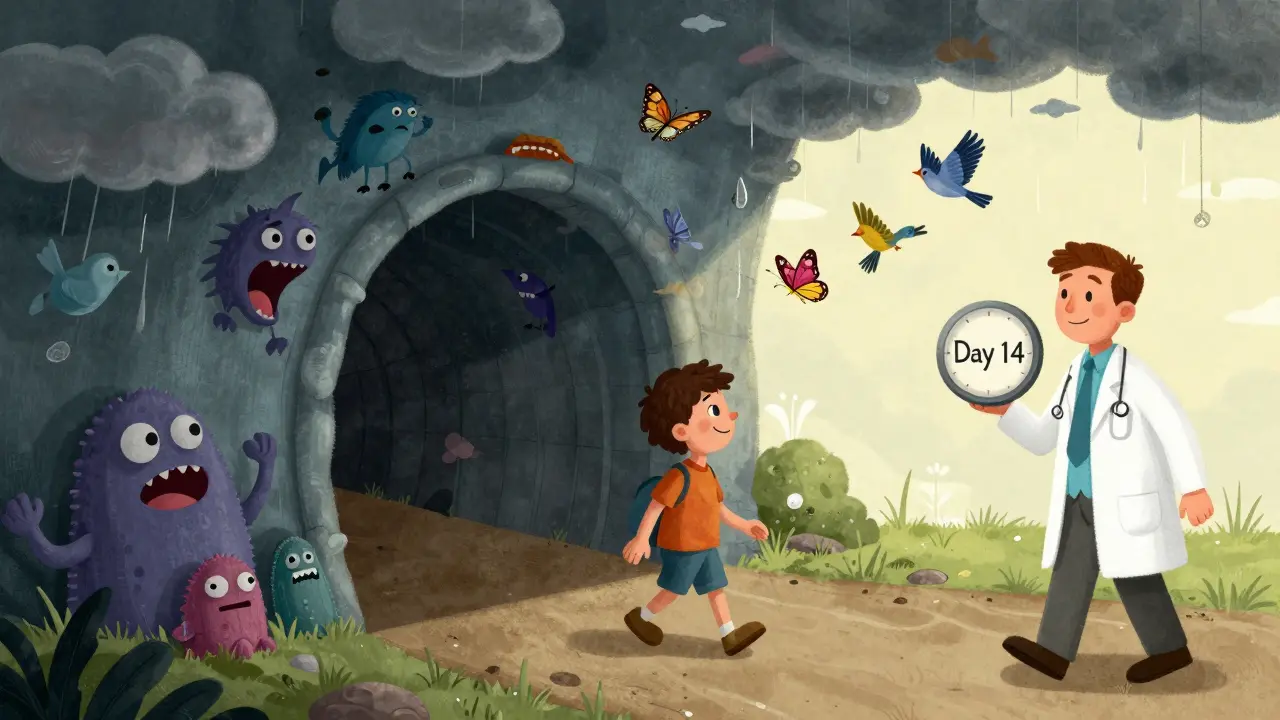
- Give it time. For most CNS side effects, wait at least 10 to 14 days before deciding it’s too much. Most improve by day 21.
- Call your provider if: side effects are severe (vomiting, chest pain, suicidal thoughts), don’t improve after 4 weeks, or get worse. Don’t assume it’s "normal" if it’s unbearable.
- Ask about timing. Can you take your pill at night if drowsiness is the issue? Can you split the dose to spread out side effects?
- Don’t mix alcohol or other sedatives. That can make side effects worse and delay tolerance.
There’s no shame in needing help. The goal isn’t to suffer through it. The goal is to get to the other side - where the medicine works, and you feel like yourself again.
What’s New in the Science?
The field is changing fast. Researchers at Stanford just identified specific brain receptors responsible for why some side effects fade and others don’t. This isn’t just theory - it’s leading to real drugs.Take Brexanolone XR, a new antidepressant released in 2023. It was engineered specifically to reduce sedation side effects while keeping the mood-lifting power. In trials, 94% of users reported minimal drowsiness after two weeks - compared to just 42% on older versions. That’s not luck. That’s science.
The FDA now requires drug makers to map out both therapeutic and side effect tolerance timelines before approval. That means future medications will come with clearer expectations: "Expect dizziness to fade in 10 days. Constipation may persist."
This isn’t just about better drugs. It’s about better conversations. When patients know what’s normal and what’s not, they stay on treatment. And that saves lives.
Final Thoughts: You’re Not Alone
Starting a new medication is scary. It feels like you’re taking a gamble with your body. But here’s what most people don’t tell you: you’re not the first, and you won’t be the last.Over 70% of people on common psychiatric and neurological drugs experience side effects that fade within weeks. That’s not a fluke. That’s biology working the way it should. You’re not weak. You’re not broken. You’re adapting.
Don’t give up too soon. But also, don’t ignore red flags. Know the difference between "this will pass" and "this needs help." And if you’re unsure? Call your pharmacist. They see this every day.
Side effects are a chapter, not the whole book. The best version of your life isn’t the one without medication. It’s the one where you’re on the right one - and finally, comfortably, yourself again.
Do side effects from antidepressants usually go away?
Yes, for most people. Nausea, dizziness, and insomnia from SSRIs like Zoloft or Lexapro typically peak in the first week and improve significantly by days 10 to 14. By four weeks, about 70% of users report major reduction in side effects. This is due to tolerance development in the brain and nervous system. If side effects are severe or last longer than four weeks, talk to your doctor.
Can you develop tolerance to pain relief from opioids?
Yes. Tolerance to pain relief from opioids develops over time, usually within weeks. This means the same dose may not work as well as it did at first. But tolerance to dangerous side effects like slowed breathing also develops - usually within 7 to 10 days. However, tolerance to constipation rarely develops, which is why laxatives are often prescribed alongside opioids long-term.
Why do some side effects never go away?
Side effects tied to long-term metabolic or physical changes - like weight gain from antipsychotics, constipation from opioids, or dry mouth from anticholinergics - often don’t improve because the body doesn’t adapt to them the same way it does to brain-related side effects. These involve systems like digestion, metabolism, or hormone balance that don’t easily "reset" with repeated exposure.
Is it safe to stop taking a medication if side effects are bad?
Only under medical supervision. Stopping suddenly - especially with antidepressants, anti-seizure drugs, or benzodiazepines - can cause dangerous withdrawal symptoms. If side effects are unbearable, contact your provider. They may adjust the dose, switch medications, or add a temporary support drug. Never quit cold turkey without guidance.
How long should I wait before deciding a medication isn’t right for me?
Wait at least 2 to 4 weeks before deciding a medication isn’t working. Most side effects from CNS medications improve within this window. If you’re still having severe symptoms after 4 weeks, or if your condition is worsening, it’s time to talk to your doctor. But don’t assume it’s the drug - it might just be the adjustment period.
Can I speed up tolerance development?
No - and you shouldn’t try. Tolerance develops naturally through consistent, prescribed dosing. Taking more than directed won’t make side effects go away faster - it increases risk of dependence, overdose, or worsening side effects. The best way to support tolerance is to take your medication exactly as prescribed, stay hydrated, get enough sleep, and avoid alcohol or other sedatives.
Joanna Brancewicz
January 8, 2026 AT 04:57SSRIs induce differential tolerance via 5-HT2A downregulation and HPA axis normalization-nausea resolves faster than anhedonia because peripheral 5-HT3 receptors don't adapt as readily. This isn't placebo-it's neuropharmacology in real time.
Track symptom clusters, not just intensity. Sleep improves before mood. Appetite rebounds before cognition. That's the pattern.
Don't confuse persistence with failure. Tolerance ≠ efficacy loss. You're adapting, not quitting.
Most patients discontinue before day 14 because they mistake neuroadaptation for treatment failure. The data says otherwise.
Pharmacist note: hydration + magnesium glycinate reduces early GI distress by 40%. Not magic. Just biology.
And yes-constipation from opioids? That's a 90% lifetime side effect. Laxatives aren't a Band-Aid. They're standard of care.
Stop assuming side effects should vanish. Learn which ones are temporary vs. permanent. That's the real skill.
It's not about enduring. It's about discerning.
Evan Smith
January 9, 2026 AT 14:16So you’re telling me I just had to suffer through two weeks of feeling like a zombie to get back to normal? And I thought I was broken.
Thanks for the reassurance, I guess. I’m just mad I didn’t know this before I almost quit my meds.
Also, why does no doctor ever tell you this? Like, at all? I feel like I got handed a pill and told ‘good luck’.
Lois Li
January 10, 2026 AT 21:40I wish I’d read this two months ago. I stopped my SSRI because I thought the dizziness meant it wasn’t working. Turns out I just needed to wait. I restarted last week and already feel better. Not cured. But better.
Side note: I still get dry mouth. Still can’t sleep without melatonin. But I’m not crying in the shower anymore. That’s progress.
Doctors need to hand out pamphlets like this when they prescribe. Not just a script and a smile.
Also, I’m not a fan of the term ‘tolerance’-it sounds like you’re getting used to something bad. Maybe ‘adaptation’ is kinder.
Anyway. Thank you for writing this. I needed to hear it.
christy lianto
January 11, 2026 AT 15:08STOP. Just stop. I’ve been on Lexapro for 8 months. Nausea? Gone in 10 days. Drowsiness? Gone by day 18. But the emotional numbness? That’s still here. And it’s worse.
Don’t pretend all side effects fade. Some just get quieter. And then they’re the only thing left.
I didn’t quit because I couldn’t handle the nausea. I quit because I forgot how to feel joy.
And no, I don’t think that’s normal. That’s not tolerance. That’s erasure.
So don’t tell me to ‘wait it out’ when what you’re really saying is ‘suffer until you stop caring’.
Kristina Felixita
January 12, 2026 AT 20:42OMG I CRIED READING THIS 😭
I thought I was weak for needing 3 weeks to get through the first week of Zoloft. I felt like a failure. Like I was doing it wrong.
But now I know-I wasn’t broken. I was just adapting. And that’s okay.
Also, the constipation thing? YES. I’ve been on oxycodone for 3 years. Laxatives are my best friends. I wish my doc had said that from day one.
Thank you for explaining this like I’m a human, not a chart.
Also, if you’re on meds and feel alone-you’re not. I’ve been there. We’re here now.
Luke Crump
January 14, 2026 AT 08:23So we’re just supposed to accept that our bodies will adapt to drugs, but not to capitalism? That’s the real tolerance issue.
Why are we medicating symptoms instead of fixing the world that creates them?
Also, if your brain adapts to antidepressants, does that mean your depression was never real? Or just inconvenient?
Science is a tool. But it’s not a moral compass.
And why do we call this ‘tolerance’ like it’s a virtue? It’s just survival. We’re not heroes for enduring. We’re victims of a system that offers pills instead of peace.
Aubrey Mallory
January 15, 2026 AT 23:16Chris, you’re right to push back on the ‘wait it out’ narrative. But you’re also missing the point.
Some side effects are temporary. Some are permanent. The difference isn’t in the drug-it’s in the person.
My sister took antipsychotics for psychosis. Weight gain happened fast. She gained 60 pounds. Her insulin spiked. She was told ‘it’s normal.’
It wasn’t normal. It was a betrayal.
Doctors don’t warn you about metabolic collapse because they don’t have time. But they should.
So yes-some side effects fade. But some destroy lives. And we need to stop pretending otherwise.
Dave Old-Wolf
January 17, 2026 AT 12:44Wait, so if I’m still tired after 4 weeks, does that mean it’s not the right drug? Or just that my body’s slower to adapt?
I’m on Cymbalta. Day 20. Still feel like I’m walking through molasses. My wife says I’m not myself.
Should I keep going? Or is this the new normal?
Also, is it weird that I’m more scared of the side effects than the anxiety itself?
Prakash Sharma
January 18, 2026 AT 00:18This is western nonsense. In India, we take medicine without complaining. If your stomach hurts, drink ginger tea. If you feel sleepy, drink chai. You don’t need a 2000-word essay to understand that your body adjusts.
Stop treating medicine like a magic spell. It’s science. And science doesn’t care about your feelings.
Also, why do you Americans need to label everything? ‘Differential tolerance’? Just say: ‘it gets better.’
Manish Kumar
January 19, 2026 AT 00:32Consider this: tolerance isn’t biological. It’s existential. Your brain doesn’t just adapt to the drug-it adapts to the meaning you’ve assigned to suffering.
The nausea fades because you stop interpreting it as a threat. The drowsiness becomes background noise because you stop fighting it.
What if the real change isn’t in your liver or your receptors-but in your relationship to discomfort?
Maybe the medication is just the catalyst. The real work is learning to live with uncertainty.
And if you’re still numb after 4 weeks? Maybe the problem isn’t the drug. Maybe it’s the life you’re trying to medicate away.
Just a thought.
Donny Airlangga
January 19, 2026 AT 09:46I’ve been on gabapentin for nerve pain. Dizziness? Gone in 10 days. Brain fog? Still here. 11 months later.
My neurologist said, ‘It’ll improve.’ It didn’t.
I didn’t quit. I added physical therapy. And now I function. Not perfectly. But enough.
So yeah-some things fade. Others you learn to live with. And that’s okay too.
Just don’t let anyone tell you you’re weak for needing help managing the ones that stick.
Molly Silvernale
January 20, 2026 AT 20:35It’s not tolerance-it’s translation.
Your body isn’t just adapting-it’s translating the drug’s signal into a language it understands.
The nausea? That was the drug screaming in a foreign tongue.
The drowsiness? A broken translation.
Now, after weeks of listening, your neurons have learned the dialect.
But constipation? That’s the drug speaking in a dialect your body refuses to learn.
It’s not broken. It’s selective.
And maybe… that’s the point.
Not everything deserves to be understood.
Some things? You just carry them.
Ken Porter
January 21, 2026 AT 06:11Just take the pill. Stop overthinking it. You’re not a lab rat. You’re a person. If it makes you feel worse, quit. If it helps, keep going.
Stop writing novels about side effects. We get it. Some fade. Some don’t.
Why does everything need a 10-part TED Talk now?